



Original Coverage & Source Attribution: www.northcarolinahealthnews.org
by Jennifer Fernandez, North Carolina Health News
October 9, 2026
By Jennifer Fernandez
Key Takeaways:
- Kinship care is growing in North Carolina, which started paying unlicensed kinship caregivers in late 2023.
- Research shows that children in kinship care have better academic and health outcomes than children in traditional foster care.
- State health officials acknowledge there’s work to be done on financial support, access to services and training tailored to the unique relationships between kinship caregivers and children.
At 19 years old, Jamie Barricelli became a de facto mother of four.
She was a student at UNC Wilmington when she got the phone call that changed the trajectory of her life. It was her younger brother, who told her police and social services were at the house. The children, who were ages 11 to 15 at the time, would be placed in foster care when their caregiver was experiencing mental health issues.
Barricelli asked officials if she could take them home with her instead, a response she described as instinctual.
“My siblings needed me,” she said.
Barricelli, now 26, shared her story last month at Foster Family Alliance of North Carolina’s first kinship care conference in Wilmington.
About 125 caregivers, professionals and community organizations attended, said Jenn Stout, the nonprofit’s chief administrative officer. A second conference Oct. 17 in Asheville is already fully subscribed.
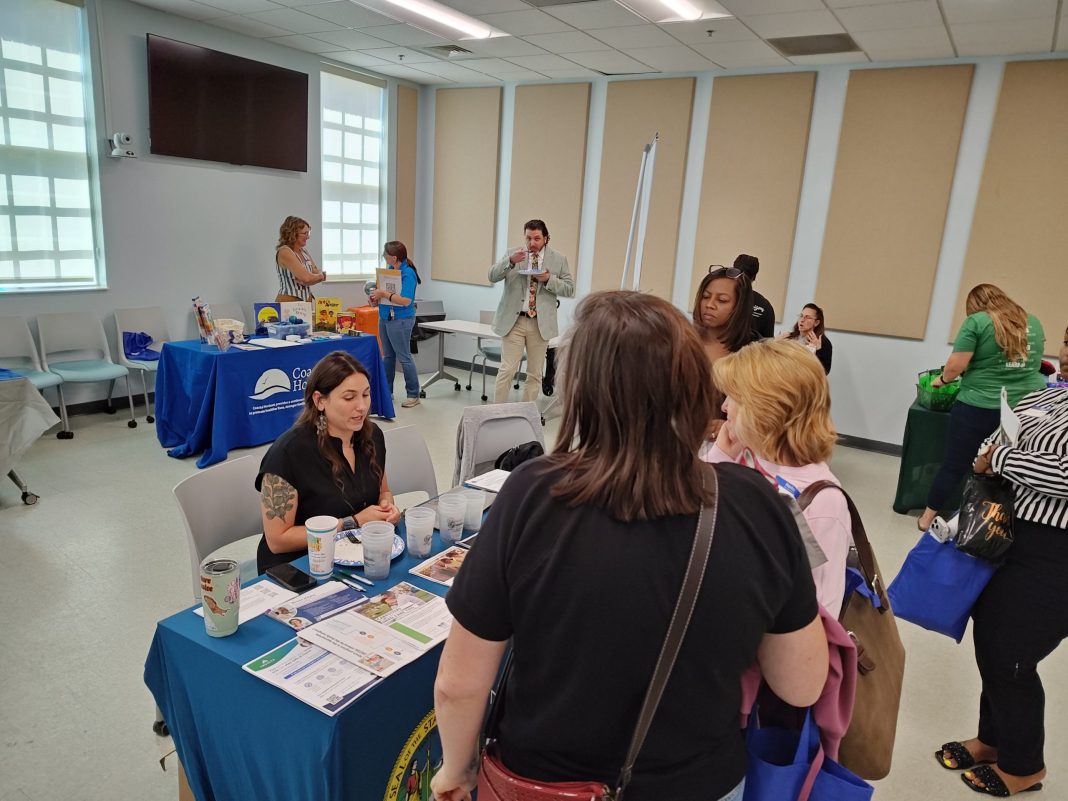
The event at UNCW included presentations with information on resources, research on kinship care and a panel discussion with kinship caregivers — family or close friends who have taken in children who otherwise would have ended up in care with a foster family. About a dozen organizations set up booths and shared information about available services.
Reidsville resident Queena Clyburn, who took in her niece six years ago, said the stories of other caregivers at the conference showed her that there are others who share similar experiences and concerns.
“I never knew that anybody else felt that way,” she said. “I realize that I’m not alone.”
The shift to kinship care has been encouraged at the federal level. In 2018, the Families First Prevention Services Act included funding to support kinship navigator programs that help families sheltering the children of relatives to find resources. In 2023, the federal government relaxed rules to make it easier for kinship caregivers to get resources and financial assistance. In 2025, the Supporting America’s Children and Families Act became law. It clarifies that certain federal funds for foster parents can also be used for kinship caregivers. The law also directed another $75 million to foster care supports and $10 million annually for five years to support kinship navigator programs.
For the past few years, North Carolina has been moving toward a kin-first foster care model. Last month’s conference helped bring needed resources and community to those families.
Kinship care is growing
North Carolina has “made significant strides in centering families to child welfare,” Lisa Tucker Cauley with the North Carolina Department of Health and Human Services said at the conference.
As part of North Carolina’s transition to promoting kin-first foster care, the state changed long-standing policy and began paying unlicensed kinship caregivers in late 2023.
“This was a historic shift that led to at least one-third of all children in foster care actually living with relatives,” said Cauley, who is a division director for human services with NCDHHS. The number of people who took in a juvenile family member increased nearly 16 percent from 2023 to 2025, according to state data analyzed by NC Health News. “So that is a big change in North Carolina, and we want that number to continue to grow.”
Kinship care rises by Jennifer Fernandez
She said the state’s goal is that every child in the child welfare system is supported by family and other significant connections so they can “remain safely within their community, maintain their identity, and achieve permanency through relationships that last.”
That vision is not abstract, Cauley said.
“It’s built on what we know to be true. Children thrive when they remain connected to people who know them, love them, and share their culture, history and story,” she said.
North Carolina is not alone in its shift toward kinship care, said president and CEO of Agape Therapeutic Services Tyreasa Washington, a licensed clinical social worker and researcher who has studied the effects of kinship care on children and their caregivers.
Data is driving some of that change. People are realizing that outcomes are generally better for children in kinship care than for those in traditional foster care, she said.
“Another thing is the people are understanding a little better the psychological distress that happens when you separate a child from their parents, and we can lessen that psychological stress when we place children [with] kin,” said Washington, who was the keynote speaker at the Wilmington conference.
Money is another driver, she said.
Kinship caregivers save taxpayers at least $10.5 billion annually by keeping kids out of foster care, according to a 2025 report by Generations United, a nonprofit focused on improving the lives of children, youth and older people.
For every one U.S. child being taken care of by a relative in the foster care system, another 19 are being raised by a family member outside of the system, according to Generations United.
In North Carolina, closer to 31 children are being raised by a family member outside the system for each one in the system, Washington said.
Impacts on children, caregivers
Washington said research, including her own, shows that children placed in kinship care generally do better than those in traditional foster care on everything from getting a college degree to being employed as an adult.
“What we have found is that when children are placed with kin, both formal and informal, they have higher academic outcomes than when children are placed in [traditional] foster care,” she said.
Formal kinship care is overseen by the child welfare system. Under informal care, which is more common, families take in children with no supports, training or oversight.
The type of kinship care can also make a difference.
For example, academic outcomes and high school dropout rates for children in formal kinship care are very similar to children who are not in the child welfare system, she said.
The better outcomes extend to health, with children in kinship care showing better behavioral development and mental health. In contrast, long-term research on adverse childhood experiences shows that children exposed to trauma in childhood end up with more mental and physical health issues decades later.
In interviews with caregivers, Washington has found that they are thankful to be helping and say “that does bring them an amount of joy.”
Still, caregivers often experience stress, and that affects their own health, Washington said.
“Stress directly affects your cardiovascular disease. Also, there’s research now talking about how stress affects dementia,” she said.
She told caregivers that they need to figure out how to take care of themselves too. That might mean making sure to exercise, or eating healthy, or even seeking a short break from caregiving — often called respite care.
Caregiver stress can lead to anxiety or depression in children, Washington said. They worry about their loved ones and notice when they are stressed or not taking care of themselves.
“When you’re taking care of yourself, it helps the children,” she said.
Support needed
In its report, Generations United cited the need for more support for kinship caregivers, including the types of supports that paid foster parents receive. The nonprofit said they need access to respite care, support groups, educational and legal services, housing, mental health programs and kinship navigators.
Cauley, the NCDHHS division director, acknowledged that the state still has challenges to overcome. There are disparities in financial support and inconsistent access to services, she said. Currently, unlicensed kinship caregivers receive only half of what licensed caregivers receive. That amount increases once a caregiver gets licensed.
The state needs to expand kin-specific licensing pathways, increase pay parity and establish kinship network services, Cauley said.
Jonathan Rockoff, program manager for the Family and Children’s Resource Program at the UNC School of Social Work, said the state’s foster care system wasn’t designed for kinship care.
“A child being placed with a stranger, like in traditional foster care, is clearly much different than kinship care,” he said. “We’ve traditionally lumped them together. In fact, even though kinship care dramatically predates traditional foster care, it was kinship care that was forced to fit into an existing foster care system, as opposed to the other way around.”
Caregivers shared their frustrations with a system not designed for them.
Clyburn said she would have benefited from financial education on how to deal with the expenses of an unexpected child.
Robin Singleton said that after her great nephew came to live with her, she decided to get licensed as a foster parent.
“The process to become licensed was very stressful,” said Singleton, who lives in Pleasant Garden in Guilford County. “We thought, ‘OK, we don’t need this. We don’t. We don’t need to do this. It’s just too much.’”
She said the licensing process needs to be streamlined.
For Ramona Williams, who also lives in Guilford County, calling the county Department of Social Services to ask questions was frustrating. She said employees who answered the phone didn’t know what kinship care is.
“It’s unfair that I get through to a customer service desk that has no idea what I’m speaking of,” she said after Washington invited participants to share their stories. (During a break, an official spoke with her about making sure staff are trained, she later told NC Health News.)
Williams attended the conference with two of her grandchildren, who, along with her daughter, help with raising her 2-year-old granddaughter.
“We have been the entire team for this little girl, and we will pull for her to the best of our ability,” Williams said, “but if there’s help for us, we’d like it.”
Afraid to ask for help
Asking for help can be difficult for kinship caregivers, Washington said. They worry that admitting to financial hardship or depression could lead to social workers removing their foster children, she said.
That was Barricelli’s fear after taking in her younger brothers and sisters.
“I was afraid to ask for things because I’m so young, and they already didn’t want to give me my siblings,” she said. “So if I say that I need help, if I say that I’m struggling, if I say that I’m depressed, are they going to take my siblings away?”
She dropped out of UNC Wilmington because she couldn’t afford to pay tuition and cover the costs of raising four children. While her boyfriend — now her fiance — supported her decision, Barricelli said they had to give up a lot.
“We couldn’t have friends over anymore. It was hard for us to go out to see our friends,” she recalled. “I was having an existential crisis every other day because I dropped out of college, and that was my one goal that I wanted to do for myself.”
People were often rude, asking how someone her age was in charge of children, Barricelli recalled.
“I had to very quickly learn to assert myself,” she said. “I had to be kind of rude because that was the only way that people took me seriously.”
She also had to learn how to be a mom instead of an older sister. Barricelli said kinship care training should take into account the differences among the types of relationships between caregivers and children. Raising a sibling is not the same as raising a niece or a grandchild, she said.
Today, her siblings are all grown and out of the house. She describes herself as an “empty nester.”
She said raising her siblings healed her — because she grew up in the same home, experienced foster care before they were all adopted and dealt with the same trauma.
Barricelli took her siblings in to keep them safe, and learned something about herself.
“I was that person that I never had.”
This <a target=”_blank” href=” first appeared on <a target=”_blank” href=” Carolina Health News</a> and is republished here under a <a target=”_blank” href=” Commons Attribution-NoDerivatives 4.0 International License</a>.<img src=” style=”width:1em;height:1em;margin-left:10px;”>
<img id=”republication-tracker-tool-source” src=” style=”width:1px;height:1px;”><script> PARSELY = { autotrack: false, onload: function() { PARSELY.beacon.trackPageView({ url: ” urlref: window.location.href }); } } </script> <script id=”parsely-cfg” src=”//cdn.parsely.com/keys/northcarolinahealthnews.org/p.js”></script>