



Original Coverage & Source Attribution: researchmatters.in
By tweaking titanium sesquioxide with hydrogen, researchers have built ultra-efficient micro-supercapacitors that leverage light to dramatically boost energy storage.
As portable and wearable technology continues to shrink, the demand for smaller, faster, and more efficient energy storage devices, like micro-supercapacitors, has skyrocketed. Traditional micro-supercapacitors, which typically rely on carbon-based nanomaterials like graphene, often struggle with limited energy storage because they lack surface-driven chemical reactions. Now, a team of researchers from the Indian Institute of Science (IISc), University College London (UCL), Indraprastha Institute of Information Technology (IIIT Delhi) and the Indian Institute of Technology (IIT) Bombay has developed a novel technique that promises to overcome these limitations. By treating titanium sesquioxide nanoparticles with hydrogen and harnessing light, scientists have created a new class of micro-supercapacitors that deliver unprecedented energy storage performance, opening doors for advanced, miniaturized electronics.
Titanium sesquioxide (Ti2O3) is a type of unique material known as a Mott-insulator, a class of materials that are expected to be conductors, but behave as insulators because of electron interactions within them. Ti2O3 features high intrinsic conductivity and boasts of an ultra-narrow bandgap, which means electrons require very little energy to jump from its valence band to the conduction band. The research team set out to enhance this material’s electrochemical properties through a process called hydrogenation. By annealing Ti2O3 nanoparticles in a controlled mixture of hydrogen and argon gases at 400 degrees Celsius, the researchers successfully modified the material’s surface. This treatment significantly increased the number of hydroxyl groups and oxygen-related defects on the material’s surface, creating active sites that readily exchange protons with surrounding electrolytes.
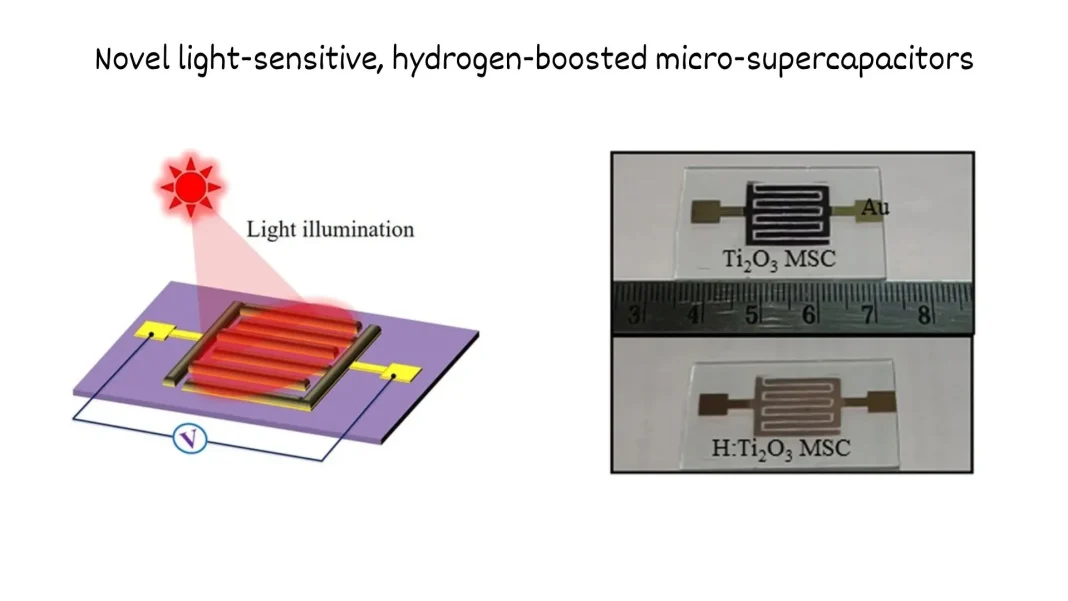
When tested in a three-electrode system, the hydrogenated titanium sesquioxide (H:Ti2O3) electrodes exhibited a specific capacitance of 82.6 millifarads per square centimeter, 82 times higher than traditional titanium dioxide-based supercapacitor electrodes. Building on this, the team fabricated an on-chip planar microsupercapacitor,a flat energy-storage chip, using the hydrogenated nanoparticles. Planar micro-supercapacitors allow for energy-carrying ions to slide sideways across the flat surface instead of forcing them to stack vertically. As a result, they offer much shorter ion diffusion lengths and rapid response times. The resulting device achieved a specific capacitance of 13.5 millifarads per square centimeter, outperforming carbon-based micro-supercapacitors by roughly seven times. Furthermore, the device demonstrated exceptional durability, retaining nearly 88% of its capacitance even after 5,000 rigorous charge and discharge cycles.
More remarkable is the material’s unique sensitivity to light. Because the H:Ti2O3 possesses an ultra-narrow bandgap, it acts as an effective light absorber. When exposed to infrared light illumination, the material absorbs photon energy that exceeds its bandgap, generating pairs of electrons and holes. As these photoinduced charge carriers relax, they convert the excess energy into heat through a phenomenon known as the photothermal effect. This internally generated heat, combined with the photo-generated electrons and holes, actively boosts the electrochemical activity of the electrodes. Consequently, the micro-supercapacitor’s energy storage performance jumped by an impressive 58% under light illumination compared to darkness. Prolonged light exposure tests revealed that this enhancement could reach up to 98% after eight minutes as the photothermal conversion efficiency scaled over time.
Traditional carbon nanomaterials and earlier titanium-based devices have historically suffered from restricted redox activity and lower energy densities. By deliberately engineering oxygen vacancies and hydroxyl groups via hydrogenation, the researchers unlocked a fast proton-exchange mechanism that bypasses old performance ceilings. Additionally, the successful integration of a photothermal response directly into energy storage bypasses the traditional boundaries of passive battery systems, creating an active, light-harvesting power unit. As the modern world pivots toward smart textiles, implantable medical sensors, and ultra-compact Internet of Things devices, the need for safe, flexible, and high-capacity micro-power sources has never been more urgent. By utilizing earth-abundant titanium compounds and tapping into ambient light to actively generate supplemental energy, this technology paves the way for self-sustaining, highly efficient micro-electronics.