
Original Coverage & Source Attribution: tspasemiconductor.substack.com
As SpaceX and xAI push their computing infrastructure toward gigawatt scale, attention naturally gravitates toward GPU orders, electricity demand, and capital spending. Yet circuit boards, optical transceivers, transformers, and cooling equipment also determine when those investments become usable computing capacity. A delay in any one of these systems can leave expensive chips waiting to be switched on.
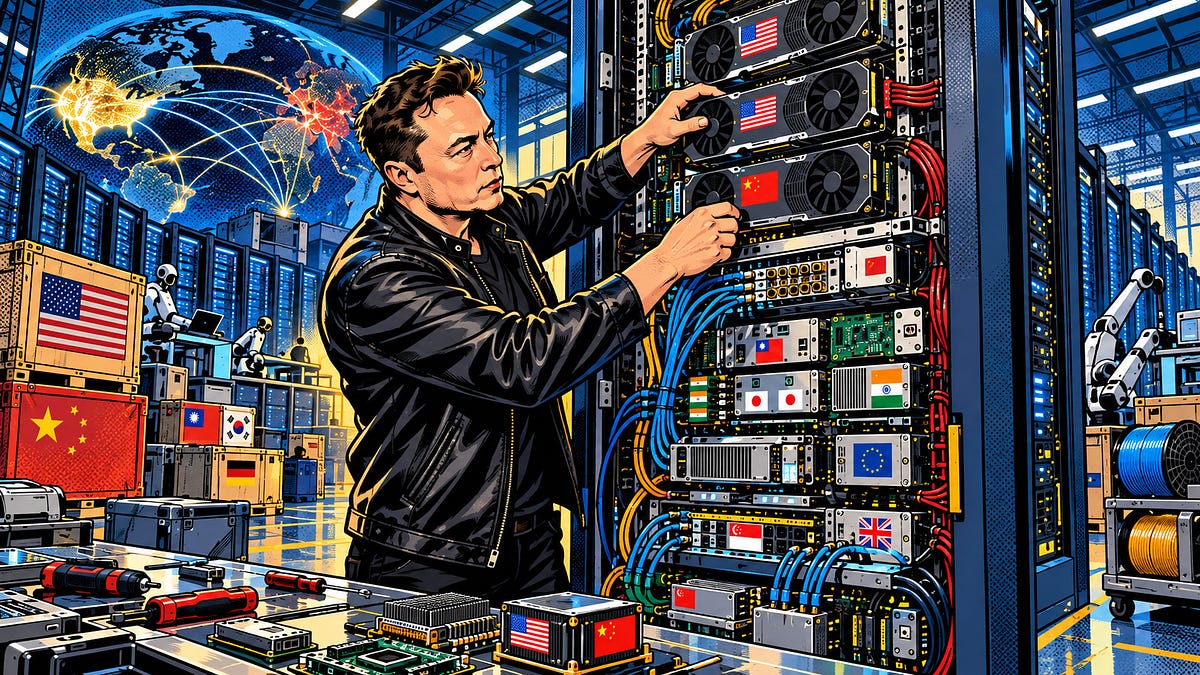
The expansion exposes an often overlooked reality: leadership in AI models and chip design still depends on an international manufacturing network to achieve deployment at scale. Mainland China, Taiwan, Japan, Europe, and the United States each provide distinct capabilities. Geopolitics is changing procurement options, but cannot immediately supply the factories, engineers, and qualified production capacity needed to replace them.

SpaceX IPO: Building the Space Economy for the AI Era
SpaceX’s second-quarter 2026 results reported 1.4 GW of nameplate computing capacity at the end of June, up from 1.0 GW at the end of March. AI capital expenditure reached approximately $15.8 billion in the quarter, showing that the expansion has entered the equipment procurement and construction phase.
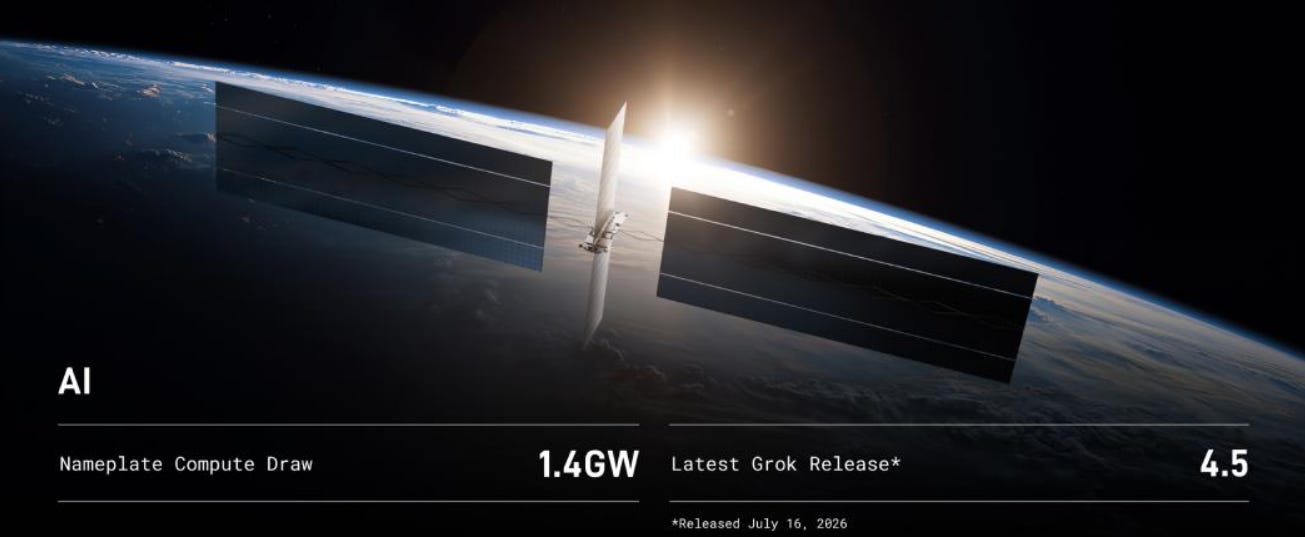
The 10 GW and 20 GW targets measure different layers of infrastructure. According to the publicly available transcript of the August 4 earnings call, Musk hoped cumulative computing capacity would approach 10 GW by the end of 2027. The 20 GW figure was a tentative target for projects encompassing power, cooling, and electrical equipment over the same period. He also acknowledged that not all projects would necessarily finish on schedule. These figures describe ambitions for computing equipment and supporting infrastructure, respectively.
SpaceX calculates nameplate computing capacity from installed GPU counts multiplied by their respective power ratings. It does not represent actual electricity consumption or utilization, and excludes cooling and other facility overhead. Dividing 20 by 10 therefore does not establish a power usage effectiveness, or PUE, of 2. PUE compares total facility energy consumption with IT equipment energy consumption.
For perspective, a 10 GW load operating continuously at full power would consume 87.6 TWh annually, before facility overhead. Expansion at this scale requires coordinated delivery of generation, power distribution, networking, and cooling alongside the processors themselves.

The AI Race Is Turning Into a Power Race
Printed circuit boards, or PCBs, connect processors, memory, connectors, and power systems. Copper-clad laminates provide a key material foundation for these boards. In high-speed AI systems, their value depends on preserving signal quality while surviving complex fabrication processes and sustained thermal loads.
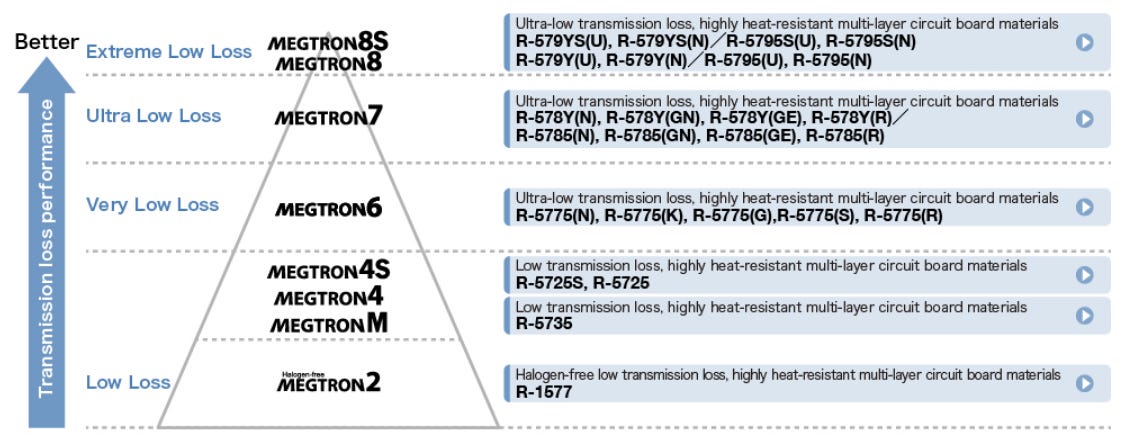
As data rates increase, dielectric loss, copper surface roughness, and board stack-up design all influence signal attenuation. Japan’s Panasonic uses low-loss materials and low-profile copper foil in MEGTRON 8, which supports boards with more than 20 layers. Taiwan Union Technology Corporation, or TUC, also supplies extremely low-loss laminates. Japan is therefore an important participant alongside mainland China and Taiwan in the advanced materials supply chain.
The challenge is that owning a factory does not make a supplier an immediate substitute. Changing laminate vendors can require adjustments to the board stack-up, processing conditions, and signal validation. Moving PCB production to another factory also requires checks on yield and reliability. Buyers need capacity that is qualified for their platform and can deliver consistently.
Materials availability, board fabrication, and customer qualification must consequently be assessed together. Even when final assembly moves to the United States or Southeast Asia, upstream materials and manufacturing expertise may still come from established Asian clusters. Geographic diversification can reduce some risks, but building complete replacement capabilities takes time.

From AI Servers to High-Speed PCBs: Why CCL Prices Are Entering a New Upcycle

EMC’s Rise to No. 1: AI Servers Redefine the Global CCL Supply Chain
Optical fiber carries light signals; optical transceivers convert between electrical and optical signals. Transceivers combine lasers, photodetectors, electronic chips, packaging, and control functions. As AI clusters exchange large volumes of data across racks, link bandwidth, power consumption, and stability influence how effectively their GPUs work together.