
Original Coverage & Source Attribution: www.cloudsek.com
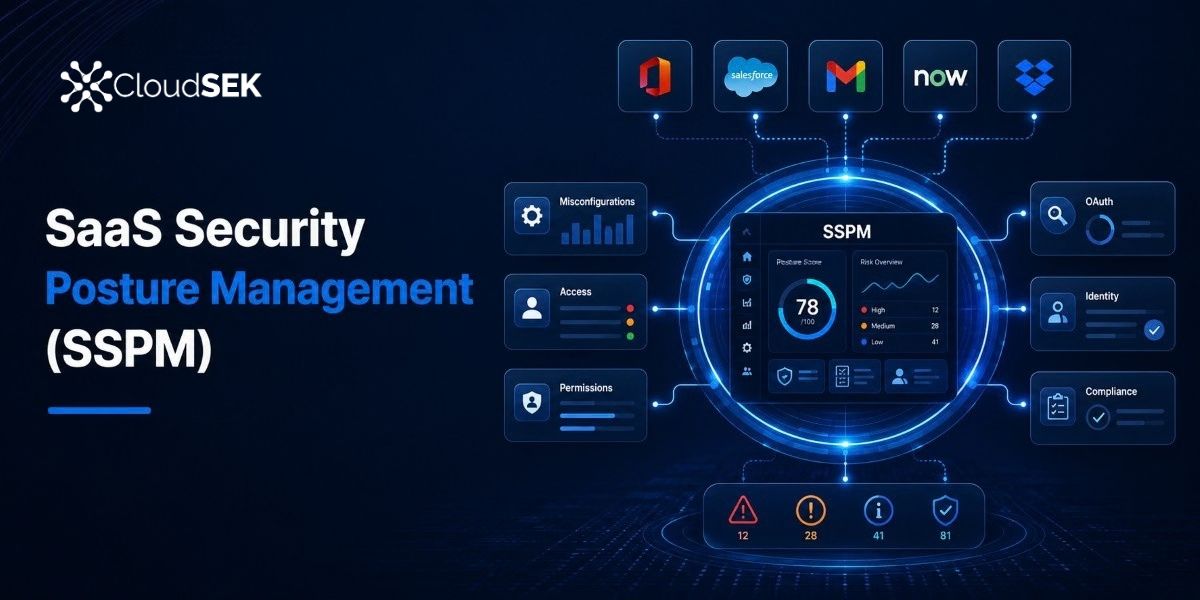
SaaS Security Posture Management (SSPM) is a category of automated security tools that continuously monitor and manage the configuration and security posture of an organization’s SaaS applications. It surfaces misconfigurations, excessive permissions, and compliance gaps across platforms like Microsoft 365, Salesforce, and Google Workspace, then guides teams to close them.
The problem it addresses is already costly. The Cloud Security Alliance ties the recent wave of SaaS breaches, including the Snowflake attacks that reached more than 165 customer organizations, to stolen credentials and misconfigured controls rather than to any weakness in the platforms themselves.
What is SaaS Security Posture Management (SSPM)?
Gartner coined the term SSPM to describe tools that continuously assess and manage the security risk of SaaS applications. The category emerged because earlier cloud security tools watched the network and the infrastructure, yet had no visibility inside the SaaS apps where sensitive data increasingly lives.
Shared responsibility explains why the category exists. A SaaS provider secures its own platform and infrastructure, but the customer stays responsible for configuring the application securely, managing who holds access, and protecting the data inside it. SSPM addresses that customer half, which no vendor covers on a customer’s behalf.
Why SaaS Security Posture Management Matters
Five forces have turned SaaS configuration into a security problem too large to manage by hand:
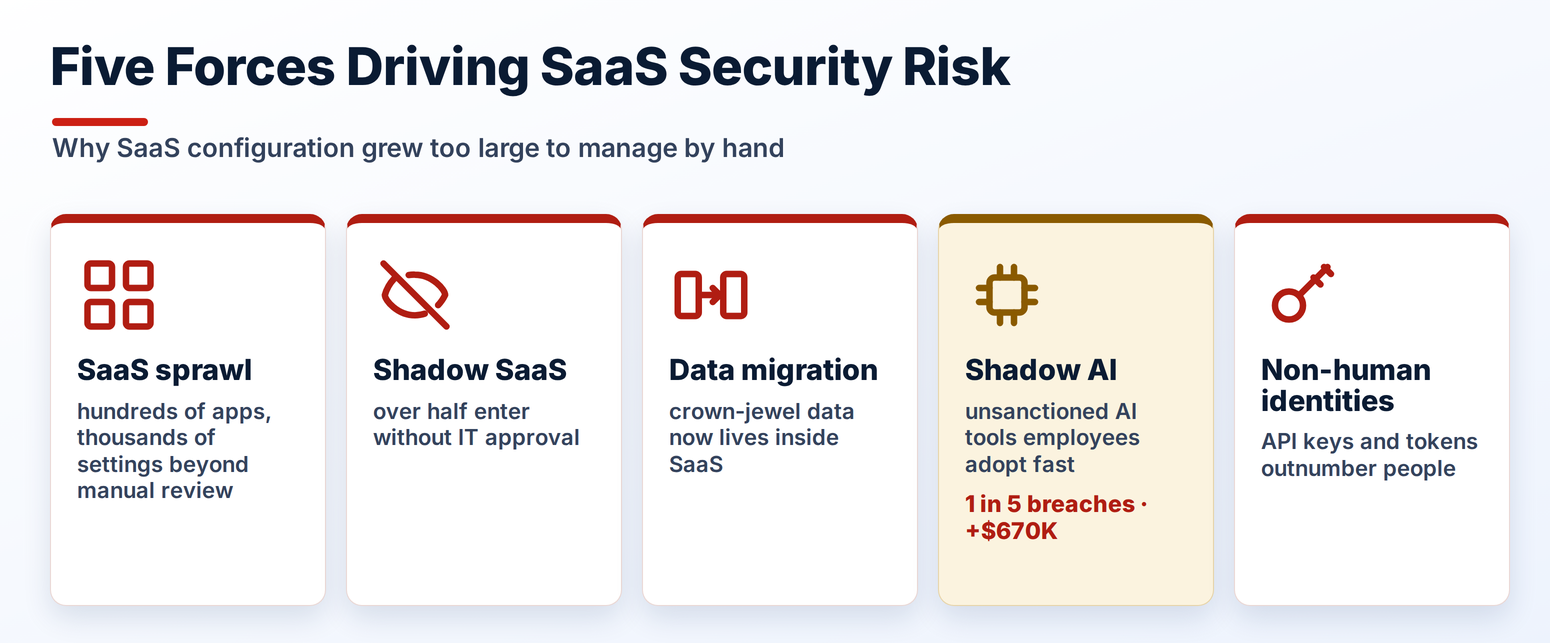
- SaaS sprawl. The average enterprise runs several hundred SaaS applications, each with its own settings, roles, and sharing rules, which puts thousands of configurations beyond the reach of manual review.
- Shadow SaaS. More than half of SaaS apps enter an organization without IT approval, and security teams cannot protect applications they do not know exist.
- Sensitive data migration. Customer records, financial data, and intellectual property now live inside SaaS platforms rather than on internal servers, raising the cost of every misconfiguration.
- Shadow AI. Employees adopt unsanctioned generative AI tools faster than any software category before them, and IBM’s Cost of a Data Breach report links shadow AI to one in five breaches, adding roughly $670,000 to the average cost.
- Non-human identities. Service accounts, API keys, and OAuth tokens now outnumber human users many times over, and each one is an access path that traditional identity controls rarely track.
How Does SSPM Work?
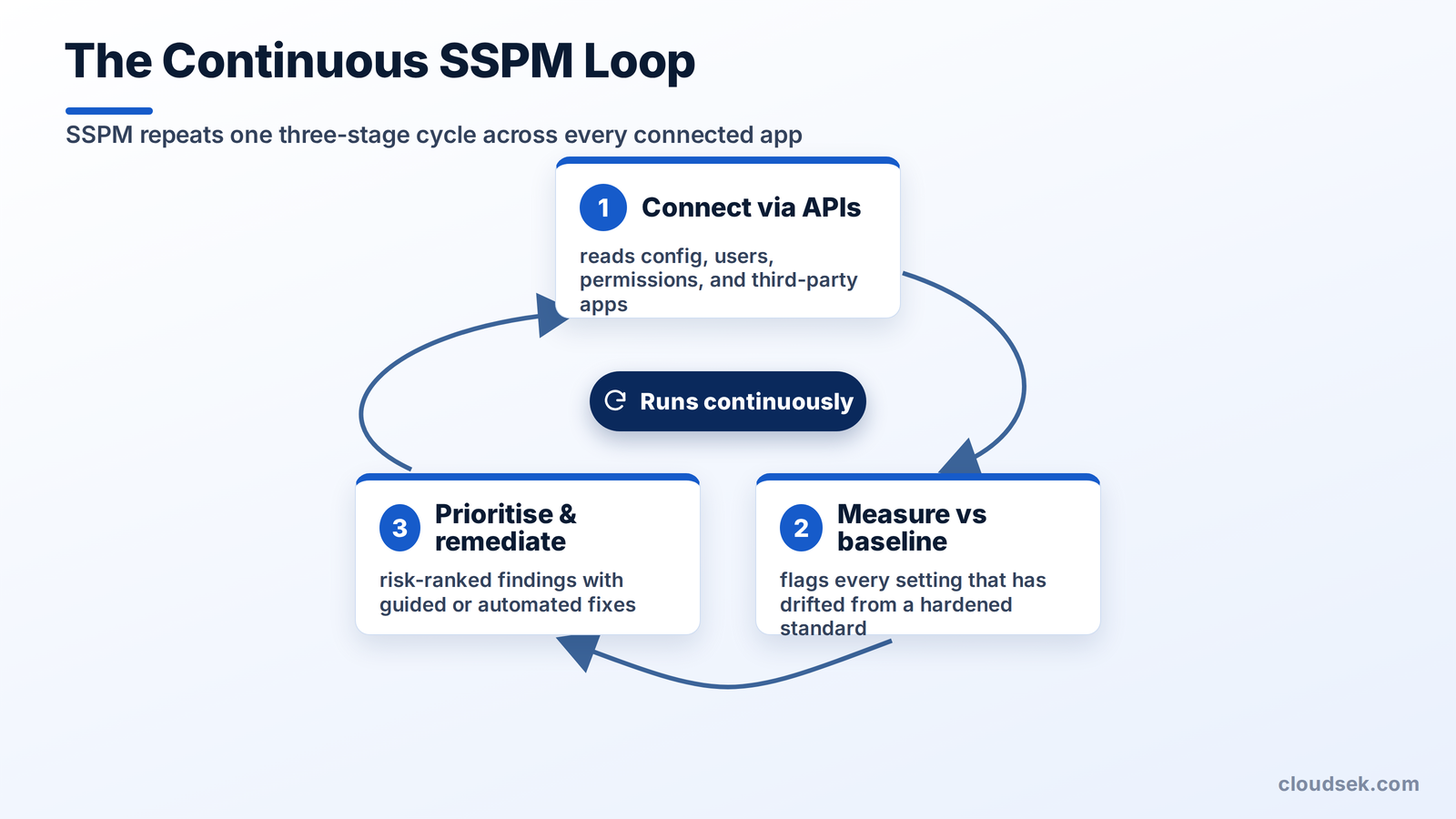
SSPM runs a continuous three-stage loop across every connected application.
1. Connecting Through APIs
SSPM connects to each SaaS application through its API, reading configuration settings, user accounts, permissions, and connected third-party apps without disrupting the service.
2. Measuring Against a Secure Baseline
It then measures those settings against a secure baseline. Reference standards such as CISA’s Secure Cloud Business Applications baselines define what a hardened Microsoft 365 or Google Workspace tenant looks like, and the tool flags every setting that has drifted from that mark.
3. Prioritizing and Remediating Findings
Detection is only half the value. A capable SSPM prioritizes findings by risk and provides guided or automated remediation, turning a list of problems into fixes an administrator applies without becoming an expert in every application.
What SSPM Detects
SSPM surfaces the security gaps that accumulate quietly across a growing SaaS estate:
- Misconfigurations. Insecure default settings, disabled logging, and weak external sharing controls that expose data.
- Excessive and dormant access. Over-privileged accounts, unused administrator rights, and former employees who never lost their logins.
- Weak authentication. Missing multi-factor authentication, unenforced single sign-on, and gaps in conditional access policies.
- Compliance drift. Settings that fall out of alignment with SOC 2, ISO 27001, HIPAA, or GDPR requirements.
- Risky third-party apps. OAuth integrations granted broad permissions, often approved by individual users with no review.
- Data exposure. Files, records, and folders shared publicly or with anyone holding a link.
Key Benefits of SSPM
SSPM turns SaaS security from a periodic manual audit into a continuous, automated program. The benefits that follow:
- Continuous visibility. A single view of configuration and access across every connected SaaS application, replacing scattered per-app checks.
- Reduced attack surface. Misconfigurations and excessive permissions get caught and closed before an attacker finds them.
- Automated compliance. Continuous mapping to SOC 2, ISO 27001, HIPAA, and GDPR, with audit-ready evidence in place of manual collection.
- Faster remediation. Prioritized, guided fixes shorten the window between a risky setting appearing and being corrected.
- Lower manual effort. Automation frees security teams from configuring and reviewing hundreds of applications by hand.
- Consistent enforcement. One security standard applied across every application, rather than app-by-app interpretation.
SSPM vs CSPM vs CASB
SSPM sits alongside two related tools that guard different layers, and the three complement one another rather than overlap.
A useful shorthand: CSPM secures the cloud an organization builds on, SSPM secures the apps it buys, and CASB governs how people reach both.
Modern SaaS Attack Surface
The nature of SaaS breaches has changed, and three angles show where the risk sits now.
1. From Misconfiguration to Identity
SaaS risk has shifted from misconfiguration alone toward identity and integration. The breaches making headlines rarely exploit a software flaw; attackers sign in with stolen credentials, ride a trusted third-party integration, or abuse an over-permissioned OAuth app. As the phrase now goes, they do not break in; they log in.
2. Third-Party Integrations as an Attack Path
The Snowflake campaigns show the pattern in full. In 2024, attackers used credentials harvested by infostealer malware to reach customer accounts that lacked multi-factor authentication, and a later wave reached Snowflake customers through a compromised third-party analytics integration. That integration exposure is a supply chain problem that SSPM’s internal focus does not fully cover.
3. Posture, Identity, and Vendor Risk
Posture and identity are separate problems, the lesson now reshaping SaaS security. SSPM hardens configuration, yet catching a valid-looking login from a stolen session belongs to identity threat detection and response, and vetting the vendors behind every integration belongs to third-party risk management. Durable SaaS security now spans all three.
SSPM Best Practices
Value from SSPM depends on how it is operated, not only on which tool is chosen. Here are the best practices that improve SSPM:
- Discover every SaaS app. Include shadow SaaS and unsanctioned AI tools, since the apps nobody tracks carry the highest risk.
- Prioritize by risk. Act on the findings that expose sensitive data first, rather than working through alerts by volume.
- Review OAuth grants regularly. Audit third-party integrations and revoke permissions that exceed what an app needs.
- Enforce MFA and SSO everywhere. Close the authentication gaps that credential-based attacks depend on.
- Run periodic access reviews. Remove dormant accounts and trim over-privileged roles on a set schedule.
- Automate remediation where safe. Let the tool correct low-risk drift on its own, and route higher-risk changes for review.
- Treat posture as continuous. Reassess constantly, because every new app, user, and integration shifts the baseline.
How to Choose an SSPM Solution
SSPM tools vary widely in depth and coverage, and a few factors separate them:
- Application coverage. Support for the specific SaaS apps in use, with real depth beyond the handful of largest platforms.
- Depth of checks. Granular configuration and permission analysis rather than surface-level scoring.
- Remediation quality. Clear, prioritized fixes and automation instead of an unranked wall of alerts.
- Third-party app visibility. Discovery of OAuth integrations and the permissions each one holds.
- Identity integration. Signals that feed identity threat detection, since posture and identity overlap in practice.
- Compliance mapping. Findings mapped to the frameworks the organization actually reports against.
Frequently Asked Questions
Is SSPM a replacement for CASB or CSPM?
No, SSPM complements CASB and CSPM rather than replacing them. Each guards a different layer: SSPM the SaaS apps, CSPM the cloud infrastructure, and CASB the access between users and services.
What SaaS applications does SSPM support?
SSPM tools commonly support major platforms such as Microsoft 365, Salesforce, Google Workspace, Slack, and ServiceNow. Coverage of smaller or niche applications varies from one vendor to another.
What is the difference between SSPM and ITDR?
SSPM manages configuration and posture, while identity threat detection and response (ITDR) detects and responds to identity-based attacks in real time. Posture closes gaps in advance; ITDR catches active misuse.
Is SSPM only for large enterprises?
No, any organization running several SaaS applications benefits from SSPM. Smaller teams often carry the same misconfiguration risk with fewer people to catch it by hand.
What is the difference between SSPM and DLP?
SSPM secures how SaaS applications are configured, while data loss prevention (DLP) focuses on stopping sensitive data from leaving. The two address different stages of the same underlying risk.
Is SSPM the same as an app’s built-in security settings?
No, SSPM centralizes posture management across many applications, while native settings are configured and watched app by app. It applies one consistent standard that per-app controls alone cannot.
{
“@context”: “https://schema.org”,
“@type”: “NewsArticle”,
“headline”: “What Is SaaS Security Posture Management (SSPM)?”,
“datePublished”: “2026-10-06 15:31:00”,
“image”: “https://cdn.prod.website-files.com/635e632477408d12d1811a64/6ac38140e6378297a54b5052_what-is-saas-security-posture-management-ssp.jpg”,
“author”: {
“@type”: “Organization”,
“name”: “Pune.Media Editorial Desk”,
“url”: “https://pune.media”
},
“publisher”: {
“@type”: “Organization”,
“name”: “Pune.Media”,
“logo”: {
“@type”: “ImageObject”,
“url”: “https://pune.media/wp-content/uploads/logo.png”
}
},
“isBasedOn”: “https://www.cloudsek.com/knowledge-base/saas-security-posture-management-sspm”,
“mainEntityOfPage”: “https://www.cloudsek.com/knowledge-base/saas-security-posture-management-sspm”,
“creativeWorkStatus”: “Editorial-assisted Curation”,
“comment”: {
“@type”: “Comment”,
“text”: “This article was curated, verified, and structured under organizational human editorial guidelines by the Pune.Media Editorial Desk.”
}
}