

Original Coverage & Source Attribution: www.digitalreviews.net
AI promises to make work easier, but is it actually delivering? New research commissioned by Jabra suggests employees are spending more time on work, while executives and individual contributors are experiencing AI adoption very differently. We examine the growing divide, the changing nature of collaboration and whether workplace AI is genuinely making people’s working lives better.
What happens when the time saved by AI simply becomes an opportunity to give employees more work?
That’s one of the questions raised by Jabra‘s latest WorkLife 2026: The New Shape of Work study, which surveyed more than 6,000 knowledge workers across six countries.
For years, one of the biggest selling points of artificial intelligence has been productivity. Let AI handle the mundane tasks, the argument goes, and workers will have more time to concentrate on the things that matter.
The research found that 85% of respondents reported spending more time on at least one category of work over the previous 12 months, while 35% reported spending less time on at least one type of work.
That doesn’t establish that AI itself is responsible for the additional workload. However, the differences between heavy AI users and those who use the technology less frequently raise interesting questions about what workplace productivity actually means.
They also raise another, arguably more important question: Who is actually benefiting from the efficiencies AI promises?
IN THIS EDITORIAL
Estimated reading time: 14 minutes
More productive, or simply expected to do more?
The study found that employees using AI multiple times a day were considerably more likely to report increased time spent on several categories of work.
Among heavy AI users:
- 57% reported spending more time on administrative and coordination work, compared with 38% of non-users and light users.
- 56% reported spending more time on creative and content creation work, compared with 30%.
- 56% spent more time on strategic planning, compared with 35%.
- 45% reported an increase in routine execution tasks, compared with 33%.
At first glance, those figures seem counterintuitive. Surely a technology designed to automate routine work should mean less time spent doing it?
The reality is more complicated. AI may make individual tasks faster to complete, but that doesn’t automatically translate into shorter working hours or reduced demands.
An employee who previously produced one report might now be expected to produce three. Someone who once spent an afternoon researching a problem might now be expected to investigate multiple alternatives, prepare comparisons and deliver recommendations in the same timeframe.
The technology may have improved productivity, but whether the worker actually benefits is a question rarely asked.
There is also an important distinction between doing more work and spending more time on particular activities. The Jabra study asked respondents how the amount of time spent on different categories of work had changed. It did not directly measure their output or independently establish whether their employers had increased expectations.
Nor does the research prove that AI adoption caused workloads to increase. Heavy AI users may have different responsibilities, more demanding roles or work in organisations already undergoing significant transformation.
Nevertheless, the findings challenge a commonly repeated assumption: that automating parts of a job necessarily makes the job itself less demanding.
Efficiency and workload reduction are not interchangeable concepts.
The growing AI divide between management and employees
Perhaps the most concerning finding isn’t the increase in reported workloads.
It’s how unevenly AI is being adopted across organisational hierarchies.
According to the study, 30% of top managers are heavy AI users, compared with just 8% of individual contributors, meaning employees without management responsibilities.
At the other end of the spectrum, 40% of individual contributors use AI monthly or less frequently, compared with 14% of top managers.
The differences extend beyond adoption.
While 47% of top management reported significant or fundamental changes to their work over the previous year, only 18% of individual contributors said the same.
Training appears to be another major dividing line.
Some 64% of individual contributors reported receiving no AI training or only a brief introductory session, compared with 26% of top management.
Among those who had received training, only 39% of individual contributors considered it very or extremely relevant to their roles, compared with 76% of top management.
That’s a substantial disconnect.
Organisations may be enthusiastic about AI transformation at an executive level, but enthusiasm alone doesn’t translate into practical capability throughout the workforce.
There is also a difference between how executives perceive the support being provided and what employees experience.
The research found that 44% of C-suite respondents believed their organisation had implemented at least three measures to support AI adoption. Only 14% of individual contributors reported the same.
Meanwhile, 38% of individual contributors said their employer had taken no action or that they were unaware of any measures being introduced.
Among top management, that figure was just 10%.
Of course, executives and individual contributors are not necessarily seeing the same parts of an organisation. Different responsibilities and levels of access may account for some of the disparity.
Even so, if management believes an AI transformation programme is progressing successfully while large sections of the workforce are unaware of the support supposedly available, there is a communication and implementation problem worth examining.
And if executives are becoming comfortable using AI significantly faster than the employees they supervise, there’s a risk that expectations about efficiency and output may begin to outpace the training and resources available to deliver them.
Rather than blaming technology, it is just as important to look at how organisations introduce and manage it.
Giving employees AI isn’t the same as making them AI-ready
One of the more revealing findings concerns the relationship between management competence and employee adoption.
Among workers who considered their managers competent in AI, 65% used the technology daily.
For those who did not perceive their managers as AI-competent, that figure fell to 27%.
That’s a 2.4-fold difference.
Workers with AI-competent managers also reported greater career optimism, scoring 8.3 out of 10 compared with 5.5 among those without that support.
These results don’t establish that managerial competence directly causes greater AI adoption or career confidence. Employees who perceive their managers as capable may also work in organisations with better training, clearer policies and more effective technology integration.
Nevertheless, they suggest that the environment in which AI is introduced matters considerably.
Giving employees access to software is one thing.
Making sure they understand where it is useful, where it introduces risks and how to incorporate it responsibly into their work is something else.
This distinction also emerged during DRN’s conversation with Jabra’s Ling Lu at Integrate 2026.
Lu, Jabra’s Global Head of New Product Development for Headsets, described a future where employees could interact with workplace AI agents conversationally through their headsets, asking questions, retrieving information and carrying out tasks without repeatedly returning to a screen.
But as we explored during that interview, even an advanced headset capable of capturing speech accurately cannot independently deliver a fully integrated workplace assistant.
That experience also depends on software, access to organisational information, appropriate permissions and well-designed workflows.
The same principle applies to AI adoption more broadly.
Simply deploying an AI assistant doesn’t mean employees automatically understand how to use it effectively, question its outputs or incorporate it into existing business processes.
Without appropriate training and integration, organisations risk adding another technology platform to the working day rather than removing unnecessary work from it.
And that’s before considering whether the processes employees are being asked to accelerate are particularly efficient in the first place.
Automating an inefficient process doesn’t necessarily make it a good process.
It may simply allow an organisation to perform that inefficiency faster.
AI isn’t necessarily making work more isolated
One of the more surprising findings challenges another common assumption about workplace AI: that greater reliance on intelligent assistants will reduce human interaction.
Among heavy AI users, 64% reported collaborating more with colleagues than they had 12 months earlier, compared with 25% of light users.
Meanwhile, 63% of employees using AI several times a day said their sense of connection with their team had improved, while 12% reported that it had deteriorated.
That suggests AI-assisted work may be changing the nature of workplace collaboration rather than eliminating it.
Generating research, drafting documents and producing preliminary analysis may become faster, but those outputs still need to be discussed, challenged, refined and translated into decisions.
AI can help prepare the information, but people still need to decide what to do with it.
But that creates another interesting possibility – if AI makes it easier to generate information, it may also increase the volume of material colleagues need to review, discuss and act upon.
An AI-generated report may take minutes to produce, but evaluating its recommendations, verifying its accuracy and deciding what happens next still requires human effort.
In some environments, AI could therefore create more opportunities for collaboration.
In others, it could simply create additional coordination overhead.
The study doesn’t establish which explanation is more prevalent.
More collaboration also creates greater demands on technology
The changing nature of collaboration creates another challenge that extends beyond the AI software itself.
During our earlier reporting on Jabra’s workplace AI developments, we examined the technical challenges involved in capturing conversations accurately, identifying individual speakers and ensuring that AI-generated meeting summaries attribute decisions and responsibilities correctly.
At Integrate 2026, Microsoft’s Kyle Spiess, Product Lead for Teams Intelligent Device Experiences, discussed the importance of correctly identifying speakers within Microsoft Teams Rooms.
It’s an issue that can easily be overlooked amid the excitement surrounding automated meeting summaries.
A system might accurately record that a decision was made, yet still create confusion if it attributes responsibility for the resulting action to the wrong person.
Similarly, Jabra demonstrated how its meeting room hardware is evolving to capture audio from different positions around a room, improving the quality of the information available to transcription systems.
But better audio capture doesn’t independently solve speaker identification, meeting context or the accuracy of subsequent AI-generated actions.
These challenges become increasingly relevant if AI-assisted work involves more coordination and collaborative decision-making.
Generating a meeting summary is relatively straightforward.
Ensuring that the right decision is recorded, attributed to the right person and translated into the correct action is far more demanding.
And if AI is encouraging employees to collaborate more frequently, the consequences of getting those details wrong could become more significant.
That old joke about “to err is human, but to really screw things up takes a computer” is supercharged with AI.
There’s also the question of whether organisations are actually reducing unnecessary meetings and communications, or simply using AI to make it easier to generate even more of them.
Technology can reduce the effort required to document a meeting. It cannot determine whether that meeting needed to happen in the first place.
Talking to AI: convenience, wellbeing and a commercial interest
Another element of Jabra’s research examines how employees interact with AI, particularly the difference between conversational voice interfaces and traditional text-based interactions.
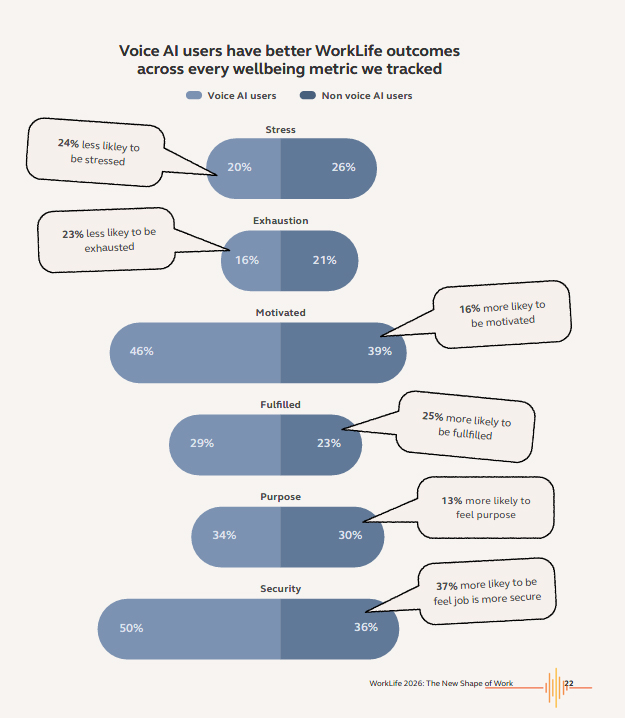
The findings suggest that employees who regularly speak to AI report better wellbeing than those who only type.
Among voice AI users, 20% reported stress, compared with 26% of non-voice AI users.
Similarly, 16% reported exhaustion, compared with 21%.
Voice AI users were also more likely to report feeling motivated, fulfilled and secure in their jobs.
These findings are interesting, particularly in the context of Jabra’s longer-term vision for conversational workplace technology.
In our earlier interview, Lu described voice as an increasingly important way for employees to interact with AI.
She outlined a possible scenario where someone returning from leave could ask a workplace assistant through their headset what had happened in their absence, which messages needed attention and what awaited them that morning.
The attraction is understandable.
There are circumstances where speaking a question or capturing a thought is considerably more convenient than stopping to open an application and type.
For someone moving between locations or trying to capture an idea before it disappears, conversational interaction could remove some of the friction associated with conventional computer interfaces.
I do need to point out that Jabra has a substantial commercial interest in professional audio and communications hardware. Its emphasis on the potential benefits of voice-driven AI aligns closely with its product strategy.
It doesn’t invalidate the wellbeing findings, but it does make independent scrutiny important. More to the point, the survey demonstrates correlation rather than causation.
Workers who regularly speak to AI may also have better training, more supportive managers, different job responsibilities or access to more suitable workplace technology.
Indeed, Jabra’s own research identifies associations between conversational AI use and favourable organisational conditions.
It would therefore be premature to conclude that speaking to AI directly reduces stress or improves job security.
What the results do suggest is that the interface between employees and AI deserves attention alongside the capabilities of the underlying technology.
If AI becomes something people regularly converse with rather than simply a tool they operate through a screen, that could change how naturally it fits into the working day.
But convenience isn’t the only consideration.

When AI starts listening, governance matters
Greater use of conversational AI also introduces practical questions around privacy, security and organisational governance.
These are particularly relevant when AI moves beyond individual prompts and begins processing meetings, workplace conversations and potentially sensitive business information.
As our previous Jabra reporting explored, accurately capturing a conversation is only part of the challenge.
Organisations must also consider who can access the information, how long recordings and transcripts are retained, whether participants have consented to being recorded and how AI-generated content is subsequently used.
Speaker identification introduces another layer of responsibility.
At Integrate 2026, Microsoft discussed the consent and administrative controls associated with voice recognition in Teams Rooms, including the fact that voice recognition is disabled by default.
Those safeguards matter because the ability to identify who said something is fundamentally different from simply improving audio quality.
Conversational AI may make interaction more convenient, but that convenience must be balanced against the responsibility of handling potentially sensitive information.
A headset capable of capturing a clear voice cannot independently resolve questions about access, consent, retention or appropriate use.
Those decisions belong to the organisations deploying the technology.
And as AI becomes more deeply embedded in workplace processes, treating governance as an afterthought could create problems that no amount of productivity improvement will compensate for.
What does this mean for Australian workplaces?
There is an important limitation for Australian readers.
Although Jabra distributed the findings locally, the WorkLife 2026 research did not include Australian respondents.
The survey, conducted by Toluna on behalf of Jabra, covered Germany, the United States, the United Kingdom, France, Poland and India.
Consequently, the results should not be interpreted as a direct measure of Australian workplace experiences, employment conditions or AI adoption rates.
Differences in workplace culture, industry composition, regulation and organisational maturity may influence how employees experience AI adoption.
Nevertheless, the underlying questions are relevant to Australian organisations considering how best to introduce AI into their operations.
Are employees receiving adequate training, or are organisations simply providing access to new tools and expecting people to work out how to use them?
Are productivity improvements genuinely reducing unnecessary work, or are they creating opportunities to increase output expectations?
Are managers sufficiently familiar with the technology to support their teams?
And perhaps most importantly, how are organisations measuring the success of AI adoption?
The number of licences deployed?
The number of employees using AI daily?
The amount of content generated?
Or whether the technology is actually improving the way people work?
Those are very different measures of success.
DRN’s take
There’s a certain irony in technology promising to give us more time, only for that newfound efficiency to become an excuse to fill every available minute.
We’ve seen variations of this before.
Computers made documentation easier. Email accelerated communication. Smartphones made it possible to remain connected almost anywhere.
Each promised greater efficiency.
Each also changed expectations about how quickly work should be completed, how much information people were expected to process and how available they should be.
AI could be another chapter in that story.
To be clear, the Jabra study doesn’t prove AI is making employees work harder. It is based on self-reported experiences and doesn’t establish whether AI directly caused the changes respondents described.
But it raises an uncomfortable possibility.
The efficiencies delivered by AI may be flowing into higher expectations rather than giving employees meaningful relief from their workloads.
The divide between management and individual contributors should concern organisations embarking on ambitious AI transformation programmes.
It’s relatively easy to introduce new software, announce an AI strategy and talk about productivity gains.
It’s much harder to equip employees with the skills, confidence and support to use that technology effectively.
There’s also a tendency to treat AI adoption as an achievement in itself.
Yet adoption is only a starting point.
A worker using AI every day isn’t necessarily more productive. A team generating more documents isn’t necessarily making better decisions. And an organisation completing more tasks isn’t necessarily operating more effectively.
The technology might make individual activities faster while simultaneously increasing the amount of work that needs to be reviewed, coordinated and managed.
That isn’t automatically progress.
There is genuine potential for AI to eliminate repetitive tasks, improve access to information and help people concentrate on work that requires human judgement.
But realising that potential requires more than an impressive demonstration or another enterprise software subscription.
It requires organisations to understand their processes, invest in their people and decide what they actually want productivity improvements to accomplish.
AI is making individual tasks easier. That doesn’t necessarily mean it is making work easier.
Perhaps the better measure of successful AI adoption isn’t how much more work employees can complete.
Perhaps it’s whether the technology actually makes their working lives better.
Research note: The WorkLife 2026: The New Shape of Work study was commissioned by Jabra and conducted by Toluna among more than 6,000 knowledge workers across Germany, the United States, the United Kingdom, France, Poland and India. The findings are based on survey responses and should not be interpreted as establishing causal relationships between AI use and changes in workload or wellbeing. The study did not include Australian respondents.



