

Original Coverage & Source Attribution: www.cnn.com
Jim Darnell’s family has been farming beans in Nebraska for three generations, but he says the past few years have been some of the more difficult for his crops and his sales.
And the future, the 77-year-old said, also looks tough.
“It’ll be a difficult time in farming for the next year,” Darnell told CNN.
Farmers like Darnell in western Nebraska have suffered blow after blow in recent years. Extreme drought, cripplingly high prices for fuel and fertilizer, and the disruption of a market for surplus crops – America’s foreign food aid – have weakened the bottom line for his business, JD Farms.
Washington’s funding cuts to food assistance programs and the abrupt dismantling of the US Agency for International Development early last year meant that farmers and crop elevators weren’t able to sell as much to aid programs like Food for Peace or the McGovern-Dole Food for Education Program, which feed millions globally.
“Anytime we lose an end user, it eventually affects our prices… So, it did disrupt it for the price of beans,” Darnell said, adding that he is proud to contribute to any program that reduces global hunger. “That’s a great thing – any program that helps. And beans are a great thing to put in a program like that, because they’re great in protein and they store so well.”
The United States has a long, bipartisan history of backing food assistance programs aimed both at helping domestic farmers and tackling global hunger. Food for Peace, which purchases agricultural products from American farmers each year to send to food-insecure populations overseas, has fed more than 4 billion people since it was created in the 1950s, according to the US State Department.
“That’s a win-win for everybody,” said Cathy Kaufman, whose husband Mike runs a family farm that has been growing beans and corn for five generations. “It’s kind of amazing when you think that Nebraska farmers can help to achieve world security, as an end product, and feed the hungry.”
But Congress recently cut government funding for Food for Peace by about 25%, from about $1.62 billion annually to $1.2 billion for FY2026.
And the Trump administration has sent even less of that money out the door. The amount spent by the US Department of Agriculture (USDA) on food aid commodities in 2025 and 2026 has fallen by about 55% compared to the spending levels in 2024 under the Biden administration, according to an analysis of USDA data conducted by the Center for Global Development (CGD).
“The impact of this is playing out in human lives in the most catastrophic way imaginable,” said Sam Vigersky, an international affairs fellow at the Council on Foreign Relations, a New York-based think tank.
“These are some of the most… impactful programs that the US government has anywhere in the world,” said Vigersky, who previously served as a senior humanitarian adviser to the US ambassador to the UN. “When you take money out of a program like Food for Peace, you’re taking food out of the mouth of starving children.”
The White House originally proposed cutting the entire budget for Food for Peace and the McGovern-Dole International Food for Education program.
But “Congress has really signaled continued support for food commodity programs,” according to Jocilyn Estes, a senior policy analyst at CGD. Food assistance programs have historically been protected by a bipartisan coalition of agricultural interests, shipping companies and humanitarian organizations.
Experts have long noted that shipping bulk purchases of agricultural commodities overseas isn’t the most efficient way to administer humanitarian assistance, and in many cases, food could be purchased closer to crisis areas.
“But right now, given the myriad of challenges and crises that the world’s most vulnerable populations are facing, I think any amount of bipartisan support for human care and assistance is good, and we should be really focusing in on how to improve that,” Estes told CNN.
A spokesperson for the White House Office of Management and Budget told CNN that Food for Peace and McGovern-Dole are “inefficient, wasteful, and do not align with President Trump’s America First agenda,” and that they create “permanent dependency on the American taxpayer.” The budget preserves “far more efficient food aid programs,” the spokesperson added.
The White House has called for cutting the funding, however, rather than redirecting it to other programs.
Kaufman, who volunteers as an advocate for food assistance through the Christian nonprofit World Vision, said she believes cutting food aid programs not only threatens food security but also diminishes the United States’ global leadership.
“Foreign assistance is less than 1% of our budget. I’m sorry, but that’s not going to balance our budget or even close,” Kaufman told CNN. “What it will do, though, is put our country in jeopardy of not being a world leader.”
During the Trump administration’s dismantling of USAID, the Food for Peace program was transferred to the USDA. Some humanitarian experts have criticized that shift, arguing that the USDA lacks the same expertise in emergency management.
The list of countries that the program supports has been heavily reworked under the USDA. Food for Peace provided American-grown food aid to seven non-emergency countries this year, while dropping several nations experiencing famine risk, like Somalia and South Sudan.
“The administration has been clear that need is only one of the criteria, and that political objectives of the administration and the relationship with those governments is an important factor for them,” a senior official from a nonprofit told CNN, speaking anonymously because it still has US government contracts. “There are a lot of countries that are in need that, really, we’d like to see on that list.”
In Yemen, which faces emergency levels of food insecurity after years of conflict, the Trump administration cut all foreign aid, including food assistance.
Even still, farmers and agriculture industry workers told CNN that they applaud the USDA for its work picking up Food for Peace.
Meanwhile, the senior nonprofit official told CNN that almost all its McGovern-Dole projects, which feed hungry schoolchildren overseas, were terminated in 2025, but “now some are coming back.” The official described the last two years as “unbelievably disruptive and confusing,” but added that the USDA has a “good team” working to resuscitate the work.
The USDA declined to answer questions from CNN about Food for Peace but said in a recent statement that since the program was transferred “there has been over $1 billion invested in awards and agreements in principle for international emergency food assistance which utilizes approximately 467,000 metric tons of U.S. commodities.”
Vigersky also noted that many countries are not only dealing with the end of Food for Peace deliveries but also facing cuts to other US aid programs plus cuts by other international donors.
Grace Mavhezha, World Vision’s communications manager in Sudan, said “the funding uncertainty makes it increasingly difficult to maintain the planned scale of assistance.” The organization had to alter its food distribution plans and ration sizes this year due to funding reductions.
She told CNN that “foreign food assistance is not simply about sending food overseas; it is about saving lives, protecting children, supporting families and giving vulnerable communities an opportunity to survive and recover from crises.”
American food companies and grain elevators up and down the country also play a role in food aid programs and are feeling the impacts of the aid cuts and last year’s sudden disruptions.
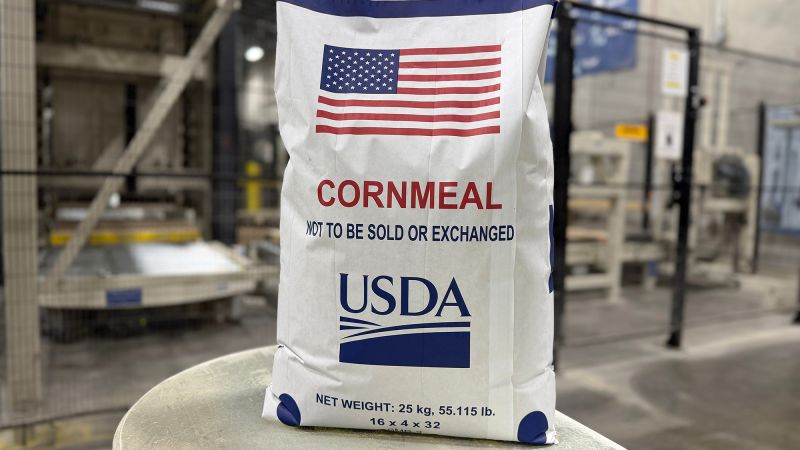
Didion Inc., a family-run agricultural processing company in Wisconsin, told CNN that last year the supply chain was severely disrupted for its cereal product that’s used to treat acute malnutrition in young children overseas. The company had to suspend production, according to chief executive Riley Didion, but things have started moving again this year.
“When that program stops, we also buy less corn from the farmers that are in our area,” Didion told CNN. “But the biggest impact by far will be people who don’t get fed.”
Didion traveled to Kenya last October for meetings about improving the aid supply chain and the delivery of products to a refugee camp in Kakuma. “When I was there, there was a recent cut, and most of the folks were living off 30% or 40% of what they would normally get. That was really difficult to see,” he said.
“There is an unbelievable need, globally.”
He added that his firm is proud that its acute malnutrition products don’t bear the company’s own logo, but rather the American flag. “There’s an unbelievable gratitude that our team has the ability – and that our community has the ability – to play a part in feeding people all over the world.”
CNN’s Becky Pinnington contributed to this report.



