

Original Coverage & Source Attribution: economy.ac
Europe’s High North has many governors and no single authority
Norway and Russia still set cod quotas despite sanctions
Cables, investment screening and Svalbard expose gaps between layers
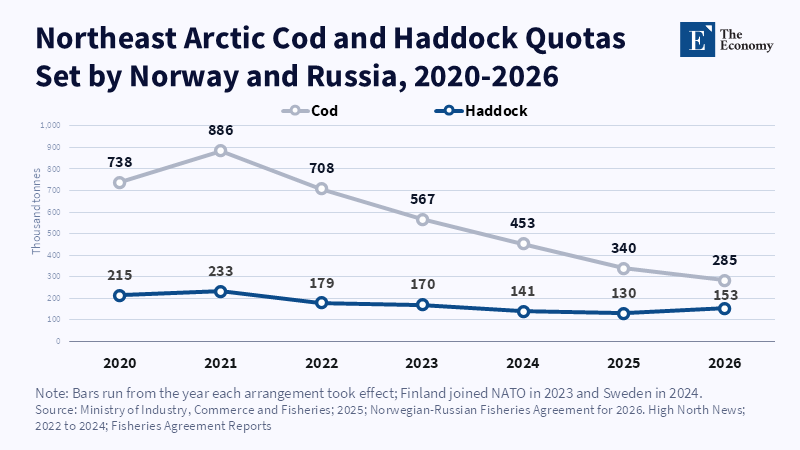
On 18 December 2025, the quota for Northeast Arctic cod was agreed upon by Norway and Russia. 285,000 tonnes was decided upon, which is 16 percent lower than the previous year and the lowest quota since 1991. Of this, Norway will be given 139,827 tonnes. What happened around this number is more important. Five months earlier, Norway had closed its ports and fishing areas to the Russian companies Norebo and Murman Seafood. These two companies were believed to be working with Russian intelligence. Together they had 28 vessels of the 121 that were permitted to fish in the Norwegian zone that year. Russia responded by stating that they would close their own zone to Norwegian vessels. The quota was agreed anyway based on the scientific advice that came from Norway’s Institute of Marine Research and Russia’s VNIRO. This agreement can be used to examine the current situation in Europe’s High North. Many different laws, treaties and bodies oversee the area but there is no one body that has complete control. Can all of these things work together now that security has taken the top spot on every agenda?
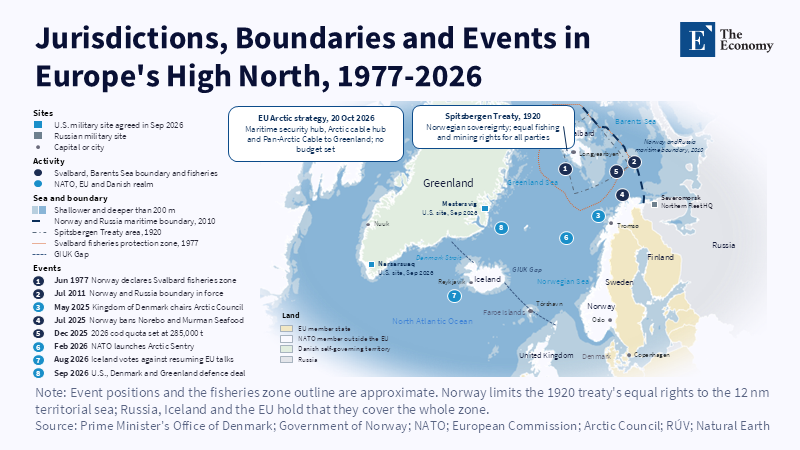
The USA and Russia sit on opposite sides of the Bering Strait. The question of who owns the waters can be answered with two responses. In the North Atlantic, this is not so simple. Norway, Iceland and the UK are all part of NATO but not the EU. Denmark is a member of both. Greenland and the Faroe Islands are Danish territories in the North Atlantic and Arctic and are not part of the EU and can make most decisions on their own. So when the European Commission published its new Arctic Strategy on the 20th of October 2026, it was with this in mind. The EU, NATO and many National and Home rule governments all have an interest in the region.
Sovereignty in the North Atlantic Is Split Unevenly
As stated above, Greenland is a part of the Kingdom of Denmark. This is stated in the Danish Constitution and the Act on Greenland Self-Government. This Act was passed after a referendum in Greenland in which 75.5 percent voted yes. It came into effect on 21st June 2009. The Act recognises the people of Greenland as a people with the right to self-determination under international law. It also allows for certain areas to be taken over by the Government of Greenland. These include police, courts and mineral resources. Mineral resources were taken over by Greenland on 1st January 2010. There are some areas that cannot be taken over while Greenland is a part of the Kingdom of Denmark. These include nationality, the Supreme Court, monetary policy and foreign affairs, defence and security. Denmark still gives Greenland a yearly block grant which is fixed at DKK 3.4 billion in 2009 prices. This will be reduced by half of any mineral income above DKK 75 million. The Act also allows for Greenland to become independent. There are several steps that must be taken before this can happen.
Faroe Islands have had Home Rule since the 23rd of March 1948. They have also been given the opportunity to take over more fields of work with the Takeover Act in 2005. Similar to Greenland, they can represent the Kingdom of Denmark in international agreements if the field is taken over. Except for defence and security and anything within an organisation Denmark belongs to. Neither of them belongs to the EU. Greenland withdrew from the European Community in 1985 and the Faroe Islands have never been a member. Denmark is in charge of defending both. They do so through NATO. That is why they have established a contact committee with Denmark, Greenland and the Faroe Islands. This committee can exchange confidential security information about the two territories.
Iceland is a member of NATO and joined the single market in 1994 through the European Economic Area. On the 29th August 2026, Iceland voted against resuming EU accession talks. 52.8 percent voted no and 47.2 percent voted yes. This was largely due to fishing rights. Norway is also a member of the EEA and NATO. The UK left the EU in 2020. So all three areas that make up the Greenland-Iceland-UK gap are not part of the EU. The EU will only have influence in this area through its agreements with Iceland and Denmark.

Brussels and NATO Share Europe’s High North Without a Map
The Commission’s strategy has four areas it wants to focus on. Security and resilience come first. Then climate, prosperity and opportunities. Most of the actions it lays out are civilian. There will be a maritime security hub that can collect information from member states and partners. An Arctic cable hub to monitor and help fix cables. More Copernicus coverage; help member states buy icebreakers. The Pan-Arctic Cable will connect Greenland to Europe and IRIS² Arctic Connectivity will provide secure communications. According to Reuters, the strategy does not come with a budget. In September 2026, the Commission announced €200 million of investment in Greenland. This is the first time the EU has changed its Arctic policy since 2021.
NATO has been deploying more troops to the region. On the 11th of February 2026, they started Arctic Sentry. It is stated by the AP that this will not be a military operation. It will include operations already taking place, such as Denmark’s operation Arctic Endurance and Norway’s Cold Response. There will be more operations included. The U.S., Denmark and Greenland have signed the agreement on the 22nd of September 2026. This has updated the old 1951 defence agreement. This will also mean that the EU has no control over this. They will be allowed to build bases in Narsarsuaq and Mestersvig. If Greenland were to become independent, the agreement would still apply. It also says that if any investment comes from a non EU/NATO country, all three must approve.
Taken together, these agreements and treaties leave sovereignty in the hands of Denmark, Greenland, the Faroe Islands, Norway, Iceland and the UK. Defence is in the hands of NATO and its member states. And the EU will have its say in areas that fall under EU law, which is not a lot in the GIUK Gap. This can work as long as these things don’t overlap. Cables are one of those things. They fall under many of these categories. Commercially, they are owned by private companies and are overseen by national law. They are mentioned in military threat assessments. And now the EU is watching over them. Who is in charge if a cable is cut in the North Atlantic? The EU likes to remind people that it and NATO have 23 members in common. But the countries that make up most of Europe’s coastline in the High North are not part of that overlap.
Svalbard Shows Where Treaty Law Runs Out
Although Svalbard is not in the GIUK Gap, it shows what can happen when a treaty is clear and the law of the sea is not. The Spitsbergen Treaty was signed on 9th February 1920. It gave Norway full and absolute sovereignty over the islands with some exceptions. All parties to the treaty can fish, hunt and do business on the islands and in the territorial waters. No military bases or fortifications can be built. There is no argument about this. Countries were later given a 200-nautical-mile zone around their coasts. And the UN Convention on the Law of the Sea states that countries can have innocent passage through territorial waters and freedom of navigation beyond. But what about Svalbard? In 1977, Norway created a 200 nautical mile fisheries protection zone. Not an exclusive economic zone. Which may have saved them from this argument.
Norway believes that the treaty only applies to the territorial waters. Russia, Iceland and the EU believe that rights that apply on Svalbard should also apply in the zone and on the continental shelf. In 2004, after Norway limited the amount of herring that could be caught in the zone, Iceland began preparing legal proceedings against Norway at the International Court of Justice. There is no clear answer to this. Robin Churchill and Geir Ulfstein looked at both sides and came to the same conclusion. For now, Norway’s self-imposed rules have kept the argument from getting out of hand. They have allowed foreign countries to fish in the zone without discrimination.
So a treaty can grant sovereignty and still not settle who can fish in the area. Or who can drill on the continental shelf one day. The new EU Strategy mentions that they want to work more closely with like-minded partners. The EU is one of those countries arguing with Norway. So it will be interesting to see how that works. No one has taken this to an international court.
The Barents Cod Deal Survived Sanctions
Norway and Russia have had a joint fishing arrangement in the Barents Sea. It’s been around longer than their border. Since 1976 the Joint Commission has allocated quotas. When the border was decided in 2010 they wanted to keep this. Fish don’t know where the border is they swim over it. Norway said that this year’s quota was necessary to help replenish the cod stocks. The stocks are struggling. In 2025 they were below the precautionary level.
Most fishing takes place in Norwegian waters. Therefore, if Russia were to close its waters, it would not impact too many Norwegian vessels. Fiskebaat, the Norwegian deep-sea fleet, said there are very few boats that fish in the Russian waters. However, both countries would suffer if they are not able to regulate the fish. When one country sets a quota on a fish stock. It can cause the fish to be overfished. This has happened in the North Atlantic. The ministry did say that the two companies listed have impacted this year’s negotiations. The haddock quota was raised by 18 percent to 153 293 tonnes. Capelin will be closed for another year. They also agreed to conduct research together in 2026.
Norway has not ignored security to save the fish. They have used the same laws for both. By closing Norwegian waters to the Russian companies, Norway was aligning with sanctions the EU adopted in May 2025. Iceland and the Faroe Islands have also taken action. A Norwegian court ruled that the ban on the companies was correct. Norebo had argued that the fisheries agreement only allowed for punishment for certain offences, such as overfishing but the court upheld the ban under Norway’s Sanctions Act. Russia was still able to make a fishing agreement with the Faroe Islands for 2026 as they have their own home rule and can take care of some of their own affairs.
Layered Arctic Governance Holds Until Its Seams Are Tested
Some would say no and that one Western power needs to take over the area whether that be the EU or NATO. The events of 2026 do not support this. When the US tried to take Greenland. Denmark and Greenland were able to work together. As the Act on Greenland Self-Government allows. NATO stepped in with Arctic Sentry. And the EU offered money and connectivity. In the end the agreement stated that it recognised Denmark and Greenland’s sovereignty and territorial integrity. And the right to self-determination. With one power in charge, it would have been up to that power to decide what would happen to Greenland. Circumpolar relations were also able to continue. The 8 Arctic countries released a statement together in May 2025 when the Kingdom of Denmark took over the chair of the Arctic Council from Norway.
This can fail if one layer of governance crosses into another. As mentioned above, the September 2026 defence agreement requires all three parties to approve investors from non-EU/NATO countries. But the EU is trying to gain access to Greenland’s critical raw materials and is investing money on the island. If an EU project has a non-EU/NATO country involved, it would have to be screened. But the EU would have no say in that. Iceland voted against resuming EU accession talks. So they will not be part of the EU’s maritime security hub unless they make another deal. The EU has said they will be making a security and defence agreement with Iceland. It is still unclear what will happen with Svalbard. None of these issues needs a new body to be created. But they do need the current bodies to work together and figure out who is in charge. The new EU strategy has not yet done that.
The cod quota is a good example of how things can work. Even though there is conflict between the two countries, they are still able to work together. Because they have an agreement that allows them to. Europe’s High North has a lot of agreements that allow for this. But it is still unclear who will be in charge of the cables. Or who will have a say in screening investments. Or who can drill on Svalbard’s continental shelf. The new EU strategy has not addressed these issues. The next few years will show how this plays out. But for now, the cod will be at 285,000 tonnes for one year.
The views expressed in this article are those of the author(s) and do not necessarily reflect the official position of The Economy or its affiliates.
References
Al Jazeera (2026) ‘Iceland rejects EU accession talks in referendum’, Al Jazeera, 30 August.
Arctic Council (2025) Arctic States and Indigenous Permanent Participants Convene for the 14th Meeting of the Arctic Council. Tromsø: Arctic Council Secretariat.
Associated Press (2026) ‘NATO launches Arctic Sentry military effort in seeking to move on from Greenland dispute’, Associated Press, 11 February.
Churchill, R. and Ulfstein, G. (2010) ‘The disputed maritime zones around Svalbard’, in Nordquist, M.H., Heidar, T.H. and Moore, J.N. (eds) Changes in the Arctic Environment and the Law of the Sea. Leiden: Martinus Nijhoff, pp. 551–593.
European Commission (2026) EU Sets Out a New Strategy for the Arctic. Brussels: European Commission.
House of Commons Library (2026) The New US–Denmark–Greenland Agreement. London: House of Commons Library.
IntraFish (2025) ‘We’ll survive, but it will hurt: Port closures will threaten cod flow to global markets’, IntraFish, 9 July.
Ministry of Foreign Affairs of Norway (2010) Treaty between Norway and Russia concerning Maritime Delimitation and Cooperation in the Barents Sea and the Arctic Ocean: Frequently Asked Questions. Oslo: Government of Norway.
Ministry of Industry, Commerce and Fisheries of Norway (2025) Norwegian-Russian Fisheries Agreement for 2026. Oslo: Government of Norway.
Prime Minister’s Office of Denmark (n.d.a) Faroe Islands. Copenhagen: Statsministeriet.
Prime Minister’s Office of Denmark (n.d.b) Greenland. Copenhagen: Statsministeriet.
Reuters (2026) ‘EU unveils new Arctic strategy with focus on security’, Reuters, 20 October.
SeafoodSource (2025) ‘Norwegian fishing industry group Fiskebåt backs Russia sanctions’, SeafoodSource.
SeafoodSource (2026) ‘Norwegian court rules sanctions against Russian fishing firm Norebo are valid’, SeafoodSource.



