

Original Coverage & Source Attribution: www.cbc.ca
Scary.
That’s about the only way to describe the daily preoccupations of NATO military planners these days.
What is perhaps more unsettling is how NATO’s deputy military commander, British Air Chief Marshal Sir John Stringer, described those concerns.
Being a military planner is at the best of times not a barrel of laughs, nor a job for the faint of heart given all of the grim scenarios and outcomes one must imagine.
Lately, it’s not so much the routine prospect of a war with Russia, but rather the possibility that President Vladimir Putin, despite being consumed by his war of choice in Ukraine, might decide to have a go at one of the Western allies.
The distinction has profound implications for the way countries such as Canada prepare themselves militarily — and the speed with which they do it.
Throughout 2026, the warnings coming out of Europe have become more pointed and stark.
“Russia is a war economy now,” Stringer said in an exclusive broadcast interview with CBC News, portions of which were aired on CBC Radio’s The House on Saturday.
“Let’s not dress it up any other way. It is.”
The rate at which the Russians are producing everything from relatively unsophisticated drones to munitions to ballistic missiles far surpasses not only their pre-2022 production, but outstrips almost everything NATO is churning out, Stringer said.
WATCH | NATO’s deputy commander on Canadian spending:
Canada ‘spending well’ on NATO commitments: NATO’s 2nd in command in Europe
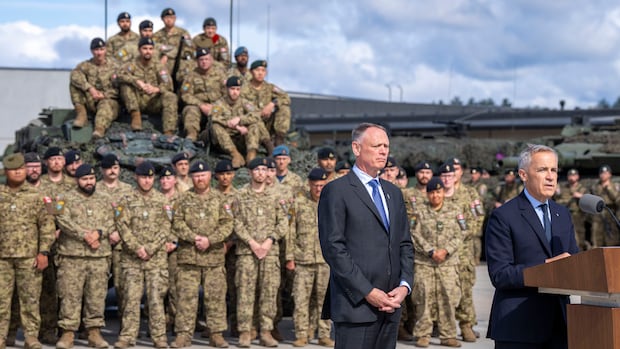
Asked by CBC News about the Pentagon’s assessment that Canada isn’t pulling its weight on defence investment, NATO deputy commander Air Chief Marshal John Stringer said Canada is ‘a nation that is recapitalizing its investments in its air forces and its land component, in maritime.’
And while the possibility of a direct military confrontation with NATO remains at the low end of the spectrum of potential outcomes, Stringer said the likelihood has increased.
The economic damage the Ukrainians have inflicted on Russia, notably on its oil industry, has heightened the possibility of recklessness on the part of Putin, he said.
Stringer said NATO’s military planners concern themselves with possibilities, not probabilities.
It is an instructive lens through which to view a lot of what’s happened recently in Ottawa as it relates to defence.
The federal government of Prime Minister Mark Carney has committed to the biggest sustained increase in defence spending in generations. Yet, the military is wrestling with budget restraint, curtailing some training activities and restructuring its reserve force.
The latest federal budget lays out an ambitious long-term spending trajectory, all of it calibrated to put Canada on track to spend five per cent of its gross domestic product on defence by 2035.
But the near-term funding picture for the Canadian Armed Forces is considerably less dramatic.
And the government is in the process of creating a powerful new Crown corporation to buy military equipment, an organization that will be expected to devote considerable energy to rebuilding the country’s industrial base and fostering economic prosperity.
WATCH | Conservative defence critic on proposed Crown corp.:
New defence bill is more paper-shuffling, bureaucracy: shadow minister
The newly designated Canadian Corporation for Defence Investment will operate at arm’s-length from federal departments and have its own board of directors and CEO to speed up military procurement and investment decisions. But how is this latest move by the Liberals being received by the Opposition? Power & Politics hears from Conservative shadow minister for national defence James Bezan.
Taken individually, there are explanations — some of them perfectly reasonable — for each of those decisions.
Taken together, they invite a rather fundamental question, particularly in light of what the Europeans are saying.
Are we, or are we not, preparing for war?
The Carney government’s own recent national security strategy spelled it out this way: Canada must “prepare for all contingencies up to and including war.”
It is the “up to and including” part that has preoccupied the House of Commons defence committee as it studies Bill C-40, which converts the Defence Investment Agency into a Crown corporation.
But for retired Dutch admiral Rob Bauer, the former chair of NATO’s military committee, it is the “including war” part on which he’s fixated.
In a separate interview with CBC News chief correspondent Adrienne Arsenault, Bauer made the point that the Russians are rebuilding their military even as they are fighting in Ukraine.
“They’re producing more weapons than they actually need in Ukraine,” said Bauer.
The surplus equipment, he said, can be stockpiled or used to rebuild military formations elsewhere, including along the border with Finland, one of NATO’s newest members.
And perhaps more importantly, the Russians are learning at enormous cost how to fight a modern, industrial-scale war.
For countries such as Canada, which have historically enjoyed the luxury of geography, Bauer had a particularly pointed observation.
“Your distance doesn’t help you anymore. And basically, time is no longer our friend.”
War of choice vs. defence
Much of the Western military establishment, including Canada’s, was conditioned by the wars in Afghanistan and Iraq to think about military operations in terms of choices.
Governments decided whether to participate, how many troops to send, how long they would stay and what kind of equipment they would take with them.
There was generally time to train soldiers and, in Canada’s case, buy equipment once it became apparent that what they had wasn’t up to the job.
A war in defence of the Western alliance would be an altogether different proposition.
The enemy would have a considerable say in the timing, the duration and the scale of the commitment.
The time to buy equipment, stockpile ammunition and train soldiers would be before the shooting started.
It is worth noting that none of this is particularly at odds with the “more dangerous and divided world” Carney has articulated since he became prime minister.
What is less clear is the extent to which that assessment is driving the day-to-day decisions of the federal government.
The irony of the current budget restraint within National Defence is that it is taking place against the backdrop of what the Liberal government has characterized as a historic reinvestment in the military.
The department has been looking for hundreds of millions of dollars in savings in its operations and support budget.
Weekend training and competitions for military cadets have been suspended in various parts of the country until the end of the fiscal year.
More consequentially, the army’s restructured reserve force is expected to result in the elimination of hundreds of full-time reservist positions.
WATCH | More about cadet funding: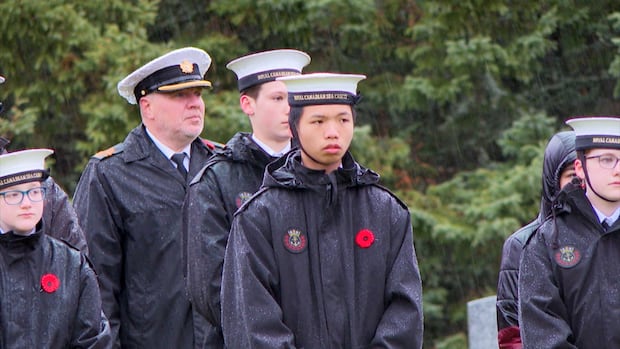

‘It’s heartbreaking’: Parts of cadet programs on hold, for now, as national group reviews fiscal plan
Programming for national cadets and junior rangers programs across the country is changing — for now. Leaked emails reveal national defence budget constraints have forced a halt to parts of cadet training across the country. One former cadet from Newfoundland and Labrador disagrees with that decision, and has written a letter to the prime minister. The CBC’s Madison Taylor reports.
There is a legitimate debate to be had about how many reservists should be employed in full-time administrative jobs and whether the money would be better spent getting part-time soldiers into the field.
But the reserve force, which in the event of a major war would be expected to provide much of the additional manpower, has historically been a convenient place for the Defence Department to find savings when money gets tight.
It is also the kind of institution that cannot be rebuilt overnight.
You could hear strains of that in the Pentagon’s increasingly public, bellicose campaign to pressure the Carney government to meet the five per cent GDP NATO target before the end of the decade.
U.S. officials pointed to the low state of readiness of all three branches of the Canadian military.
And more pointedly, it accused Ottawa of prioritizing “parochial economic and commercial interests over military optimization.”
Given the enormous commercial stake in some of Canada’s outstanding military equipment purchases, notably the F-35 fighter jet, the comments were taken in Ottawa with a giant heaping of salt.
But the temptation to dismiss the American criticism in its entirety because of the political and commercial motivations behind it obscures a rather uncomfortable reality.
“They’re not wrong,” was how Steve Saideman, a defence expert at Carleton University, described the Pentagon’s criticism. “The key is that the Americans are upset that we’re responding to their bullying by not giving in to them.”
Much of the evidence the Pentagon marshalled in making its case was drawn from the Canadian Defence Department’s own reporting.

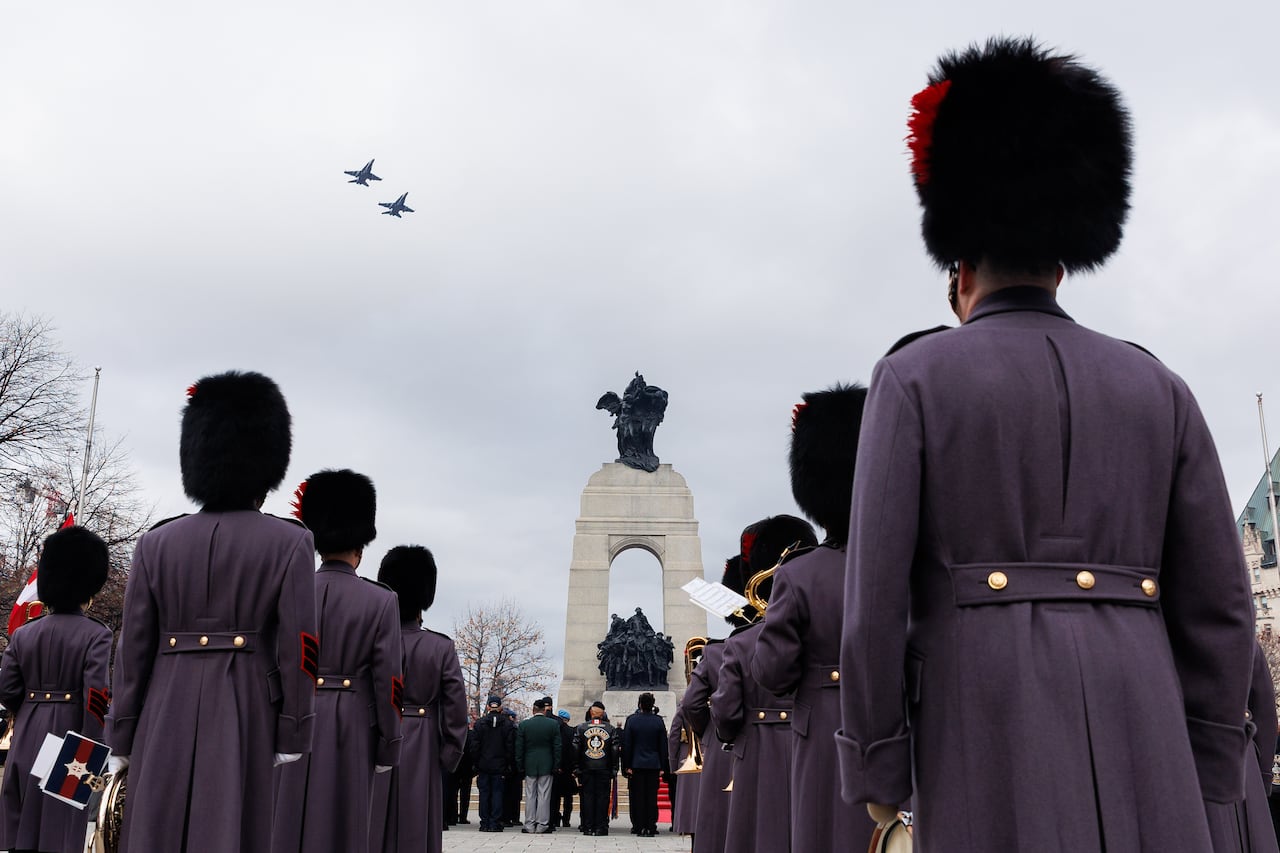
The collision between industrial policy, nationalism and military necessity is not a new phenomenon. (Keito Newman/The Canadian Press)
And that leads us to a tiny — but important — moment of political theatre recently in front of the House of Commons defence committee.
Liberal MP Tim Watchorn read aloud a partial list of the military equipment and support contracts the federal government had signed since the newly minted Defence Investment Agency (DIA) was stood up in the fall of 2025.
Turning the agency into a Crown corporation means it will have substantial powers to sole-source military contracts but also invest in domestic arms companies.
In light of everything we’re seeing in the world, Andrew Latham, a professor of international relations and political theory at Macalester College in Minnesota, offered the committee an important yardstick to evaluate the mandate of the agency.
“The overriding purpose of defence procurement is to ensure that the Canadian Armed Forces are equipped to fight and win in the conflicts they will actually be engaged in.”
It is a debate that would have been familiar to several generations of Canadian politicians and military officers.
Perhaps the most notorious example of the collision between industrial policy, nationalism and military necessity was the controversy surrounding the Ross rifle in the early years of the First World War.
Canada’s first domestically manufactured military rifle was championed by Sir Sam Hughes, the country’s wartime minister of militia and defence. It was an exceptionally accurate weapon and represented the industrial ambitions of a young country that wanted to be something more than a customer of the British arms industry.
Unfortunately, the rifle proved unreliable under the conditions in which Canadian infantrymen found themselves fighting on the Western Front. Soldiers lost confidence in the weapon, some discarding it in favour of British Lee-Enfields. Hughes remained a stubborn defender of the Canadian rifle, blaming its shortcomings in part on British-manufactured ammunition. By 1916, the Ross had been withdrawn from front-line infantry service.
The significance of the Ross rifle controversy, more than a century later, is not that Canada was wrong to aspire to a degree of industrial independence. Rather, it is the extent to which the political investment in a domestic industrial undertaking made it difficult to acknowledge that the military’s needs were not being adequately served.
Canadian history is littered with other examples, such as, in 1986, the Mulroney government passed over a cheaper, technically superior bid from Winnipeg’s Bristol Aerospace for a lucrative CF-18 maintenance contract in favour of Montreal-based Canadair.
Pierre Trudeau’s government opted for domestic production of the German-designed Iltis military jeep at considerably greater cost than importing it.
The Carney government will spend billions of dollars on defence over the next several years. There will be announcements about new weapons, new factories, new technologies and thousands of Canadian jobs.
What will be harder to discern amid all of that is how much more capable the Canadian military will be of fighting a war two or three years from now.



