

Original Coverage & Source Attribution: siliconangle.com
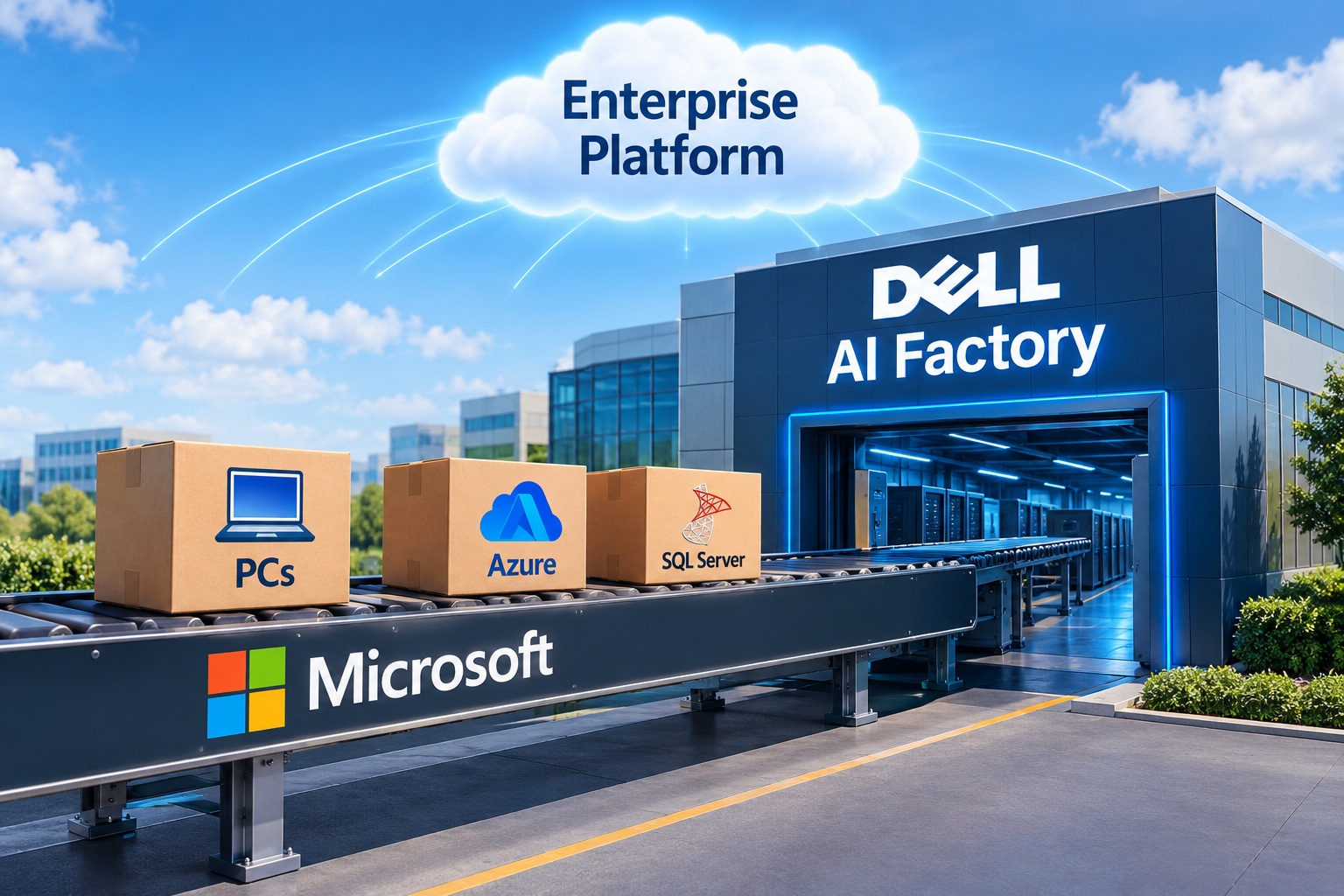
How can software and cloud giant Microsoft Corp. translate its platform vision into fully deployed enterprise architecture in the age of AI?
This central question has defined the next chapter in a decades-long partnership between Microsoft and Dell Technologies Inc. Dell provided some answers at this year’s Dell Technologies World by expanding its private cloud offering to deploy the latest Microsoft software implementations.
Since that event, Microsoft has worked to enable a disaggregated architecture, simplifying operations across Dell PowerEdge compute, Dell PowerStore storage and Azure Local. Flexibility is the key attraction for enterprise customers evaluating Dell and Microsoft’s joint solutions, according to Paul Nashawaty, principal analyst at theCUBE Research.
“Microsoft and Dell are moving beyond infrastructure partnerships to deliver a more integrated go-to-market strategy for enterprise AI, hybrid cloud and application modernization,” he said. “Since Dell Technologies World in May, the focus has been on connecting Microsoft Azure Local, SQL Server and hybrid-cloud capabilities with Dell’s automation platform and enterprise infrastructure to help customers deploy, govern and operate AI workloads wherever their data resides.”
This feature is part of SiliconANGLE Media’s exploration of the architectural shifts powering continuous, production-grade AI. Be sure to check out theCUBE’s “Dell AI Data Platform Event: From Ambition to AI at Scale,” and past coverage of this year’s Dell Technologies World. (* Disclosure below.)
Integrating enterprise architecture from hardware to workload
The market opportunity for both Dell and Microsoft centers on the need to operationalize AI applications. Meeting this goal requires integration across the full AI deployment lifecycle.
Dell Automation Platform and Dell Private Cloud provide an operational backbone for deploying Azure Local on-premises and managing the hardware lifecycle, including firmware and updates. Azure Arc provides consistent management across environments. SQL Server can be run in virtual machines or Kubernetes containers without learning separate skill sets for cloud and on-premises environments.
“The key architecture for AI capabilities is integrating with things like embedding models for vector searching or chat completion models for AI agents, but we do it all inside … the SQL Server Engine,” Bob Ward, principal architect at Microsoft, told theCUBE. “We [formed a] partnership with Dell so that we can connect to anything on premises. I can connect to Azure Local, Dell [and] Nvidia Factory. We just got a framework built in. It doesn’t matter where you’re running these AI models; we can easily integrate with it.”
A central element of Dell and Microsoft’s partnership involves integrating database, automation and hybrid cloud capabilities into a stack that can feed AI the data it needs. Data fragmentation is often cited as a top blocker to scaling AI beyond pilots, and integrating the two companies’ services addresses a pressure point that surveys have identified across enterprise information technology.
Data fragmentation remains a barrier to scaling AI beyond pilots. Dell and Microsoft’s partnership brings database, automation and hybrid cloud capabilities into a common stack.
“From an AppDev perspective, that integration matters because the challenge is no longer simply building AI applications, but operationalizing them securely, consistently and at scale,” said Nashawaty. “TheCUBE AppDev Research highlights the execution gap: Approximately 88% of AI pilots fail to reach production, while 64% of enterprise AI teams identify integration complexity as a leading barrier to adoption.”
Delivering AI for real-world outcomes
Dell’s partnership with Microsoft also extends to unstructured data storage. The two companies are bringing familiar storage capabilities into hybrid and multicloud environments.
Dell PowerScale for Microsoft Azure brings Dell’s OneFS file system software into Azure as a managed storage service. Customers can provision file storage directly from the Azure portal while retaining familiar PowerScale management capabilities.
The solution supports a wide range of production workloads across industries. These industries increasingly depend on high-throughput, low-latency file access to drive the next generation of agentic AI and advanced analytics. Media and entertainment firms can use it to handle massive video files, real-time editing and tight production timelines. Semiconductor and electronics design houses can accelerate simulation and modeling using large datasets.
“This isn’t really about running the software just in the cloud,” said Rachna Lalwani, senior consultant, director and product manager at Dell, in an interview with theCUBE. “It’s about creating a truly integrated experience that empowers businesses to do more with their data. What they really gain is the operational consistency across their entire storage landscape.”
Integrating agents with PCs
A recent IDC analysis found that 95% of enterprises already run at least one AI agent workflow in production, and it predicted 2.5 billion agents by 2030. With the rise of agentic AI, Dell and Microsoft are collaborating on solutions designed to help enterprises deploy autonomous agents while controlling costs.
Managing the cost of tokens, the fundamental units of data processed by large language models, is one of AI’s financial challenges. To help address it, Dell introduced Deskside Agentic AI in May in collaboration with Microsoft and Nvidia Corp., providing a local environment for building and testing AI agents.
“What’s resonating with customers right now is that the cost of tokens is through the roof,” explained Jon Siegal, senior vice president of Dell portfolio marketing at Dell. “We know even though the cost of a token has come down pretty dramatically, the amount of tokens that are being consumed right now is just astronomical. The cloud costs are just pretty high right now. How do customers balance that out and run the right workload in the right place? We’re trying to give customers a place to start. The PC is a great place to start.”
In early October, Dell announced an expansion of its Windows PCs and workstations for agentic AI. In partnership with Microsoft, Dell broadened its AI development portfolio to provide creators, developers and enterprises with more choice in how they build, test and scale agentic AI on Windows.
This marked a key step in the evolution of Windows, where the platform has evolved into a broader resource for agentic AI. Tools such as Windows AI Foundry give developers a structured path to build, package and scale agents inside a governed environment.
“With Windows, we’re going beyond just it being an operating system — we’re thinking about it as really a canvas for AI,” said Mary Ann Anderson, worldwide marketing director of Dell partnerships at Microsoft. “Pretty soon there’s going to be a point where individual employees are managing their own agents, maybe a small army of agents. You have to do that in a way that is governed and is very secure.”
Dell and Microsoft see a significant market opportunity in closing the gap between AI development and production deployment.
“Microsoft and Dell have an opportunity to address that gap by simplifying deployment, automating infrastructure operations and giving partners repeatable solutions they can take to market,” said theCUBE Research’s Nashawaty. “The real measure of success will be whether their combined ecosystem helps enterprises move from AI experimentation to production-ready applications with stronger governance, predictable costs and measurable business outcomes.”
(* Disclosure: TheCUBE is a paid media partner for the Dell AI Data Platform Event. Neither Dell, the sponsor of theCUBE’s event coverage, nor other sponsors have editorial control over content on theCUBE or SiliconANGLE.)
Support our mission to keep content open and free by engaging with theCUBE community. Join theCUBE’s Alumni Trust Network, where technology leaders connect, share intelligence and create opportunities.
- 15M+ viewers of theCUBE videos, powering conversations across AI, cloud, cybersecurity and more
- 11.4k+ theCUBE alumni — Connect with more than 11,400 tech and business leaders shaping the future through a unique trusted-based network
Founded by tech visionaries John Furrier and Dave Vellante, SiliconANGLE Media has built a dynamic ecosystem of industry-leading digital media brands that reach 15+ million elite tech professionals. Our new proprietary theCUBE AI Video Cloud is breaking ground in audience interaction, leveraging theCUBEai.com neural network to help technology companies make data-driven decisions and stay at the forefront of industry conversations.



