

Original Coverage & Source Attribution: www.thehindu.com
On October 12, NATO’s top military commander issued a stark warning to Russia. General Alexus Grynkewich, NATO’s Supreme Allied Commander Europe, said that if Moscow were “foolish enough” to attack an alliance territory, NATO would destroy “anything and everything” involved in the attack.
His remarks came at a time of rising tensions between Russia and European nations. And one country that finds itself under pressure on the hot Russia-NATO border is the tiny Estonia.
When the U.S., Canada, and 10 other European nations came together in 1949, in the early phase of the Cold War, to form the North Atlantic Treaty Organization (NATO), they had a clear goal. As Lord Hastings Lionel Ismay, the alliance’s first Secretary General, famously put it, the purpose was to “keep the Soviet Union out, the Americans in, and the Germans down.”
Throughout the Cold War, NATO had been the primary military bulwark against Soviet power in Europe. After the disintegration of the Soviet Union in 1991, Russia fell into a phase of strategic retreat, while NATO expanded towards Eastern Europe. This set the stage for renewed tensions once Russia started reasserting itself in the region.
The situation became even more complicated after Russia annexed Crimea in 2014 and launched its invasion of Ukraine in February 2022.
Ukraine was offered NATO membership in 2018, but it never became a member. So it’s not covered by NATO’s Article 5 collective defence, but in its war with Russia, Kyiv is getting military support from NATO members.
The war has also prompted European states lately to raise concerns over Russia’s grey-zone activities. These include cyberattacks, sabotage, disinformation, and electronic interference.
A sensitive border city
Grey-zone activities are designed to put pressure on a country without necessarily triggering an open military conflict. Moscow has denied these allegations.
These concerns have become particularly important in the Baltic region, where fears are growing that Russia could attempt to spread instability beyond Ukraine without launching a full-scale invasion of another European country. This leaves Estoinia in a vulnerable position. Located in northeastern Europe, Estonia, formerly part of the Soviet Union, shares border with Russia and sits along NATO’s eastern flank. The country became independent after the Soviet Union collapsed in 1991.
It joined NATO in 2004, upsetting Moscow.
A small country bordering the Baltic Sea to its west and Russia to its east, Estonia sits in an unenviable location. Its proximity to Russian territory means that any military movements, border incidents, and developments in the surrounding region can have immediate consequences for its national security. Estonia is not alone in facing these challenges. Latvia and Lithuania also sit on NATO’s eastern flank, while Finland, a recent NATO member, shares a long land border with Russia.
For a country of around 1.3 million people, covering approximately 45,000 sq. km, Estonia risks getting caught between Russia and NATO is the crisis escales into conflict.
According to a report in the Financial Times, Russian state media has always portrayed Estonia as a hostile, “Russophobic” country seeking confrontation with Moscow. Russian officials have issued warnings about NATO’s military presence in the Baltic region.
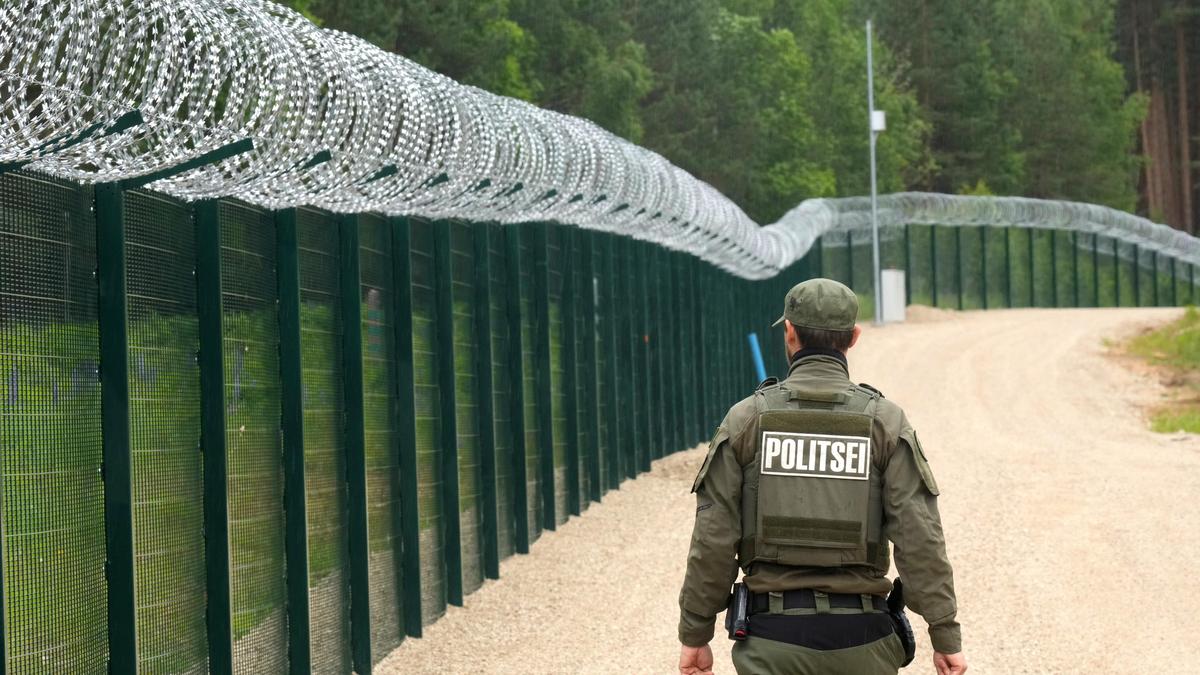
One location attracting particular attention is Narva, an Estonian city on the Russian border, separated from the Russian city of Ivangorod by the Narva River. Its geographical position makes it important to Estonia’s border security. The city also has a predominantly Russian-speaking population.
Estonian officials fear that Moscow could attempt to exploit local tensions or use disinformation to create pressure on the country. The question for Estonia now is how to prepare for the possibility of the worst.
‘Active’ defence strategy
The Estonian government introduced the concept of “active defence” into its national security planning in 2026.
Since then, the country’s small military has begun a major reorganisation, shifting away from a strategy that could allow Russian forces to advance into Estonian territory before a counter-attack.
From Tapa, one of Estonia’s main military bases, troops are being redeployed further east, closer to the Russian border.
A new military facility is being developed in Jõhvi, while another base is being built in Narva itself.
According to the Financial Times, the planned Narva facility is designed to house around 200 soldiers, with space for up to 1,000 during a crisis.
Estonia has also begun shifting towards a strategy designed to prevent an adversary from gaining territory in the first place.
Rather than relying on a later counter-attack, its forces would attempt to engage Russian troops from the beginning of an invasion while using longer-range weapons to strike military targets behind the front line.
Col. Tarmo Kundla, commander of the Estonian First Brigade, has explained the thinking behind this approach. In simple terms, he said, Estonia wants to stop an invading force from gaining ground rather than allowing it to advance and then attempting to take back the territory later (a lesson learnt from the war in Ukraine).
Adding to this is Estonia’s military spending and weapons purchases. Estonia’s defence spending is set to rise by 42% in 2026, reaching €2.4 billion, or around 5.4% of its GDP.
The country has also signed contracts to acquire nine U.S.-made HIMARS rocket launcher systems and nine South Korean Chunmoo systems. This includes M57 ballistic missiles with a reported range of up to 300 km. This is significant because St. Petersburg, one of Russia’s largest cities, lies approximately 260 km from Estonia.
Depending on the weapon used and the target involved, these systems could put military targets deep inside Russian territory within striking distance. Coming to Estonia’s manpower, the country has a trained reserve force of up to 2,30,000 people, while its permanent standing forces comprise around 4,200 personnel.
Estonia cannot defend itself entirely alone. The country does not have its own conventional combat air force and relies on NATO allies for air policing and the wider protection of its skies. Hence, it cannot be separated from the role of NATO in its military preparations.
The U.K. has maintained a military presence in Estonia as part of NATO’s forward defence. The Financial Times reports that Britain has committed to increasing its deployment from around 800 to 1,200 troops by April 2027. These deployments are intended to strengthen deterrence by making clear that an attack on Estonia could involve forces from other NATO members from the beginning of the conflict.
Estonian officials have expressed concerns about the possibility of a future conflict, but they are also preparing for the risk of a smaller attack designed to test the alliance’s response.
“I’m not sure if we can deter the mad person. What we have to do is to prepare,” said Gen. Martin Herem, former Commander of Estonian Defence Forces and current Defence Minister, earlier this month. “And that’s the only thing. We have to prepare very seriously [for an attack], and in doing so, we may prevent it.”
(Smriti Sudesh is a postgraduate student at SOAS University of London)



