

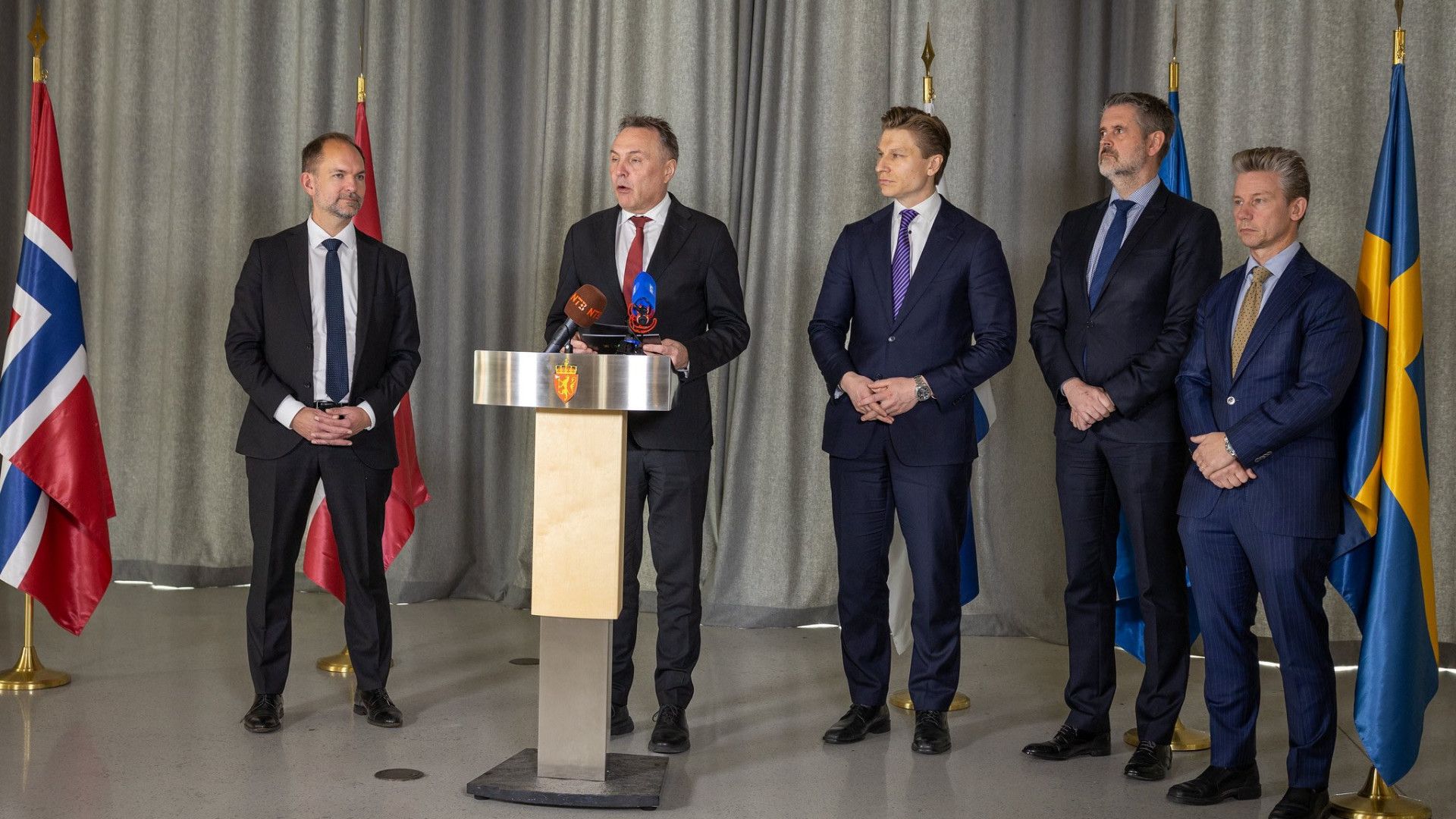
Original Coverage & Source Attribution: defence24.com

Photo. @PlJonson / X.com
The five Nordic countries are moving towards closer military integration within NATO. Denmark, Finland, Iceland, Norway and Sweden have agreed to begin drafting a Nordic Defence Cooperation Agreement (NDCA), intended to strengthen their collective defence capabilities and remove obstacles to joint military operations.
The decision, announced on 12 November 2026 following a NORDEFCO ministerial meeting in Oslo, comes as the Nordic and Baltic countries assume an increasingly important role in NATO’s efforts to deter Russia. Together, they form a crucial part of the Alliance’s defence across Northern Europe, the Baltic Sea and the Arctic.
Nordic defence cooperation is entering a new chapter. At the NORDEFCO meeting in Oslo, we agreed to start developing a Nordic Defence Cooperation Agreement (NDCA). We already cooperate closely, but a stronger legal framework will allow us to do much more together. (1/3) https://t.co/JTnxPMI576
— Pål Jonson (@PlJonson) November 12, 2026
The proposed agreement is intended to establish a stronger legal framework for military cooperation, including cross-border troop movements, joint operations and logistical support. It will not create a separate military alliance, and no new treaty has yet been signed. Nevertheless, the initiative reflects a fundamental change in Northern European security. Finland joined NATO in 2023, followed by Sweden in 2024, bringing all five Nordic countries into the Alliance.
According to Norwegian Defence Minister Tore O. Sandvik, the region now possesses approximately 250 modern combat aircraft, nearly 145 surface vessels and around 100,000 military personnel in peacetime. These figures represent the combined national capabilities of the five countries, rather than a single integrated military force.
The transformation is already visible within NATO’s command structure. Since December 2025, all five Nordic countries have fallen under Joint Force Command Norfolk, strengthening coordination between the Arctic, North Atlantic and Northern Europe. NATO has also established a Multi-Corps Land Component Command in Mikkeli, Finland, and a Combined Air Operations Centre in Bodø, Norway. Sweden is developing an allied logistics command, while Denmark contributes to regional special operations structures. These arrangements are intended to improve NATO’s ability to plan and conduct coordinated military operations across national borders, particularly in a potential confrontation with Russia.
The significance extends beyond the Nordic countries themselves. Estonia, Latvia and Lithuania are equally important to NATO’s defence against Russia, particularly in the Baltic Sea region. The Nordic and Baltic countries occupy a geographically connected area stretching from the Arctic and Finland’s eastern border to the Baltic Sea and NATO’s northeastern flank. Sweden’s territory, including Gotland, is particularly important for controlling access to the Baltic Sea, while Denmark plays a major role in securing the maritime approaches connecting it to the North Sea.
Finland’s long border with Russia and the Baltic states’ exposure to Russian and Belarusian military pressure make close military coordination indispensable. Although the Baltic countries are not members of NORDEFCO, their cooperation with the Nordic states through NATO and the Nordic-Baltic Eight (NB8) format is increasingly important. In June 2026, the eight governments reaffirmed their commitment to strengthening defence cooperation and supporting Ukraine.
Military integration is also being accompanied by industrial expansion. The Nordic countries are working towards tripling their ammunition production capacity by 2030, a target established in 2023 and reaffirmed during the Oslo meeting. The defence ministers stated that progress remains on schedule, although detailed production figures have not been disclosed. Cooperation also covers joint procurement of unmanned aircraft, air-to-air refuelling and military mobility. In October 2025, Finland, Sweden, Norway and Denmark agreed to coordinate drone procurement, while separate arrangements have strengthened their participation in NATO’s multinational tanker transport capabilities. These initiatives address practical weaknesses that could become decisive during a prolonged conflict.
The Oslo meeting also demonstrated that defence cooperation is no longer limited to the armed forces. For the first time, NORDEFCO defence ministers held a joint ministerial meeting with representatives responsible for civilian preparedness under the Haga cooperation framework. The discussions included societal resilience, civil-military coordination and preparations for major crises. This matters because a confrontation with Russia would not be limited to conventional military operations. Cyberattacks, sabotage, disruption of critical infrastructure and pressure on transport networks could undermine the ability of NATO forces to operate effectively. Military capabilities must therefore be supported by functioning civilian institutions, reliable infrastructure and secure supply chains.
The Nordic initiative should be understood as part of NATO’s broader transformation rather than an attempt to establish an alternative defence structure. The five countries are seeking to reduce legal and administrative barriers that could delay military deployments during a crisis. Their expanding cooperation with Estonia, Latvia and Lithuania is equally important, particularly given Russia’s continued military activities in the Baltic region and the High North. However, deeper integration will only be meaningful if the participating countries can translate political commitments into common planning, sufficient ammunition stocks, effective command arrangements and forces capable of operating together.
For NATO, the main development is not simply the prospect of another defence agreement. It is the emergence of a more integrated northern region capable of contributing directly to the Alliance’s collective defence. The Nordic and Baltic countries are indispensable to deterring Russia, protecting the Baltic Sea and securing NATO’s northern approaches.



