

Original Coverage & Source Attribution: timesofindia.indiatimes.com
It is a joy to pick up and play with
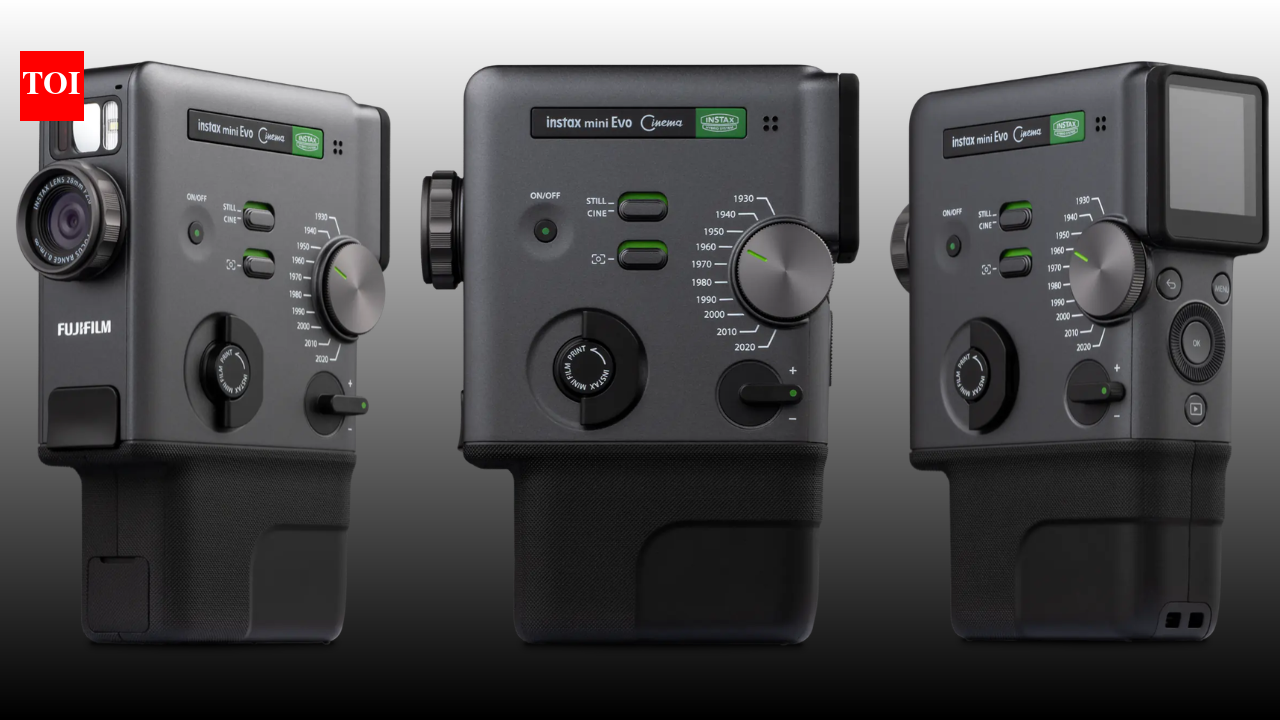
Nothing about the Evo Cinema is held the way a camera usually is. It stands upright like an old cine camera, three fingers curled around a stubby grip and the index finger resting on a trigger tucked under the lens. Squeeze, and it records. Let go, or hit 15 seconds, and it stops. At 270g, in dark grey with small green accents, it looks far more grown-up than the pastel Instax cameras most people know. Fujifilm also puts two small accessories in the box that make a real difference: a grip extension that screws into the tripod socket and gives the little finger somewhere to rest, and a magnetic eyepiece that clips over the rear screen. Snap the eyepiece on, raise the camera to your eye, and for a moment it feels less like a new gadget and more like something that lived in a cupboard at your grandparents’ place.People notice it, and they want to hold it before they even ask what it does. That rarely happens with a new phone.The dial on the left is where the evening disappears. Turn it to the thirties and the little screen flickers into black and white, with scratches drifting across the frame. The fifties look like an early television broadcast, and the sixties wash the colours out as sprocket holes creep in along the edges. The eighties stamp an orange date in the corner, just like the prints from the neighbourhood photo studio, while the nineties bring back the wobbly, slightly smeared look of a tape camcorder. The 2000s borrow the blocky on-screen icons of an early digicam, and the 2010s go as far as a livestream-style overlay. Even the audio plays along, muffling voices and adding the whirr of a film reel in the older decades, and in a few of them, a quick shake of the camera throws in glitches from that era. A ring around the lens dials each look up or down across ten levels, which makes for a hundred variations, and a small switch adds frames to suit the decade.So everything gets filmed. A desk. A street corner. A cup of chai in faded 1940s colour, then a friend laughing through a nineties haze, each clip in a different decade simply because turning the dial is that much fun.Printing comes with its own little ritual. There is no button; a lever folds out of the side and needs a firm quarter twist, much like winding film through a cine camera, before an Instax Mini print slides out of the top. It serves no practical purpose and it is satisfying every single time.Freeze a clip, print a frame, and the camera can add a QR code in the corner that plays the full video for anyone who scans it. The clip is uploaded through the Instax app and stays on Fujifilm’s servers for two years, and the same app can stitch a few clips into a 30-second short with a title card up front. Pass one of those prints across the table at a house party and watch the phones come out.
The footage is made for the moment
On the Evo Cinema’s own 1.54-inch screen, every clip looks wonderful, and that screen is small enough to be generous. Play the same clips on a phone and they turn noticeably softer, which is what 600×800 pixels from a 1/5-inch sensor will do. The older decades carry it off with ease, since grain and blur are part of their charm anyway. The cleaner settings from 2000 onwards are a little less forgiving, and 2020, with no effect at all, is the most honest of the lot. That last one does get a higher-quality 1080×1440 mode, though it only works with a microSD card inside and has to be switched on from the menu.Because the camera is built to be held upright, video comes out in a tall 3:4 frame. Turn it sideways for a wider shot and the TV-style scan lines of the older decades turn sideways with it. The zoom is digital too, and it moves in small steps that show up if you use it mid-clip.It has a few other habits worth knowing about. Waking up takes a few seconds, and so does every turn of the dial, so hopping between decades comes with a short pause each time. Every clip ends with a keep-or-discard prompt that is easy to skip past in the rush to the next shot. The decade you pick stays baked in for good, the small built-in microphone is fine for voices up close and not much further, and the internal battery prefers short outings; an evening of shooting followed by transfers to the phone is usually enough to run it down.None of it takes much away while you are out with the camera. These clips are at their best right then, passed around on that tiny screen while everyone is still laughing.
Evo Cinema’s charm lives in the little rituals
Once the first rush settles, it gets easier to see where the Evo Cinema’s charm really comes from. Set the dial and the lever aside for a moment, and a large part of it rests on the filters. They are some of the most thoughtful Fujifilm has made, and a real dial beats a slider on a screen every time. Phones, though, have offered VHS, Super 8 and film grain looks through editing apps for years, along with sharper video, no clip limit and an untouched original to fall back on. Once posted, both clips sit side by side in the same Instagram story.That is probably why, after the first day, the Evo Cinema slowly made its way from the bag to the desk and eventually into a drawer. Nothing went wrong with it; the phone was simply already in hand, and happy to do most of the same work.Printing is the one thing that keeps pulling it back out, and it is also where the Evo Cinema quietly does its best work. The app sends photos from your phone straight to the built-in printer, and since a phone captures far more detail than the camera’s own 5-megapixel sensor, those prints often look better than the ones shot on the Evo Cinema itself. The QR code is a delightful idea as well. Even so, Fujifilm’s standalone Instax printers cover much of the same ground for less.Then there is the price. Fujifilm has set the Mini Evo Cinema at Rs 47,999 before a single pack of film, the most it has ever asked for an Instax camera, and about what a well-kept older iPhone sells for these days. Still photos and printing from a phone are part of the deal, and they help, just not quite enough to close that gap.None of that takes away from what Fujifilm has built. The Evo Cinema is thoughtfully designed, more charming than almost anything else on the shelf, and nearly impossible to hand over without getting a smile back. Most of that magic, though, lands on day one, in the trigger, the lever, the dial and the first print sliding out. For anyone who grew up loving Instax prints and has something set aside for a purely joyful purchase, it will bring a lot of happiness.For most others, the phone in their pocket has been doing much of this for years, just with a little less ceremony.



