


Original Coverage & Source Attribution: www.pewresearch.org
About this research
This Pew Research Center report looks at Americans’ ratings of 18 G20 member states on a “feeling thermometer”.
Why did we do this?
Pew Research Center does research to help the public, media and decision-makers understand important topics. These questions build on our long history of tracking the global image of countries around the world.
Learn more about Pew Research Center.
How did we do this?
For this report, we surveyed 5,193 adults from Sept. 14 to 20, 2026. Everyone who took part is a member of the Center’s American Trends Panel. The survey represents the views of the full U.S. adult population.
We asked each respondent to rate a random selection of four of 18 possible countries on the “feeling thermometer”. The sample information for the people asked about each country is available in the survey methodology.
Here are the survey questions used for this report, along with the detailed responses.
As the United States prepares to host the annual G20 summit this December, Americans express a wide range of views about the other member countries, according to a new Pew Research Center survey.

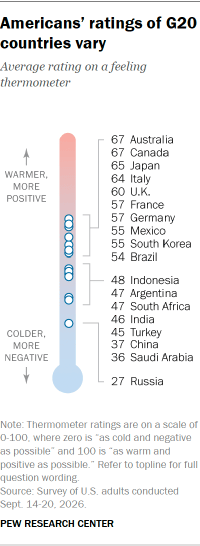
We asked Americans to rate 18 member countries of the G20 on a “feeling thermometer” ranging from zero to 100, where:
- Zero means they feel as cold and negative as possible.
- 50 means they don’t feel particularly positive or negative.
- 100 means they feel as warm and positive as possible.
Feelings are warmest toward Australia, Canada, Japan and Italy, with average thermometer ratings in the mid- to high-60s.
A handful of other countries – the United Kingdom, France, Germany, Mexico, South Korea and Brazil – also get positive ratings.
Americans give Indonesia, Argentina, South Africa, India and Turkey slightly cooler average ratings, ranging from 45 to 48. These countries also receive some of the highest shares of “neutral” views (a 50 on the thermometer).
China and Saudi Arabia are rated fairly poorly at 37 and 36, respectively. Still, Russia sits well below the rest, with an average rating of 27.
Continue reading for more detailed ratings of each country, or jump to:
- Ratings by party: Democrats and Democratic-leaning independents rate most countries more warmly than Republicans and Republican leaners do.
- Ratings by age: Younger and older Americans’ views of some G20 countries are similar. Where they differ, younger adults tend to offer warmer ratings.
- How ratings have changed over time: Views of some countries – including Japan, Mexico and China – have warmed in recent years, while views of Canada, India, Russia and the U.K. have cooled slightly.
What is a ‘feeling thermometer’?
“Feeling thermometer” questions ask people to rate something, in this case a country, on a scale ranging from zero (“as cold and negative as possible”) to 100 (“as warm and positive as possible”). With 101 points on the scale, respondents can offer a precise rating. Researchers also have more variation they can use for analysis, and the ability to look at both frequencies (the share that says 0, the share that says 0 to 24, etc.) or at average ratings.
The average ratings shown throughout this report are means, weighted to be representative of U.S. adults. Each excludes those who did not answer the question.
Pew Research Center has long measured Americans’ views of other countries, typically asking people if they have a very favorable, somewhat favorable, somewhat unfavorable or very unfavorable view. Where we have comparable data from recent years, the results from the feeling thermometer show the same story as the four-point favorability scale. For instance:
- Views of China are more negative than positive but have warmed slightly over the last five years.
- Views of Russia are overwhelmingly negative.
- Views of Canada are mostly positive and warmer among Democrats than Republicans.
Warm and cold views
Another way to think about feeling thermometers is to look at the share of Americans whose scores fall into different ranges: ratings of zero to 24 are very cold, ratings of 25 to 49 are somewhat cold, ratings of 50 are neutral, ratings of 51 to 75 are somewhat warm and ratings of 76 to 100 are very warm.

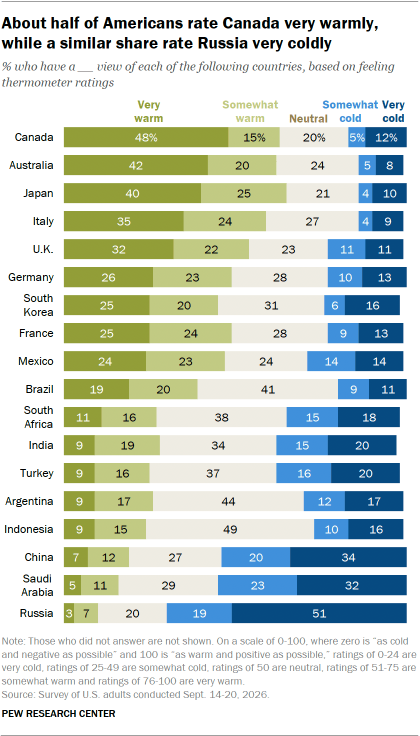
From this angle, Americans’ views of Canada stand out. Around half (48%) give their northern neighbor a very warm rating – the largest share in the survey.
Many also give Australia, Japan, Italy and the U.K. a warm rating. And views of Brazil, France, Germany, Mexico and South Korea are also more warm than cold.
Conversely, ratings for China, India, Russia, Saudi Arabia, South Africa and Turkey are more cold than warm. But these countries fall into two distinct groups: India, South Africa and Turkey are just as likely to get neutral ratings as cold ones, while a majority of Americans have a negative opinion of China, Russia and Saudi Arabia.
Russia stands out for its especially icy ratings: 51% of Americans have a very cold view of the country, significantly more than the third or so who have very cold views of China and Saudi Arabia. This pattern is also reflected in the shares who give each country a zero on the feeling thermometer (23% for Russia, 14% each for China and Saudi Arabia).
Argentina and Indonesia get more neutral ratings than positive or negative ones. But in both cases, the shares of Americans with very cold views, though relatively small, are significantly larger than the shares with very warm views.
Ratings by party
Republicans and Democrats differ in their feelings toward many, but not all, G20 countries.

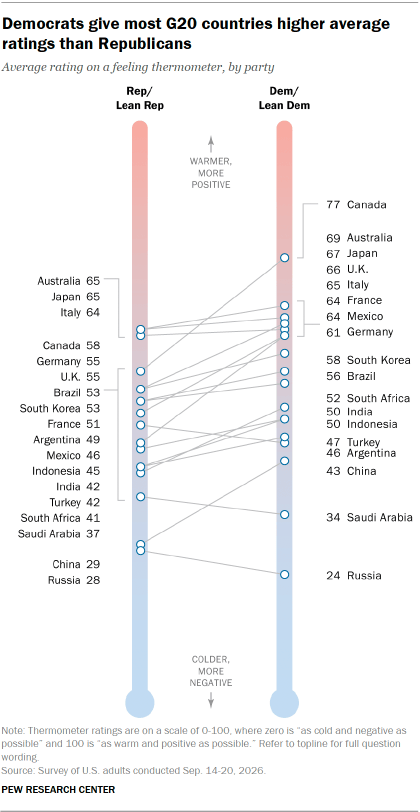
Generally, Democrats and Democratic-leaning independents are more likely than Republicans and Republican leaners to rate other countries positively. This is true of Australia, Canada, China, France, Germany, India, Indonesia, Mexico, South Africa, South Korea, Turkey and the U.K.
Some of the widest partisan gaps appear in ratings of U.S. neighbors. Democrats’ mean ratings for Canada and Mexico are a respective 19 and 18 points higher than Republicans’. Indeed, Canada stands out as Democrats’ most positively rated country, but it ranks below Australia, Japan and Italy in Republicans’ estimations.
Russia stands out as the only country that Republicans feel more warmly toward than Democrats. Though it still receives some of the coldest ratings in each party, there is an 8 percentage point difference in the shares with very cold views of Russia (48% of Republicans vs. 56% of Democrats rate it this way).
Ratings by age
Ratings of G20 countries are more similar than not across age groups. But Americans ages 18 to 49 give six members – China, Indonesia, Mexico, Russia, South Africa and Turkey – higher ratings than those 50 and older.

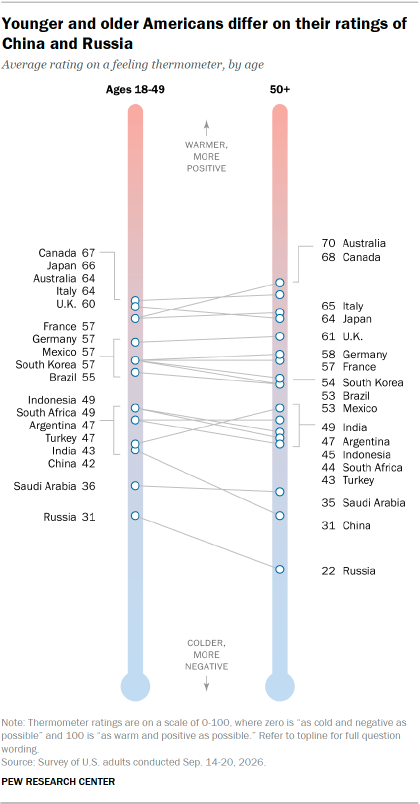
Older Americans only rate Australia and India more positively than younger Americans.
When it comes to the shares with very cold ratings, though, there are also some notable age differences. In particular, adults 50 and older are 15 points more likely than their younger counterparts to offer very cold ratings of Russia and China.
How views have shifted over time
Since 2016, we have asked about eight G20 countries in at least one previous survey. The sections below explore how views of these particular countries have – or haven’t – shifted.
Warming views

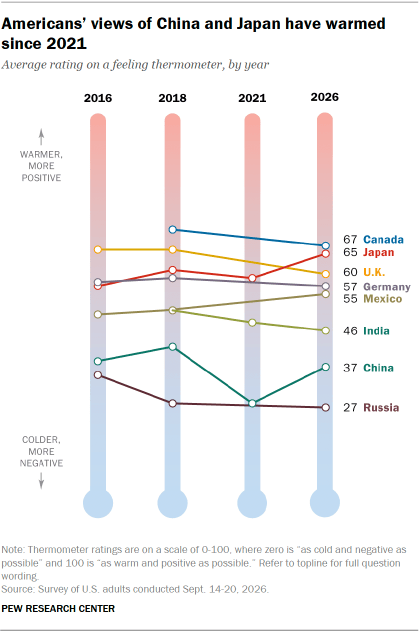
- Ratings of Japan have been more warm than cold for the past decade, but the share with warm views has increased as the shares with neutral and cold views have fallen.
- Opinion of Mexico has warmed since 2016, though a large partisan gap remains.
- Americans’ views of China have improved significantly from their relative low point in 2021 but remain cold overall.
Steady views
- Americans’ views of Germany have changed little over the past decade.
Cooling views
- Views of Canada have cooled slightly, mostly among older Republicans. Democrats’ ratings remain unchanged since 2018.
- While still broadly positive, views of the U.K. have cooled significantly since 2018, driven primarily by shifting views among Republicans.
- Attitudes toward India have cooled as the share with neutral views of the country has fallen.
- Views of Russia have not changed much since 2018 but are significantly more negative compared with 2016 – and the share with very cold views has increased.
Views of Japan
Today, Japan receives an average rating of 65, up from 57 in 2016.

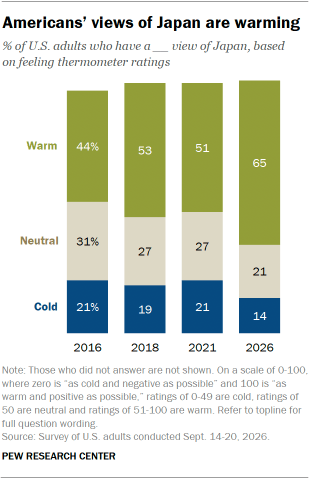
The share of Americans who give Japan a warm rating (51-100) has also increased significantly in this time, from 44% in 2016 to 65% today. Conversely, the shares who give neutral (50) and cold scores (0-49) have fallen.
Warm views have grown among all age groups and across party lines:
- In 2016, 43% of Republicans and 46% of Democrats had a warm view of Japan; today, it’s 66% and 67%.
- In 2016, 44% of adults under 50 had a warm view of Japan, as did 43% of those ages 50 and older; today, it’s 66% and 63%.
Views of Mexico
Americans give Mexico an average rating of 55, up from 50 in 2016. Around half of U.S. adults (47%) have a positive view of Mexico, up from 36% a decade ago.

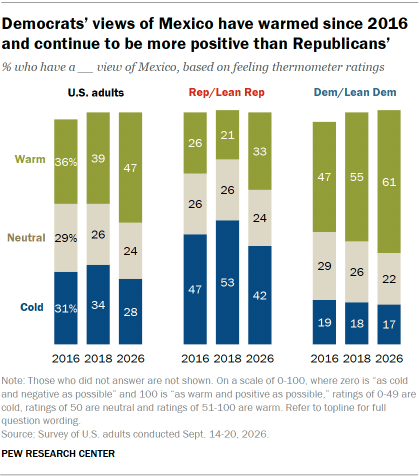
The share of Democrats with a warm views of Mexico has risen since 2016, from 47% to 61%. The share among Republicans has also grown in recent years.
Still, Democrats are about twice as likely as Republicans to say they have a warm view of Mexico – one of the largest partisan gaps across the 18 countries in the survey.
Views of China
Americans now give China an average rating of 37, up from 28 in 2021. Views have warmed among both Republicans and Democrats and among both younger and older Americans, though partisan and age gaps remain.

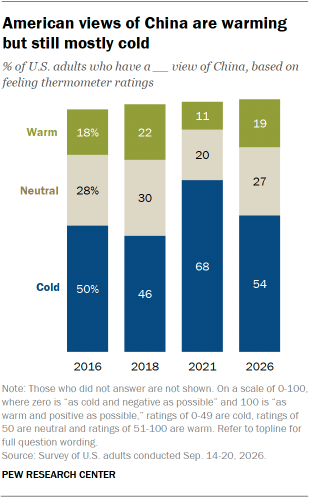
Democrats continue to hold warmer views than Republicans, as do younger adults compared with older ones. For more, read “Americans’ Views of China Have Warmed in Recent Years.”
Views of Germany
Americans’ average ratings of Germany have been fairly steady – and mostly warm – over the past decade. While there has been a very slight increase in the share of Americans who give Germany a cold rating, about twice as many still give the country a warm rating.

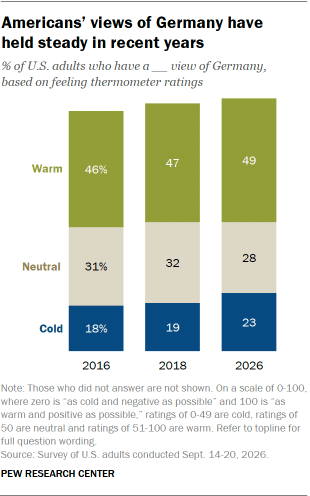
As was the case in 2016, younger and older Americans hold fairly similar views of Germany. Democrats have consistently rated the country more positively than Republicans.
Views of Canada
Since we last asked Americans about Canada, views have cooled slightly: The country receives an average rating of 67 today, down from 71 in 2018.

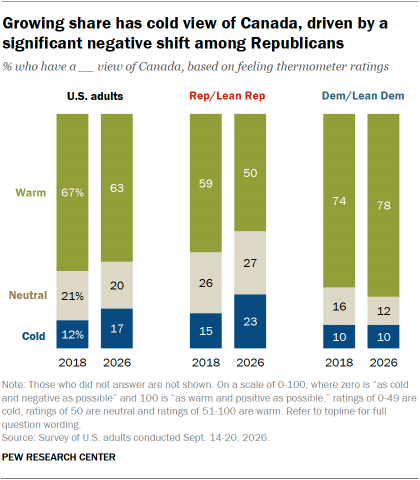
While views are still mostly warm, the share of Americans with a cold view of Canada has grown slightly, from 12% in 2018 to 17% now.
This negative shift is driven by Republicans. In the past eight years, the share of those with a cold view of Canada has grown (from 15% to 23%) while the share with a warm view has fallen (from 59% to 50%)
And it’s older Republicans in particular who are driving the change in overall views: 61% of those ages 50 and up gave Canada a warm rating in 2018, compare with 47% now. Younger Republicans’ views have not significantly shifted.
Related: Republicans’ Views of Some Countries and International Organizations Differ Widely by AgeWidely by Age
Views of Canada among Democrats have not meaningfully shifted in this time. This group remains extremely positive toward Canada – more so than any other G20 country.
Views of the U.K.
Average ratings of the U.K. have fallen over the past decade, from 66 in 2016 to 60 today. (Prior to 2026, this question asked about feelings toward “Britain,” as opposed to “the U.K.”)

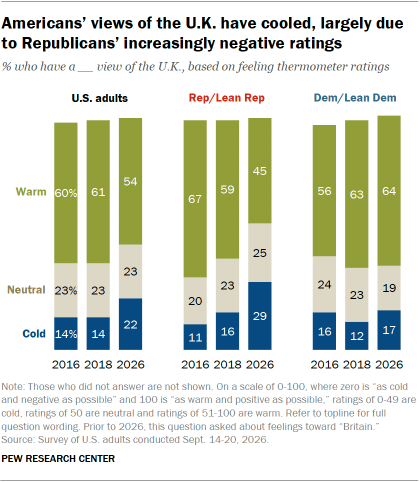
Much of this movement is driven by Republicans, the share of whom with a warm view has dropped from 67% in 2016 to 45% today. Positive views among Democrats, on the other hand, have changed little since 2018, though the share with a warm view is up 8 points since 2016.
While the U.K. was seen more positively by Republicans than Democrats in 2016, today the partisan gap has reversed. Still, more in both parties have warm than cold views.
A decade ago, older Americans were more likely than younger adults to report a warm view of the U.K. (64% vs. 56%). But that age gap has now disappeared, with 54% of adults under 50 and ages 50 and older rating the country warmly.
Views of India
Average ratings of India are now a cooler 46, down from 51 in 2018.
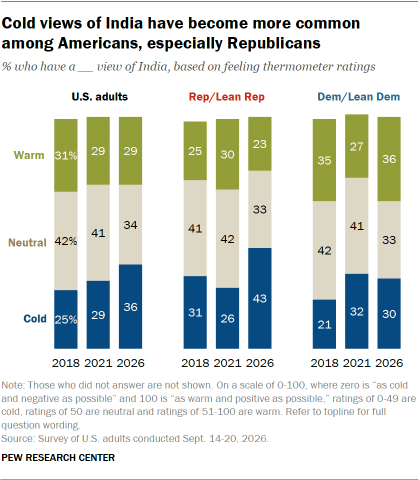
This shift reflects a decrease in neutral views and an increase in cold views, with warm views remaining stable.
Among Republicans, the share with a cold view has increased substantially since 2021, from 26% to 43%. These cold views now outpace warm (23%) and neutral (33%) ones.
Among Democrats, neutral views have fallen since 2018, while cold and warm views have fluctuated:
- The share with a cold view has held largely steady since 2021, but it’s up since 2018.
- The share with a warm view is up since 2021 but largely in line with 2018.
Interestingly, in 2018, similar shares of Americans under 50 and ages 50 and older had cold views of India (23% and 28%, respectively). Today, though, younger Americans have colder views of India than older Americans (41% vs. 30%). India is the only country of the 18 asked about for which this is true.
Views of Russia
Americans give Russia an average rating of 27, broadly unchanged from 2018 and significantly down from an already cool 35 in 2016.

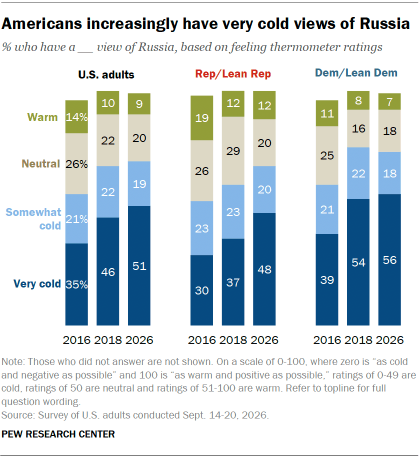
During this same decade, the share of people with a very cold view of Russia has grown, from 35% to 51%.
For Democrats, much of the shift in views of Russia came between 2016 and 2018, when very cold views rose significantly and neutral views fell. For Republicans, the share with a very cold view has continued to climb since 2018. Still, fewer Republicans than Democrats give Russia a very cold rating.



