Original Coverage & Source Attribution: adinaflores.substack.com
SONOMA COUNTY, CALIFORNIA — November 5, 2026
How many times must a defendant raise concerns about judicial impartiality before the Sonoma County Superior Court takes those concerns seriously?
That is the question I am asking as I continue defending myself against a defamation lawsuit filed by Cary Snowden, Michael Irvine, Dawn Holman, and the Boys & Girls Clubs of Sonoma Valley.
The lawsuit, filed December 18, 2024, names both me and Laura Ainsworth as defendants. I maintain that the litigation is retaliatory and that the statements at issue concern matters of legitimate public interest. Those are my positions, not findings the court has made.
Over the course of this litigation, both defendants have questioned the impartiality of judges assigned to our case. We have submitted court filings identifying relationships we believe warrant disqualification, yet the proceedings have continued amid disputed judicial assignments, default proceedings, and questions about how our challenges have been handled.
Most recently, Judge Oscar A. Pardo struck my October 28, 2026 judicial disqualification challenge.
But the controversy goes beyond that ruling.
Why did the court previously characterize my filing seeking mandatory disqualification of Judge Patrick Broderick as a peremptory challenge under California Code of Civil Procedure §170.6?
And why does the court continue assigning my case to Judge Pardo despite my subsequent objections to his impartiality?
I believe these questions deserve public scrutiny.
On July 27, 2026, I filed a document titled Notice of Motion & Motion for Mandatory Disqualification of Judge Patrick Broderick.
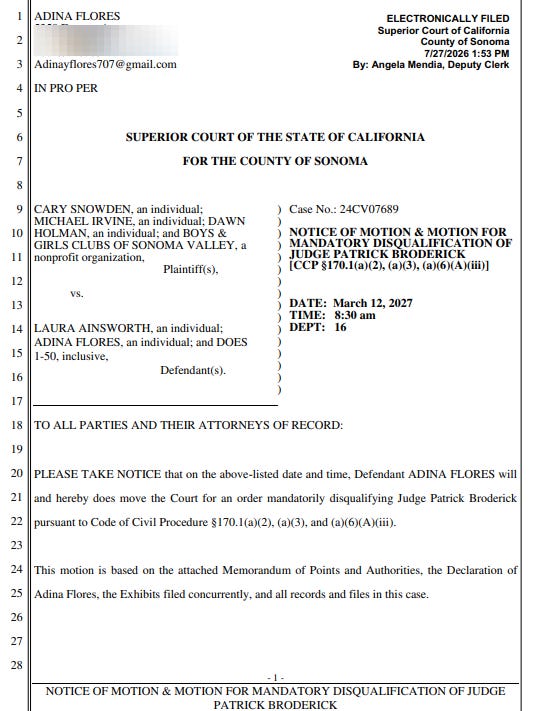
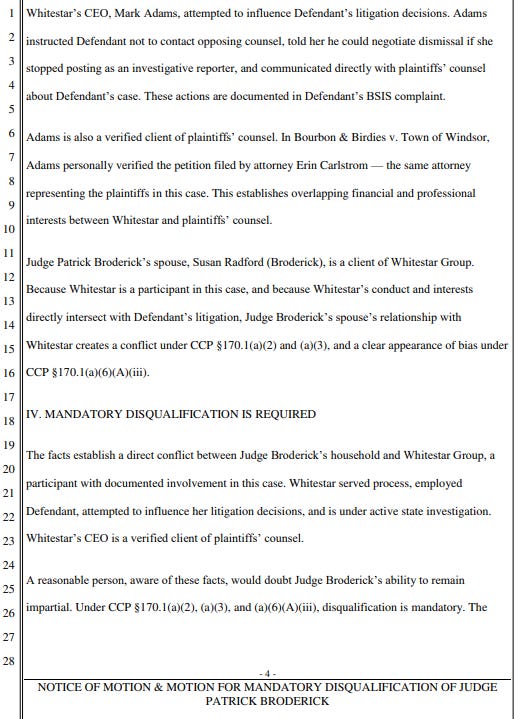
The filing expressly invoked California Code of Civil Procedure §170.1(a)(2), §170.1(a)(3), and §170.1(a)(6)(A)(iii).
My challenge concerned relationships involving Judge Broderick’s spouse, Susan Radford Broderick, and Whitestar Group, a private investigative and security company involved in serving process in my litigation.
I alleged that Whitestar had also employed me during the pending lawsuit and that its CEO, Mark Adams, had attempted to influence my litigation decisions.
I further identified Adams’s relationship with attorneys representing the plaintiffs in my case.
These were not generalized complaints about unfavorable rulings. They were specific allegations concerning relationships and circumstances that, in my view, could cause a reasonable person to question judicial impartiality.
I requested that Judge Broderick be disqualified for cause and that the matter be reassigned to a neutral judicial officer.
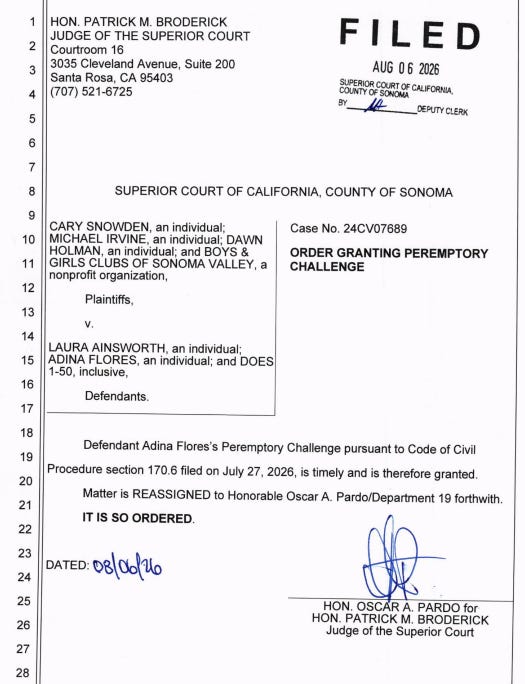
However, on August 6, 2026, the court issued an order titled Order Granting Peremptory Challenge.
The order stated:
“Defendant Adina Flores’s peremptory challenge pursuant to Code of Civil Procedure section 170.6 filed on July 27, 2026, is timely and is therefore granted.”
The case was reassigned to Judge Oscar A. Pardo in Department 19.
The order was signed by Judge Pardo on behalf of Judge Broderick.
That creates an important question: Why was a filing expressly titled as a mandatory disqualification motion under §170.1 resolved as a peremptory challenge under §170.6?
If the court relied on a separate §170.6 challenge contained elsewhere in the record, it should be possible to identify that filing and explain how the court treated my mandatory disqualification allegations.
The distinction matters because the two statutory procedures serve different purposes.
California law provides different mechanisms for challenging judicial assignments.
Under Code of Civil Procedure §170.1, a judge may be disqualified for specified reasons, including circumstances in which a person aware of the facts might reasonably doubt the judge’s impartiality.
This is a challenge for cause.
Section 170.6, by contrast, generally permits a qualifying party to seek reassignment without establishing actual bias or a specific conflict. Such challenges are subject to strict timing and numerical limitations.
A successful §170.1 challenge does not ordinarily consume a party’s §170.6 opportunity.
That is why the classification of my July filing matters.
If my allegations warranted consideration under §170.1, why does the August 6 order address only §170.6?
Was the court granting a separately asserted peremptory challenge? Did it consider my allegations of cause? Was a separate ruling issued on those allegations?
These are questions about the legal record, not merely my dissatisfaction with the judicial officer assigned to my case.
I am asking for an explanation of how the court processed my filing and what legal effect its ruling has on my remaining rights.
Following Judge Broderick’s removal, the case was reassigned to Judge Oscar Pardo.
I subsequently raised concerns about Judge Pardo’s professional relationships, historical affiliations, and connections to individuals and organizations that I believe are relevant to the appearance of impartiality in this litigation.
Among the matters I have questioned are his former association with the Press Democrat editorial board, political and professional relationships involving Sonoma County legal figures, and connections involving attorneys and organizations appearing in my broader investigation.
The existence of a professional relationship does not automatically establish judicial misconduct or legal disqualification. Nevertheless, I believe the cumulative circumstances warrant meaningful consideration under California’s judicial impartiality standards.
On October 28, 2026, I filed another verified statement challenging Judge Pardo.
The court has since struck that challenge.
I dispute that outcome and intend to seek appellate review of the ruling through the appropriate procedure.
The central issue is not whether a litigant should be permitted to remove every judge who makes an unfavorable decision. California law does not provide such an unrestricted right.
The issue is whether a defendant’s properly presented allegations of judicial disqualification are receiving the independent and procedurally appropriate consideration required by law.
From my perspective, the repeated rejection of my concerns has left me effectively compelled to proceed before a judge whose impartiality I have formally questioned.
My concerns about the handling of judicial disqualification challenges did not begin with Judge Pardo.
On April 25, 2025, my co-defendant, Laura Ainsworth, filed a motion to recuse Judge Jane Gaskell.
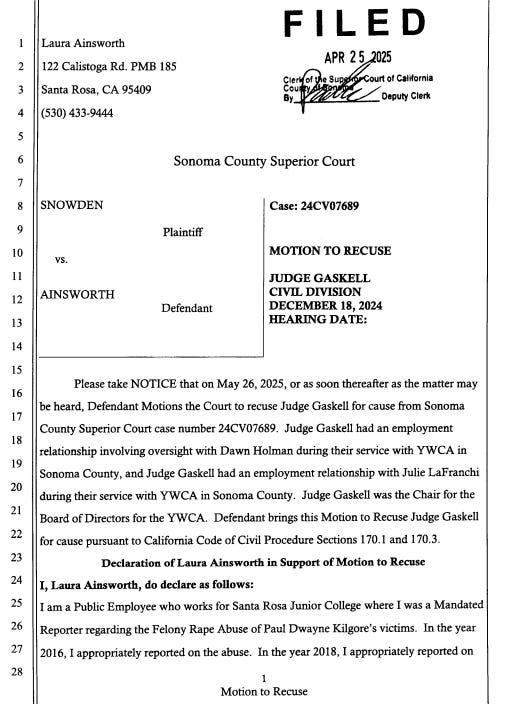
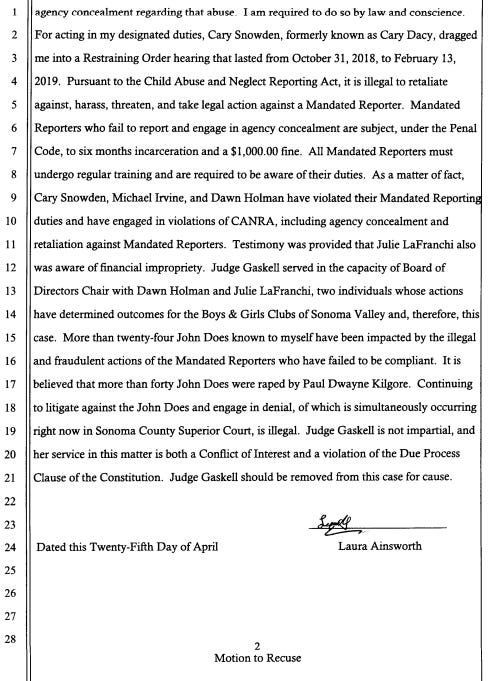
Her filing cited California Code of Civil Procedure §§170.1 and 170.3.
Ainsworth alleged that Judge Gaskell previously held a leadership position with the Sonoma County YWCA during a period when plaintiff Dawn Holman also worked for that organization.
Ainsworth specifically identified Gaskell’s position as chair of the YWCA board and Holman’s involvement with the organization.
She argued that their prior professional relationship created a conflict of interest and undermined confidence in Gaskell’s impartiality.
The court’s docket confirms that a §170.3 challenge concerning Judge Gaskell was filed on April 25, 2025.

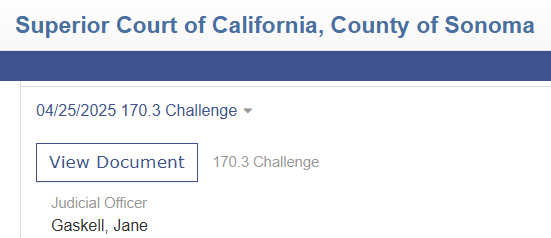
Yet I have not identified a ruling in the materials reviewed that explains how the court resolved Ainsworth’s challenge before subsequent proceedings continued.
That absence deserves clarification.
Was Ainsworth’s challenge accepted, rejected, or determined to be procedurally defective? Did Judge Gaskell file an answer to the allegations? Was the challenge referred to another judicial officer?
These are important questions because judicial disqualification procedures exist to protect the fairness of proceedings, not merely to provide litigants with an opportunity to file objections that receive no meaningful response.
The handling of Ainsworth’s default raises another significant concern.
On September 5, 2025, an entry of default was recorded against her.
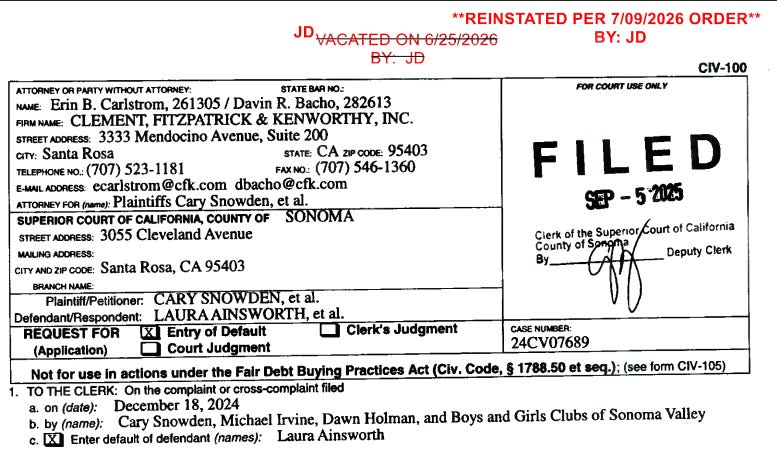
However, on June 25, 2026, Judge Gaskell signed an order vacating the default after a court clerk identified an error.
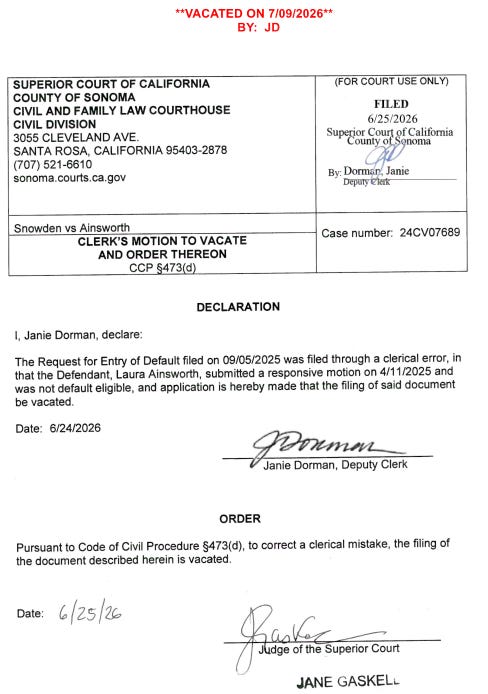
The clerk’s declaration stated that the September 5 default had been entered through clerical error because Ainsworth had submitted a responsive motion on April 11, 2025, and was therefore not eligible for default.
This is especially troubling because Ainsworth had also filed her judicial recusal motion in April 2025.
The court’s own subsequent documentation acknowledged that her default should not have been entered.
To be precise, the available records establish that an erroneous default was entered and later vacated. They do not establish that Judge Gaskell personally directed the original default entry or intentionally disregarded Ainsworth’s recusal challenge.
Nevertheless, the sequence raises legitimate concerns about procedural safeguards for a self-represented defendant.
How did the court permit the default to remain on the record for months when a responsive filing had already been submitted?
And what happened to the judicial disqualification challenge filed before that default?
The matter became even more complicated in July 2026.
On July 21, attorneys for the plaintiffs filed an ex parte application seeking to reinstate Ainsworth’s September 5, 2025 default and vacate the June 25 order correcting the error.
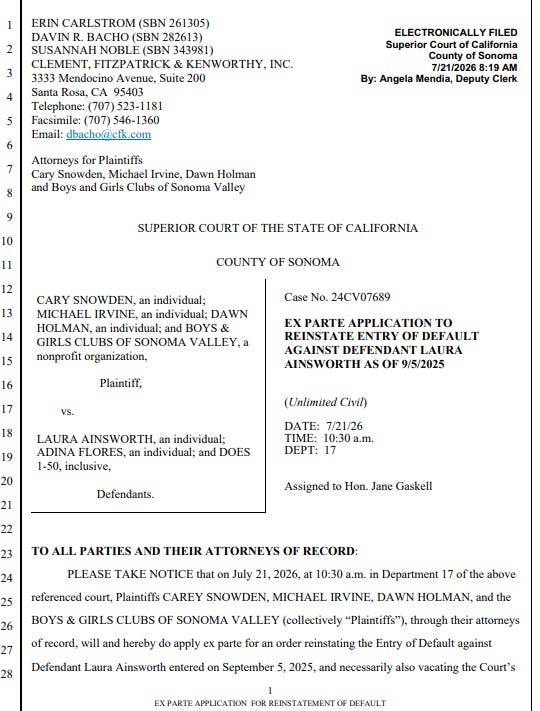
The application was assigned to Department 17, with Judge Gaskell identified as the judicial officer.
This occurred after Ainsworth’s April 2025 challenge and after I had submitted my own judicial disqualification notice concerning Gaskell.
In other words, the plaintiffs were asking the court to revisit a default that court personnel had already identified as erroneous.
They were entitled to present their legal arguments, but the circumstances warrant examination.
Why should a defendant who submitted a responsive motion face renewed efforts to reinstate a default?
And why were proceedings involving Judge Gaskell continuing while questions about her prior professional relationship with a named plaintiff remained disputed?
On July 20, 2026, I filed my own Notice of Judicial Disqualification concerning Judge Jane Gaskell.
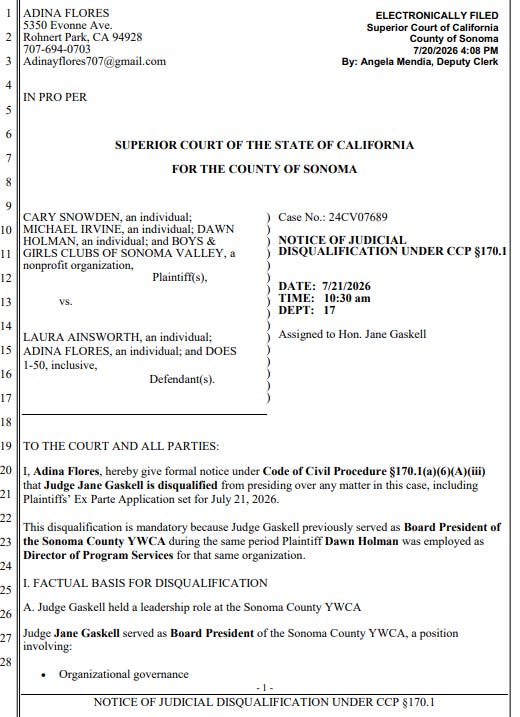
Like Ainsworth, I identified Gaskell’s prior leadership role with the Sonoma County YWCA and Dawn Holman’s employment with the organization.
I argued that the relationship warranted disqualification under Code of Civil Procedure §170.1(a)(6)(A)(iii).
My filing requested that the court cease proceedings before Gaskell and reassign the matter to a neutral judicial officer.
The fact that two defendants independently raised concerns about the same judicial officer and the same organizational relationship should, in my view, have prompted careful review.
Instead, the case has continued through multiple judicial assignments and additional contested orders.
I have also questioned Judge Gaskell’s subsequent involvement in the November 2, 2026 ex parte proceedings, including the timing of an order reflected in the court’s electronic records.
Whether Gaskell had been formally disqualified, had voluntarily recused herself, or was otherwise authorized to act requires examination of the relevant assignment and disqualification orders.
A prior challenge alone does not automatically prove that a judge lacked authority to issue a later ruling. But the court should be able to explain the basis for that authority.
As of November 5, 2026, the court’s public case information continues to identify Oscar A. Pardo as the assigned judicial officer.
My October 28 challenge has been struck.
My earlier mandatory disqualification filing against Judge Broderick resulted in an order granting a peremptory challenge instead.
My co-defendant’s April 2025 challenge to Judge Gaskell remains a subject of unanswered procedural questions.
And the default proceedings involving Ainsworth demonstrate that serious administrative errors have occurred in this litigation.
Taken together, these events have severely undermined my confidence in the court’s handling of the case.
I am not arguing that every challenge must automatically be granted. I am arguing that challenges alleging statutory grounds for disqualification must be handled according to the procedures established by California law.
If a judge is legally disqualified, the law requires reassignment. If the allegations are insufficient, the court should address them through the legally prescribed process.
What should not happen is for substantive allegations of judicial partiality to become lost in procedural classifications without a clear explanation of what was decided.
That is the transparency I am demanding.
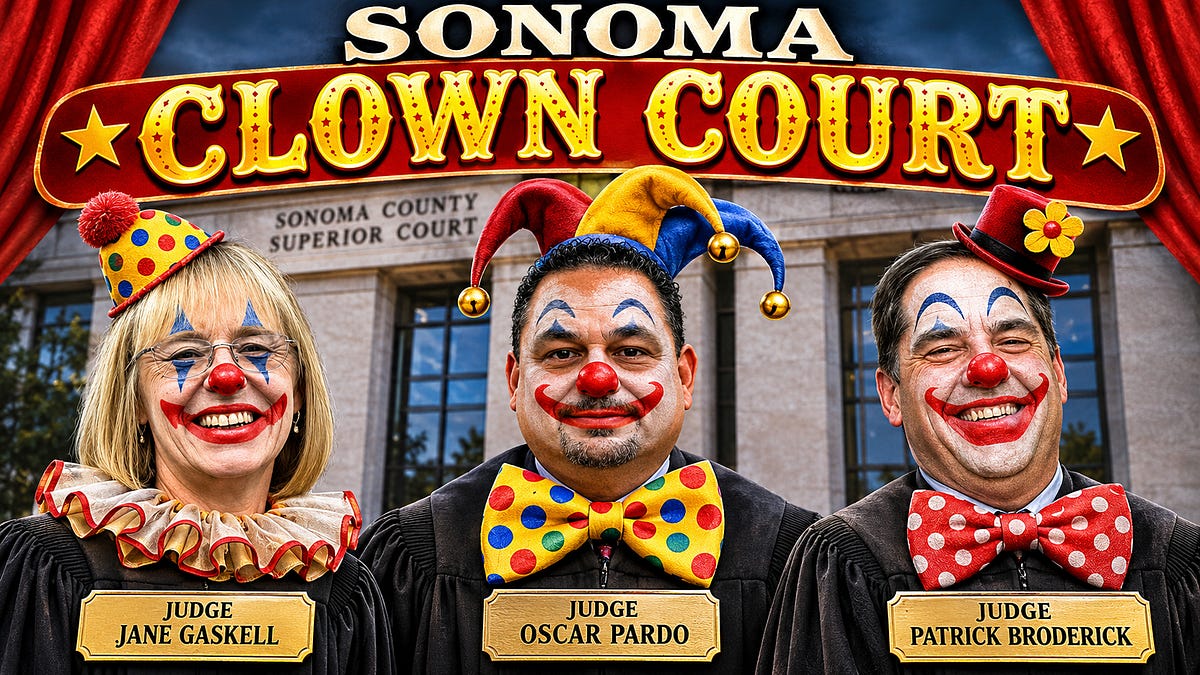
I have repeatedly described these proceedings as a “clown court” because, from my perspective, the accumulation of disputed rulings, judicial assignments, and procedural errors has made the process appear deeply dysfunctional.
That is my criticism of the institution’s handling of this case, not a factual finding that any judge or court employee has committed corruption.
Judges have an obligation to apply the law impartially. Court personnel have a responsibility to maintain accurate records. Litigants, including those representing themselves, are entitled to meaningful access to established procedures.
When a defendant submits a responsive filing, the court should not erroneously enter default.
When a litigant files a judicial disqualification challenge, the record should clearly establish how that challenge was resolved.
And when a filing invokes mandatory disqualification, the court should make clear whether it is ruling on those grounds or addressing a separate peremptory challenge.
These are not extraordinary demands. They are fundamental expectations of a functioning judicial system.
I intend to pursue available appellate remedies concerning the handling of my recent judicial disqualification challenge.
California Code of Civil Procedure §170.3(d) generally provides for review of judicial disqualification determinations by petition for writ of mandate, subject to a short statutory deadline and specific procedural requirements.
I am examining the orders, filing dates, and applicable legal standards to determine the appropriate next steps.
My objective is not to choose a judge based on personal preference. It is to obtain a judicial officer whose impartiality is not reasonably in question under California law.
I also want an accurate accounting of the court’s handling of the challenges brought by both defendants.
The public should be able to ask difficult questions about judicial administration without those questions being dismissed as hostility toward the courts.
I am asking why my mandatory disqualification filing was resolved through an order labeled peremptory.
I am asking what happened to Laura Ainsworth’s April 2025 challenge against Judge Gaskell.
I am asking why Ainsworth was placed in default when the court subsequently acknowledged that she was not default eligible.
And I am asking why Judge Oscar Pardo continues to preside over my case while I contest the handling of my disqualification allegations.
The court may have legal explanations for some or all of these events. Those explanations should be identifiable in the record and open to scrutiny.
Judicial independence does not mean freedom from accountability. And due process should not depend on whether a defendant has retained counsel or is representing herself.
I will continue seeking answers, documenting the proceedings, and exercising the legal rights available to me.
Because the question is no longer simply whether I can receive a fair trial.
It is whether the court can demonstrate, through its own records and procedures, that it is providing one.
“Woe unto them that decree unrighteous decrees, and that write grievousness which they have prescribed;