

Original Coverage & Source Attribution: www.storyboard18.com
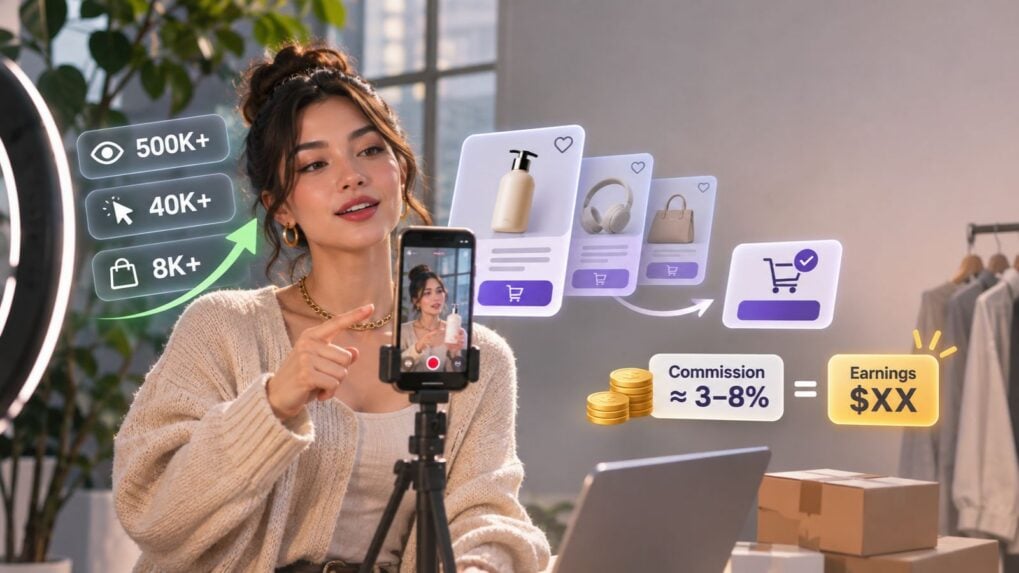
A Reel generating two million organic views might appear to be a commercial success. But for creator Renee, that level of reach has translated into just ₹10,000–12,000 in affiliate commissions, despite her estimate that the content generated approximately ₹60,000–70,000 in product sales.
The disparity highlights a challenge facing India’s creator economy as Instagram introduces Amazon as an official affiliate programme, allowing creators to link products directly within Reels, feed posts and carousels and earn commissions on qualifying purchases.
While the integration promises to simplify product linking and create additional monetisation opportunities, creators say the commercial appeal of affiliate marketing will ultimately depend on whether it delivers meaningful earnings, reliable conversions and greater control over how products are promoted.
For creators accustomed to fixed-fee brand collaborations, affiliate marketing offers an alternative income stream. But the experiences of some creators suggest that it remains a relatively small contributor to earnings, even as platforms increasingly connect content discovery with commerce.
Millions of views, but affiliate income remains limited
For Renee, affiliate commissions account for barely 2% of her income. She has created only two or three videos featuring products she genuinely uses and recommends, with some generating approximately two million organic views each.
“At most, I’ve earned around ₹10,000–12,000 in commissions from a Reel that reached two million views,” she said.
According to Renee, the relatively modest commissions and delayed payouts have weakened the incentive to produce more affiliate-led content, despite evidence that her audience is willing to purchase premium products.
She cited recommendations involving luxury products, including an expensive Tom Ford fragrance, that resulted in purchases through her content.
“Conversions haven’t necessarily been a problem,” she said, explaining that commission earnings and payout timelines remain bigger concerns.
Renee also pointed to delays in receiving earnings through Wishlink, the third-party affiliate platform she has used.
Her experience illustrates the distinction between generating consumer interest and capturing a financially meaningful share of the resulting sales.
But the challenges are not uniform across creators.
Jagjyot Singh, who has experimented with affiliate marketing on YouTube rather than Instagram, said commissions contribute approximately 2–4% of his income on average.
Unlike Renee, Singh has not experienced problems with payouts. Instead, converting viewers into buyers has been the principal difficulty.
“Conversions are very tough as taking a viewer from one app to another or just have to order while they are casually scrolling is a bit difficult,” he said.
For Singh, commissions also depend on the product category, making it difficult to assess affiliate marketing through a single earnings benchmark.
The contrasting experiences suggest that low affiliate income cannot necessarily be attributed to one problem. For some creators, the issue is what they earn from successful purchases; for others, it is persuading audiences to complete transactions in the first place.
Will native product links solve the friction?
Instagram’s Amazon integration could address one of the operational problems creators encounter when directing audiences towards products.
Traditionally, creators have relied on links in their biographies, external affiliate services or automated direct messages to direct followers to shopping destinations.
Twerk N Slay, a digital creator with more than 144,000 Instagram followers who says her content reaches nearly 30 million accounts monthly, believes simpler product linking could encourage more organic recommendations.
“The biggest friction has traditionally been the process of sharing individual links, redirecting people to the bio, or responding to multiple DMs asking where something is from,” she said.
Although most of her income currently comes from fixed brand partnerships, she sees affiliate marketing as an opportunity to monetise products that already appear naturally in her fashion, entertainment and lifestyle content.
For Renee, the attraction also lies in reducing dependence on third-party linking tools.
She said people she had spoken to at Meta had suggested that certain third-party automated DM tools could be interpreted as bot-like activity. Renee believes she experienced reduced visibility and account restrictions while using such services.
These are her reported experiences and concerns, rather than independently established evidence of Instagram penalising accounts for affiliate automation.
Direct product linking, she believes, could remove some of that uncertainty.
However, easier links do not automatically guarantee higher commissions, stronger purchase intent or improved conversion rates.
From brand collaborations to measurable sales
The integration also raises a larger question about the changing commercial expectations placed on creators.
Fixed-fee influencer campaigns traditionally compensate creators for producing content and delivering audience access, irrespective of whether individual viewers subsequently purchase a product.
Affiliate marketing shifts at least part of that commercial equation towards sales-linked compensation.
Twerk N Slay believes brands are increasingly interested in outcomes beyond visibility.
“Brands aren’t just looking at creators for visibility and engagement anymore; they also want measurable outcomes, clicks, conversions and sales,” she said.
Yet creators do not necessarily have equal abilities to influence transactions.
A creator producing entertainment-driven content may generate substantial engagement without attracting an audience actively looking to shop.
As Twerk N Slay observed, there is a significant difference between watching content, clicking on a product and completing a purchase.
She also emphasised the need for transparency around attribution, including which sales are credited to creators and how long the attribution window remains active.
Without such clarity, affiliate marketing could remain difficult for creators to evaluate as a dependable revenue stream.
Could affiliate marketing offer greater creative freedom?
Beyond earnings, Renee sees another opportunity in affiliate marketing: reducing the creative restrictions associated with conventional branded campaigns.
She argued that rigid briefs can undermine the authenticity that makes creator recommendations valuable.
According to Renee, brands have previously asked creators to wear particular colours and repeatedly mention product names, sometimes within the opening three seconds of a video.
Such requirements, she believes, make promotional content immediately recognisable as advertising and potentially less engaging.
Affiliate marketing could offer creators greater scope to recommend products through personal experiences, including comparisons with competing products, rather than simply repeating prescribed messaging.
For example, Renee said she would prefer to discuss her experience using a product such as Liquid I.V. and compare it with alternatives including Fast&Up or Glucon-D.
“Affiliate marketing gives creators the opportunity to monetise genuine recommendations without necessarily sacrificing their creative independence or audience trust,” she said.
That potential freedom, however, does not eliminate the financial uncertainty associated with commission-based earnings.
Creators may gain more control over their content while accepting greater dependence on consumer purchasing behaviour.
Creators don’t want every post to become a storefront
For Twerk N Slay, affiliate marketing would be most attractive as an extension of existing content rather than a reason to produce constant product promotions.
“I wouldn’t want my page to start feeling like a catalogue,” she said.
She believes creators should retain the freedom to focus on entertainment, storytelling or community-building without being expected to convert every interaction into a transaction.
The concern reflects a tension within the platform’s expanding commerce ambitions: the recommendations most likely to resonate with audiences may be those that do not feel primarily designed to generate sales.
Renee similarly sees Instagram’s integration as serving two interests simultaneously: making monetisation more accessible to creators while positioning them as direct sales channels for brands.
But the early experiences shared by these creators offer no evidence yet that the Amazon integration itself will increase their earnings.
For now, affiliate commissions account for only a small share of income among the creators who provided figures, while fixed brand collaborations remain central to their businesses.
Instagram may be making the journey from product discovery to shopping easier. Whether that translates into a commercially rewarding proposition for creators will depend on more than the convenience of attaching a product link.
First Published on November 19, 2026, 08:52:52 IST



