

Original Coverage & Source Attribution: michaelmcfaul.substack.com
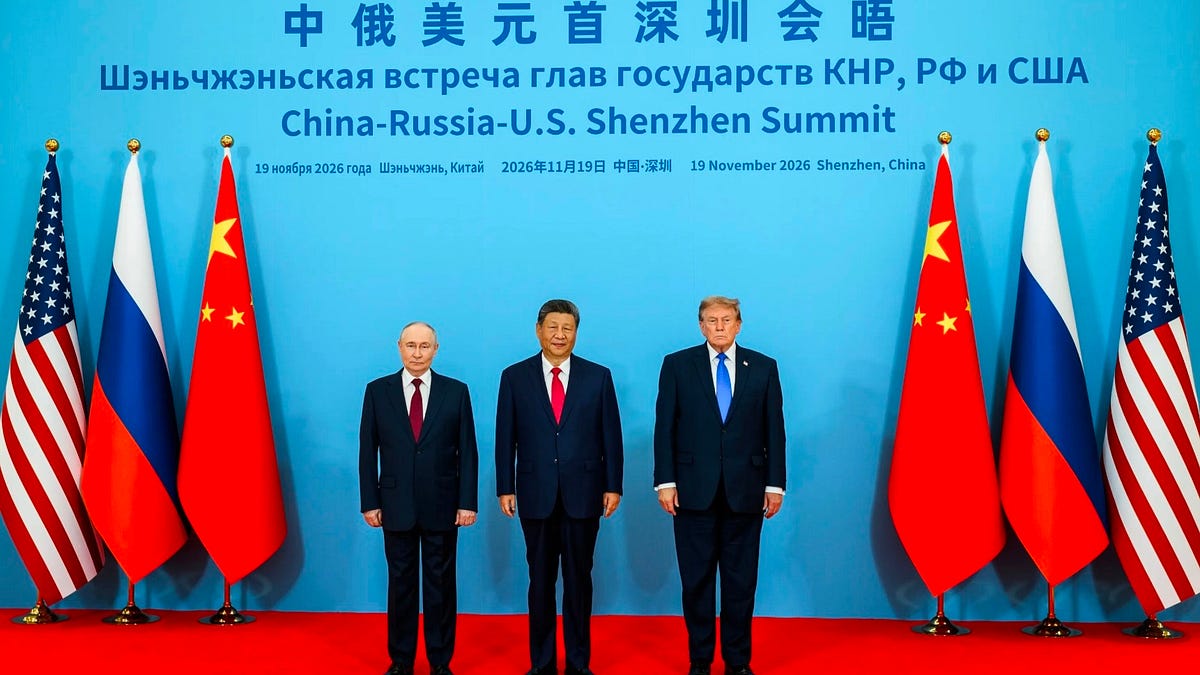
We’ve all now seen the photos of Presidents Trump, Xi, and Putin at their trilateral meeting in Shenzhen, China. These images have been broadcast on TV and printed in newspapers all over the world. But summits like this involving the U.S. president should be about more than just a photo op. They should deliver tangible outcomes that advance the security and prosperity of the American people. That is their purpose. This meeting produced nothing good for American national interests. Vladimir Putin was the main beneficiary of this meeting.
U.S. presidents sometimes need to meet with dictators to advance American national interests. During the Cold War, American presidents met with Soviet and Chinese communist leaders. While I worked for President Obama, first at the National Security Council at the White House for three years, and then as the U.S. ambassador to the Russian Federation, I participated in meetings with Putin and other senior Russian officials working for that autocratic regime. These meetings were always a means to a larger objective. A “good” meeting was never an end in itself. For instance, President Obama met with Russian President Dmitry Medvedev several times to negotiate the terms of the New START Treaty, a nuclear arms control agreement, which they eventually signed in Prague on April 8, 2010. In every one of these bilateral meetings—including on the sidelines of multilateral conferences like the APEC meeting that just concluded in China—our goal was to make progress on getting this treaty done.
Attending the same summits as our Russian counterparts afforded us opportunities to conduct diplomacy on the sidelines. We used these meetings to negotiate transit routes through Russia to support our soldiers in Afghanistan, secure agreement on multilateral sanctions on Iran, and obtain Russia’s acquiescence not to block UN security resolutions authorizing the use of force in Libya. At every meeting, we always had a list of concrete outcomes we sought to achieve. In these meetings, Obama discussed democracy, human rights, and the rule of law—including the wrongful treatment of civil society leaders, such as Lev Ponomarev (during the G20 summit in London in 2009), and the wrongful detention of Russians, such as businessman Mikhail Khodorkovsky (during an APEC summit in Yokohama in 2010).
Maybe Putin, Trump, and Xi also negotiated outcomes that we have yet to learn about that benefit American interests and values. The official joint statement released after the meeting, however, communicated nothing of the sort. Instead, it listed only four short and very general points of agreement: UN reform, nuclear nonproliferation, criticism of the International Criminal Court, and a pledge to ramp up the supply of refined petroleum products.
The summit’s most important outcome had nothing to do with this statement. The most consequential outcome was a giant gift to Vladimir Putin—a photo with two of the most powerful leaders in the world that created the impression that Putin, too, was a respected leader of a third great power. That is a shame.
This is a man who has waged a full-scale war on a democratic partner of the United States for nearly five years. He has systematically targeted Ukrainian civilians to try to break their morale. He has locked up, chased out, or had killed Russian citizens who have dared to speak out against him in his own country. This man should be vilified, not welcomed, on the global stage. And if representatives of the United States have to engage with Putin, they should have a clear purpose that advances American national interests and values. Nothing I’ve seen or read about Trump’s interactions with Putin led me to believe this was the case in Shenzhen. Shockingly, Trump even referred to him as his “friend”.
In calling Putin his friend, Trump was speaking in a personal capacity, not as a representative of the American people. More than 80 percent of Americans say they have little or no confidence in Putin to do the right thing in world affairs. A new poll released by the Pew Research Center this week found that two-thirds of Americans disapprove of Trump’s handling of Russia’s war against Ukraine. More broadly, Americans still value our democratic alliances, still support NATO, and still believe that the promotion of democracy and the defense of human rights should have a place in American foreign policy (as I wrote about here). Different from Trump, Americans value friendships abroad with democratic leaders.
The trilateral meeting in Shenzhen was the first of its kind. I also hope it is the last. We should not mistake it for the emergence of a new international order—a “G3”, or worse yet, a “Yalta 2.0.” Trump is a lame-duck president whose foreign policies are extremely unpopular at home. Putin is bogged down in a war he is losing after nearly five years of fighting and enormous cost to his country’s people and economy. Xi has done little to end either the war in Ukraine or the war in Iran. None of these men are demonstrating strong global leadership right now. They, together, most certainly are not forging a new international system based on three spheres of influence.
In the wake of the “Blue Tsunami” we saw in the midterms a few weeks ago, the Trump era is winding down. The next American president is unlikely to befriend Putin or embrace autocrats more broadly. The trilateral meeting today, which some breathlessly described as historic, pivotal, and unprecedented, will soon be forgotten as just another crazy but ephemeral moment of the Trump era. And that’s a good thing.



