

Original Coverage & Source Attribution: thepeoplesmovies.com
If there is one director who can lay claim to being the godfather of film noir, it is Fritz Lang. His silent films helped shape the genre, with M perhaps it’s clearest forerunner. When he moved to Hollywood, he brought with him an extraordinary eye for visuals and a preference for morally ambivalent heroes, producing some of the era’s most unique noirs, including The Big Heat, Clash by Night and While the City Sleeps.
Scarlet Street, now available as part of Eureka’s Masters Of Cinema collection, may well be his finest Hollywood film. Reuniting the cast of his earlier noir, The Woman in the Window, this follow-up is considerably harsher, and crueler, leading film historian Tom Gunning to describe it as that film’s “dark reflection”. Where the earlier film has a controversially upbeat ending, Scarlet Street‘s heart is black as pitch, culminating in perhaps the bleakest ending in the genre. But it is never cynical: its cruelty only works because we care about the people caught up in it.
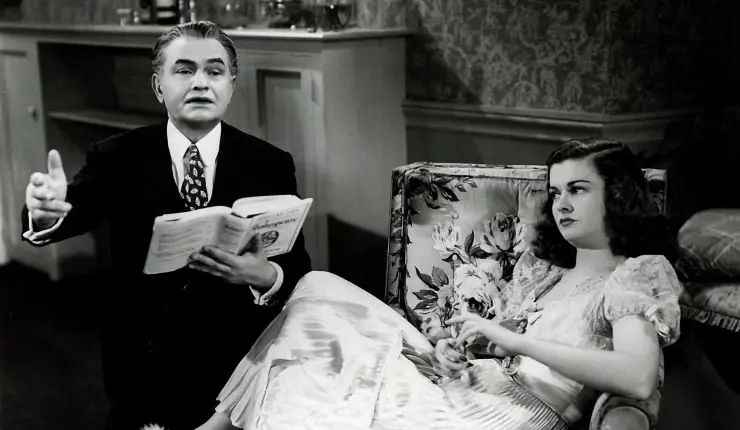
Edward G. Robinson stars as the brilliantly named Chris Cross, a mild-mannered cashier celebrating 25 years in his job. On his way home from the presentation of a lavish pocket watch for his loyal service, he rescues a young woman from an assault and soon falls for her. But Kitty (Joan Bennett) is no innocent waif. Mistaking Chris for a successful artist, she sees an opportunity to exploit him, enlisting her brutish partner Johnny (Dan Duryea) to help fleece him.
Noir takes many forms: gangster pictures, heist films and, perhaps most unsettlingly, domestic noir, where crime seeps into ordinary life. Films such as Double Indemnity, The Postman Always Rings Twice and Mildred Pierce explore ordinary people drawn into criminal schemes through their own scheming or sheer bad luck. What makes Scarlet Street distinctive is just how blameless Chris is for his misfortunes. His meek, diffident nature has left him trapped in a loveless marriage with a domineering wife and makes him an easy target for two small-time grifters.
Eddie Muller, the great authority on film noir, placed the film at number 22 in his list of the 25 greatest examples of the genre, arguing that its three leads were never better, and it’s hard to disagree. All three play variations on the characters they played in The Woman in the Window, but push them into considerably darker territory. Robinson is superb as Chris, using his physicality to make his already diminuitive frame even more heightened, hunching over as though carrying the weight of the world. It is a far cry from the tough guys of Little Caesar and Key Largo, or the confident, sharp-witted character he played in Double Indemnity. In the scene where he is fired, Robinson never speaks a word, but as his eyes glisten with tears, they convey more than dialogue ever could.
Bennett, meanwhile, plays one of the nastiest femme fatales in the genre. There is some ambiguity to Kitty, but her final diatribe against Chris is so vicious that any shred of sympathy evaporates. Duryea is equally memorable as one of cinema’s sleaziest grifters. He combines charming arrogance with sweaty desperation, and the scene where his bravado slowly drains from is face is beautifully performed. Despite playing an unapologetic heel, it’s difficult to not feel for him when his luck finally runs out.
Based on Georges de La Fouchardière‘s novel La Chienne, previously adapted by Jean Renoir, Lang’s version inevitably has to negotiate the restrictions of the Production Code. Some of the source material’s more amoral elements are softened or removed, but it is remarkable how much Lang and screenwriter Dudley Nichols still manage to get away with. Chris may appear to escape punishment, but the final moments make it clear that this is hardly a happy ending.
While beautifully filmed, Scarlet Street is not among the most visually striking noirs, although Lang saves some impressive flourishes for the final act. As the murder case gathers momentum, he makes stylised cuts between witnesses giving testimony, building to a close-up of Duryea hysterically protesting his innocence, recalling Lang’s silent-era work and German Expressionist roots – all of which look stunning in this 4K remaster from Eureka. But the final shot is the film’s true masterstroke. Chris wanders through a crowded street, penniless, while his paintings sell for a fortune, unable to take credit for fear of arrest. The crowds then vanish around him. Haunted by the voices of Kitty and Johnny, he is left utterly alone. It is one of the bleakest and most moving endings in Lang’s career.
Scarlet Street remains painful viewing, even today. Its plot unfolds with dreadful inevitability, leaving us willing the doomed characters to make different choices. There is something distinctly European about its moral outlook, closer to a merciless morality play than a conventional Hollywood crime picture. It is Lang’s finest Hollywood noir, and one of the very best films the genre has to offer.
★★★★★
Special Features | This excellent release comes with a commentary from Imogen Sara Smith; a video essay by David Cairns, interviews with film historians Pamela Hutchinson and Sheldon Hall, as well as three episodes of the radio anthology series Suspense, starring Edward G Robinson.
Out on 4K UHD on November 23rd / Edward G Robinson, Joan Bennett, Dan Duryea / Dir: Fritz Lang / Eureka: Masters Of Cinema / U



