

Original Coverage & Source Attribution: en.bloomingbit.io
Summary
It is not investment advice, and you are solely responsible for any investment decisions you make.
For more details, see STAT AI’s analysis criteria.
- CryptoQuant said Tether (USDT) supply fell by $8.1 billion over the past 60 days, marking the biggest decline since Aug. 2022.
- It said Bitcoin fell from around $83,000 to about $55,150 during the period of supply contraction in USDT.
- CryptoQuant added that a Bitcoin price rebound would require a recovery in liquidity, a return to positive territory in the 60-day rate of change in USDT supply, and stabilization in Ethereum supply.
Forecast Trend Report by Period


Biggest Decline Since Aug. 2022

The supply of Tether’s dollar-pegged stablecoin USDT has dropped by $8.1 billion over the past 60 days. USDT, which is widely used like dollars in crypto trading, was pulled in large amounts from Ethereum, driving the sharpest contraction in more than four years. On-chain analytics firm CryptoQuant said the liquidity squeeze is constraining Bitcoin’s rebound.
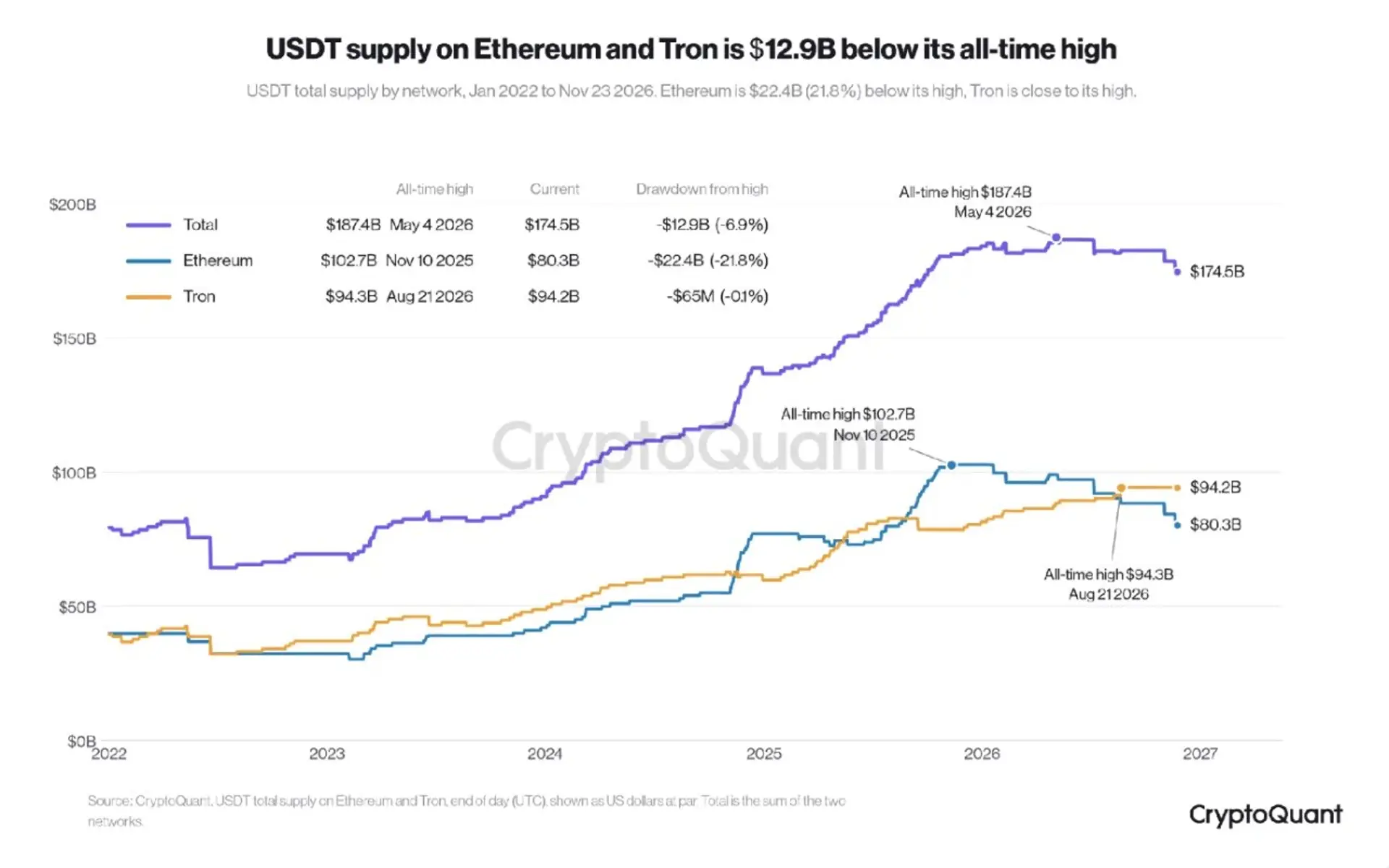
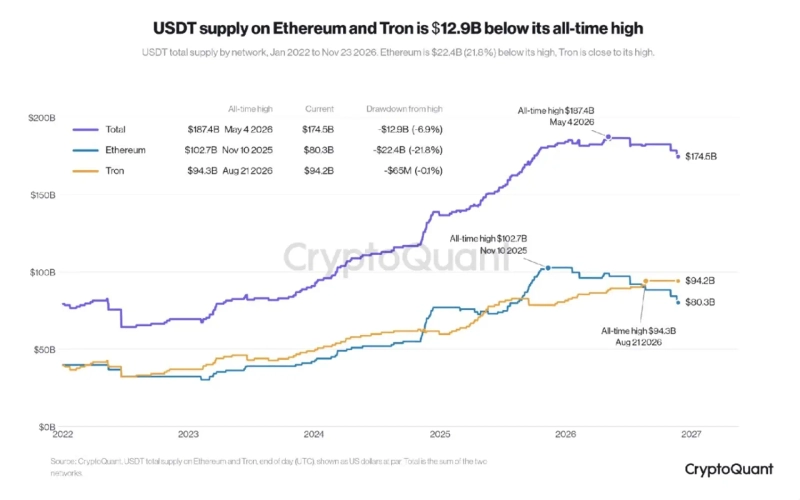
According to CryptoQuant’s weekly report released on Nov. 26, the combined USDT supply on Ethereum and Tron stood at $174.5 billion on Nov. 23. That was $12.9 billion, or 6.9%, below the record high of $187.4 billion reached on May 4. The 60-day contraction rate was 4.4%, the steepest since August 2022.
USDT supply on Ethereum stood at $80.3 billion, down $22.4 billion, or 21.8%, from its peak in November 2025. Tron’s supply was $94.2 billion, or $65 million below its all-time high. Earlier this year, growth on Tron partly offset the decline on Ethereum, but over the past 60 days Tron supply also fell by $50 million.
From Oct. 9 to Nov. 23, USDT worth $11.65 billion flowed into Tether’s treasury wallet on Ethereum. Over the same period, $4.19 billion left the treasury, resulting in net returns of $7.46 billion. Of the tokens sent to the treasury, 89% came from Bitfinex, which transferred $6.66 billion, and Binance, which sent $3.71 billion. Tether burned $4 billion on Nov. 2 and another $4 billion on Nov. 20.
Bitcoin also weakened as USDT supply shrank. The token traded around $83,000 on Oct. 20 before falling to about $55,150 intraday on Nov. 21. CryptoQuant’s analysis of data since 2022 showed that Bitcoin’s average 60-day return was negative 9.5% on days when USDT supply had declined over the preceding 60 days. On days when supply had increased, the average return was 7.6%.
CryptoQuant said all 39 instances in which Bitcoin set a new record closing high since 2022 came during periods when USDT supply was not contracting. It added that for the price rebound to continue, liquidity must recover. Investors should watch whether the 60-day rate of change in USDT supply turns positive, whether Ethereum supply stabilizes, and whether outflows from Tether’s treasury exceed inflows.



