

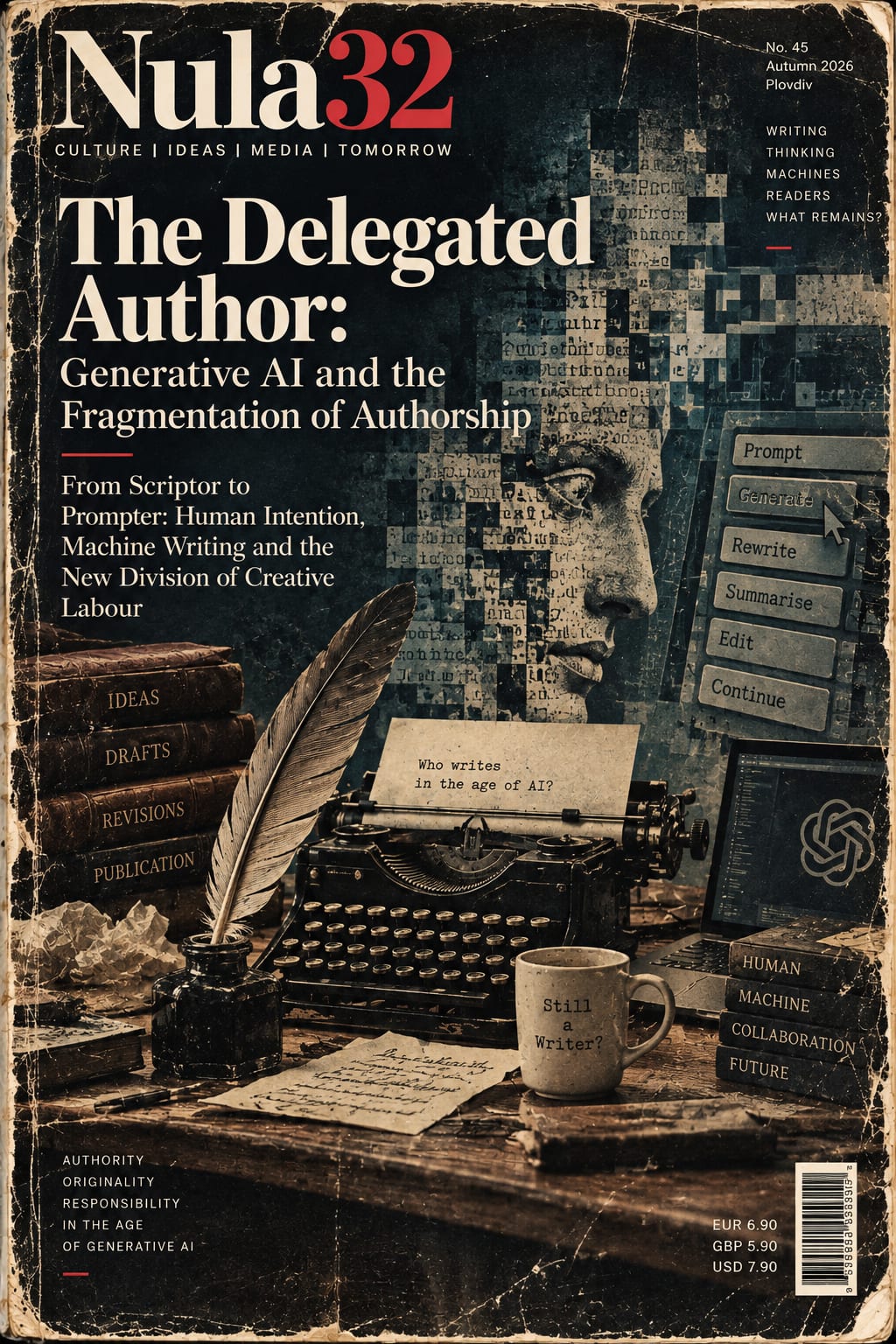
Original Coverage & Source Attribution: vocal.media
Abstract
Generative artificial intelligence does not merely introduce another instrument into the history of writing; it separates activities that modern culture has traditionally compressed into the single figure of the author. Conceiving an idea, selecting material, researching, composing sentences, structuring an argument, revising language, producing visual representations, judging alternatives and accepting responsibility can now be distributed between human and computational agents. This article proposes the concept of the Delegated Author to describe this emerging condition. Rather than approaching generative AI through the increasingly inadequate opposition between “human-written” and “machine-generated” texts, it examines authorship as a divisible process in which human intention may precede machine execution and human judgement may subsequently select, reject or transform the machine’s output. The argument develops from the twentieth-century displacement of the sovereign Author through Roland Barthes’s Scriptor and Michel Foucault’s author-function towards the contemporary Prompter: a figure capable not merely of recombining inherited language but of delegating part of the linguistic labour of recombination itself.
The article tests this theoretical transition through a controlled journalistic experiment derived from an already published human cultural product. The original publication remains unchanged as a control, while a generative Model is permitted to restructure, clarify, compress and visually reinterpret the material. This asymmetrical design deliberately distinguishes machine generation from AI-assisted transformation: the Model receives a problem, research, conceptual direction and textual architecture that already exist rather than beginning from an empty page. The comparison therefore asks not simply whether AI can produce competent language, but what happens when linguistic execution becomes partially detached from intellectual initiation. Particular attention is given to the Paradox of Improvement: the possibility that optimisation may increase clarity, coherence and accessibility while simultaneously reducing stylistic irregularity, ambiguity and recognisable authorial voice. The article argues that generative AI fragments rather than abolishes authorship. The resulting division of creative labour redistributes composition and editing while leaving intention, critical selection, refusal and responsibility unequally distributed. In this emerging configuration, the decisive human contribution may no longer consist in physically producing every sentence. Authorship may increasingly reside in determining why a text should exist, what may be delegated, which machine transformations should survive, where optimisation must stop, and who ultimately answers for what is published.
Keywords: delegated authorship; generative artificial intelligence; large language models; Scriptor; Prompter; human intention; machine writing; creative labour; authorship; editing; human–AI collaboration; authorial voice; journalism; generative images; responsibility
Introduction: When Writing Leaves the Writer
“Writing is that neutral, composite, oblique space where our subject slips away, the negative where all identity is lost.”
— Roland Barthes (1967), “The Death of the Author”
For most of the history of modern authorship, several fundamentally different operations have been concealed inside one deceptively simple verb: to write. The author conceives a subject, decides that it deserves expression, gathers material, selects what should be included and excluded, discovers relationships between fragments of information, determines a perspective, constructs an argument, produces sentences, revises them, accepts or rejects editorial interventions and eventually permits a particular version to appear beneath a name. Because these operations have conventionally occurred within or around a single human agent, their differences could remain largely invisible. The signature beneath a journalistic article or the name on a book cover compressed intention, composition, selection and responsibility into the culturally convenient fiction of one identifiable origin. Generative artificial intelligence makes that compression increasingly difficult to sustain. A human can now originate a problem without composing most of its final sentences; formulate an argument while delegating its restructuring; conduct an interview while asking a Model to compress and reorganise it; imagine a visual metaphor while permitting a generative system to execute its visible form. The technological novelty therefore lies not simply in the fact that machines can produce plausible language. More consequentially, activities previously concentrated within the practical identity of the writer can now be separated and redistributed. The question “Who wrote this?” consequently becomes inadequate whenever intention, research, linguistic production, revision, visualisation and final selection no longer belong to the same participant. This article proposes the Delegated Author as a conceptual figure for this emerging division of creative labour. The Delegated Author does not disappear from the communicative process and does not surrender authorship automatically to the machine. Instead, this figure retains some authorial operations while externalising others. Such delegation introduces an important distinction between linguistic production and authorial sovereignty. A generative Model may produce hundreds of sentences, reorganise an entire argument or generate an image without originating the intellectual necessity that caused the work to exist. Conversely, a human may physically type relatively few words while determining the problem, supplying the material, directing transformations, rejecting inappropriate solutions and accepting responsibility for the result. Authorship therefore begins to detach itself from the measurable quantity of language physically produced by a particular agent. What matters increasingly is not simply who generated the words, but who initiated the communicative act, who established its constraints, who possessed the authority to accept or refuse transformations, and who ultimately allowed the resulting object to enter public circulation.
This transformation has an intellectual prehistory that long predates generative AI. Twentieth-century theories of authorship had already dismantled the romantic image of the writer as an isolated sovereign consciousness producing language from an interior source untouched by previous discourse. Barthes replaced the authoritative Author with the Scriptor and described the text as a space in which inherited writings, cultural codes and previous utterances encounter one another; Foucault subsequently shifted attention from the individual creator towards the social and classificatory operations performed by the author-function. Theories of paratext, cultural production and literary institutions further demonstrated that the work reaching the reader is never produced by the writer alone but passes through editors, publishers, designers, critics, institutions, technologies and systems of cultural legitimation. Generative AI nevertheless introduces something structurally different into this already distributed environment. The editor traditionally intervened in a text that another person had linguistically produced; the printing press reproduced language without composing it; the word processor altered the mechanics of inscription without normally proposing the next paragraph. The large language model can enter the chain at the level of linguistic execution itself. The Scriptor could be understood as someone who writes from the immense archive of already existing language; the Prompter can delegate part of that recombinatory operation to a computational system. The emerging sequence is therefore no longer adequately represented as Author → Text → Reader. It increasingly resembles Human intention → Instruction → Machine production → Human selection → Publication → Reader judgement. The controlled experiment examined in this article makes that fragmentation observable by beginning with an already completed human journalistic work rather than asking Human and Model to compete artificially before identical blank pages. The Model receives an existing subject, research material, conceptual intention, textual structure and visual context and is asked to improve them. Such asymmetry is essential because it resembles the practical situation in which generative systems increasingly enter professional communication: not necessarily as autonomous creators, but as linguistic workers operating inside human projects. The resulting comparison makes it possible to ask what can be delegated without delegating authorship itself. If the Model changes the title, restructures the argument, rewrites transitions, removes repetitions, translates specialist ideas into accessible language and produces alternative visual forms, it is clearly doing more than correcting grammar. Yet if the human retains the initiating problem, evaluates every transformation, decides where optimisation becomes distortion and bears responsibility for publication, calling the machine the author appears equally insufficient. Between these positions emerges the central problem of the Delegated Author: once writing has been fragmented into transferable operations, authorship can no longer be defined simply by asking who produced the sentences. It must be reconstructed from the distribution of intention, execution, judgement, refusal and responsibility.
Part I: The Author Was Never Alone — From Sovereign Creator to Cultural Function
“What does it matter who is speaking?”
— Michel Foucault (1969), “What Is an Author?”
The classical Author appears to offer an elegantly simple answer to the problem of textual origin: behind the work stands an identifiable human being who intended it, produced it and can therefore be named as its creator. Modern literary and journalistic culture reinforced this association through signatures, bylines, copyright, publishing contracts and the symbolic economy of reputation. Yet the apparently elementary statement that “the author wrote the text” conceals a surprisingly heterogeneous collection of actions. The journalist who signs an article may have chosen the subject, located sources, conducted interviews, verified information, selected quotations, rejected irrelevant material, established a perspective and constructed a narrative sequence before writing the first publishable sentence. Other participants may subsequently correct grammar, alter a headline, shorten paragraphs, select photographs, design pages and determine when and where the finished work appears. Authorship has therefore never been perfectly synonymous with the physical production of words. What traditionally holds these heterogeneous activities together is something closer to sovereignty: the author is treated as the principal source of intention and as the person to whom the work is publicly attributed. This distinction becomes particularly important in journalism because the byline functions simultaneously as recognition and responsibility. The name beneath the headline does not certify that no editor has touched the prose. It indicates that a particular person stands behind the journalistic act: someone decided that the subject mattered, made choices about evidence and representation, and accepted a professional relationship to what was finally published. Authorial voice emerges within this process as something more elusive than grammatical correctness. Rhythm, preferred sentence structures, recurring metaphors, irony, unexpected transitions, digressions and even certain irregularities can become identifying characteristics. Two journalists supplied with identical facts can consequently produce radically different texts because authorship operates not only through possession of information but through selection and arrangement. The sovereign Author is therefore partly a practical fiction, but an extraordinarily useful one. It concentrates a dispersed process into an identifiable centre from which intention, ownership and accountability can be inferred. Generative AI destabilises this arrangement because linguistic execution itself can now migrate away from that centre. If the journalist continues to investigate, select and decide while the Model generates headlines, restructures paragraphs and rewrites substantial passages, the old equation between the person named as author and the person physically producing the language becomes increasingly difficult to maintain. Before determining whether this constitutes a crisis of authorship, however, it is necessary to recognise that twentieth-century theory had already begun dismantling precisely this equation long before a generative Model entered the newsroom.
Barthes’s movement from Author to Scriptor provides the first decisive rupture because it attacks the assumption that writing originates in a sovereign consciousness standing outside language. The Scriptor does not create words, genres, rhetorical forms and cultural codes ex nihilo; writing occurs within an immense archive that precedes every individual act of composition. What appears to be original expression is necessarily constructed from inherited linguistic materials whose histories exceed the person using them. This argument becomes remarkably provocative in the age of large language models, but the analogy must be handled carefully. Barthes did not anticipate computational text generation, and the human Scriptor cannot simply be equated with an LLM. The human writer remains embodied, historically situated and capable of intention, experience, desire, ethical judgement and responsibility in ways that cannot be transferred merely by observing that both human and machine operate upon pre-existing language. Nevertheless, the theoretical displacement matters because it removes one of the strongest conceptual protections surrounding traditional authorship: the belief that originality requires language to emerge entirely from an individual interior source. Once writing is understood as recombination, transformation and collision among preceding discourses, the arrival of a system capable of computational recombination creates a disturbing question. If recombination itself is not sufficient to distinguish human authorship, where should that distinction be located? Foucault’s author-function moves the problem further away from physical inscription. An author’s name does not merely report who assembled a sequence of words; it classifies, organises and regulates discourse. The name groups texts, establishes expectations, distributes prestige and permits responsibility to be attached to particular statements. In journalism this function becomes unusually concrete. The public significance of a byline survives extensive editorial intervention because the author-function identifies who stands in a particular relation to the published claim. Generative AI therefore exposes a separation already latent within Foucault’s framework: the producer of language and the bearer of the author-function need not be identical. A Model might generate a paragraph while remaining absent from the social mechanisms through which that paragraph acquires accountability, professional reputation or institutional consequence. The human journalist may consequently retain the author-function while delegating part of the material production historically associated with it. This does not solve the problem; it makes it sharper. The more substantial the delegation becomes, the harder it is to determine whether the human remains an author who uses a sophisticated instrument or becomes instead a commissioner, curator or supervisor of machine-produced discourse. The old theoretical “death of the Author” thus acquires an unexpectedly practical dimension. What twentieth-century criticism described as a displacement of interpretative sovereignty can now become an observable redistribution of creative labour.
The erosion of solitary authorship becomes still more pronounced when the text is placed within the cultural systems that surround it. Genette’s concept of the paratext demonstrates that a work never reaches its audience as naked language: titles, subtitles, covers, illustrations, typography, introductions and other framing devices participate in the construction of meaning before the reader encounters what is conventionally called the text itself. Bourdieu shifts the perspective further by situating cultural production within a field of relations in which writers, editors, publishers, critics, institutions and audiences struggle over legitimacy and value. Sapiro similarly makes it difficult to imagine literature as the isolated transmission of private inspiration from individual creator to individual reader. Production, circulation, recognition and reception depend upon social structures through which cultural objects are selected, mediated and preserved. Taken together, these perspectives produce a genealogy that becomes crucial for understanding generative AI: Author → Text → Editor → Paratext → Institution → Reader. At each stage, the apparent autonomy of the author becomes more qualified. A headline can reposition an article; an editor can radically alter its rhythm; an illustration can change its emotional register; publication within a particular institution can confer authority; reception can produce meanings the writer neither anticipated nor desired. The Model enters not at the beginning of this history but inside an already crowded system of mediation. What distinguishes it from many previous mediators is its capacity to operate simultaneously across several positions. It can propose the title that Genette would place within the paratext, perform linguistic transformations associated with editing, imitate stylistic conventions derived from the cultural field, generate visual material and anticipate possible reader comprehension. It is therefore less useful to describe AI as an alien author suddenly confronting an autonomous human creator than to understand it as a new participant entering a process that was never truly solitary. The decisive novelty is the depth at which delegation can now occur. Previous technologies reproduced, stored, transmitted or formatted human language; generative systems can participate directly in its formulation. Yet even this power does not automatically grant them the complete cultural position previously occupied by the Author. The Model can produce without possessing a biography behind the publication, intervene without independently determining why the work should exist, and formulate claims without assuming the professional consequences of releasing them. The historical movement from sovereign creator to Scriptor, author-function and cultural field therefore does not culminate logically in the declaration that AI has become the new Author. It produces a more interesting possibility. Artificial intelligence arrived at a moment when theory had already demonstrated that the solitary Author was never as solitary as modern culture imagined. Generative AI did not kill the Author. It made the Author’s internal division visible.
Part II: From Scriptor to Prompter — The Delegation of Linguistic Labour
“The writer is the person who stays in the room.”
— Ron Carlson (1997), Ron Carlson Writes a Story
The transition from Scriptor to Prompter changes the structure of authorship more radically than the familiar comparison between human and machine suggests, because the decisive transformation is not that a non-human system has suddenly acquired the capacity to produce sentences. The deeper transformation is that linguistic labour itself can be separated from the human intention that initiates it. Barthes’s Scriptor remained inseparable from the physical and cognitive activity of writing: however thoroughly language preceded the individual, a human consciousness still selected, combined and inscribed the inherited codes through which the text emerged. The Prompter occupies a different position. A person may now determine the subject, identify the problem, supply documents, establish restrictions, describe an intended audience and specify the desired intellectual movement without personally executing every linguistic operation necessary to realise those decisions. Between intention and finished prose appears an intermediary capable of generating, expanding, compressing, reorganising and reformulating language at extraordinary speed. The resulting sequence is no longer adequately described as Human → Text. It becomes Human intention → Human instruction → Machine execution → Human selection. The prompt is important within this sequence, but it should not be mystified as a new form of magical authorship. A prompt does not contain the resulting text in miniature. It establishes a field of possibility within which the Model produces an answer, after which the human must decide whether that answer corresponds to the purpose that caused the interaction to begin. The Prompter is therefore neither simply the traditional Author equipped with a faster typewriter nor a passive consumer requesting content from an autonomous machine. The figure occupies a new position between commissioning, directing, editing and writing. This becomes particularly visible when AI is applied not to a blank page but to an already existing human text. The experiment underlying this article deliberately establishes such a condition. The Model does not invent the original subject, conduct the initial intellectual investigation or independently decide that a journalistic work should exist. It receives an existing publication and is asked to recognise where its organisation, accessibility, transitions, formulations or visual presentation might be altered. The machine therefore possesses an enormous retrospective advantage: it can inspect a completed structure whose human author had to discover that structure through the uncertain process of composition. What appears as machine superiority may consequently be partly an asymmetry of temporal position. The Human confronts possibility; the Model confronts actuality. The Human must discover what the text is; the Model is invited to decide what the text could become. This distinction is essential because it prevents linguistic fluency from being confused with intellectual origin while simultaneously acknowledging that the Model’s intervention can become sufficiently substantial to exceed the conventional meaning of a neutral tool.
The concept of delegated linguistic labour provides a more precise vocabulary for describing what occurs between these two positions. Writing is not a single indivisible action but a chain of operations that can now be distributed selectively: conceptualisation, research, selection, composition, argumentation, sentence production, restructuring, compression, expansion, stylistic adaptation, summarisation, correction and final evaluation. Generative systems do not perform all of these operations in the same epistemic sense in which a journalist or scholar performs them, yet they can produce outputs corresponding to many of their linguistic functions. This distinction makes it possible to avoid two equally misleading extremes. The first treats AI as merely another word processor, denying the obvious fact that a system capable of rewriting an introduction, changing the argumentative sequence, proposing alternative metaphors and reorganising an entire article participates in decisions traditionally associated with editorial intelligence. The second interprets every substantial machine intervention as proof that the Model has become the author, ignoring the human decisions that established the problem, supplied the context and determined which outputs would survive. Delegation exists precisely between these extremes. A journalist can delegate sentence reformulation without delegating the choice of subject; delegate structural alternatives without surrendering the final structure; delegate headline generation without transferring responsibility for the headline eventually published. The distinction resembles other divisions of intellectual labour but differs in scale and immediacy. A human editor can propose radical transformations, yet editorial labour is constrained by time, availability and institutional relationships. A Model can generate twenty alternative openings, ten titles and several structural reorganisations within moments, allowing the writer to move from direct production towards continuous selection among possibilities. The resulting creative economy changes the scarcity at the centre of writing. Where composition traditionally required the author to produce a viable formulation, generative AI can make formulations abundant. The scarce resource becomes judgement. The problem shifts from “Can I write this sentence?” towards “Which of these sentences should exist?” and, more importantly, “Should any of them replace mine?” This is why linguistic agency must be distinguished from authorial sovereignty. The Model possesses an unprecedented capacity for linguistic action: it can materially transform the communicative object. Yet sovereignty remains elsewhere when the system cannot independently establish the legitimate purpose of the publication, decide that its intervention should be accepted, or assume responsibility for the consequences. The Delegated Author therefore does not necessarily write less in an intellectual sense, even when producing fewer words manually. The locus of labour moves from continuous inscription towards instruction, comparison, discrimination and refusal. The danger is that this redistribution can be mistaken for the disappearance of labour precisely because the visible act of typing has historically served as the most obvious evidence that writing is taking place.
This transformation becomes still more significant when placed beside the problem of originality. Human writing has never consisted of creating language from nothing. Quotations, clichés, idioms, narrative structures, inherited metaphors, disciplinary vocabularies and remembered sentences circulate through every cultural environment, making writing inseparable from repetition. The figure of Homo Citans captures the human propensity to inhabit language by citing, adapting and transmitting prior formulations, while Lingua Citans extends the problem towards language understood as a self-reiterating cultural mechanism whose fragments survive by passing between speakers, writers and media. Generative AI intensifies this condition because recombination becomes technologically externalised. The Prompter can delegate part of the work once performed within memory, stylistic habit and conscious revision to a system trained upon immense quantities of prior linguistic material. Yet resemblance at the level of recombination should not erase the difference between human and machine participation. A person may quote because a remembered phrase carries biographical significance, because an allusion addresses a particular community, because irony requires recognition of an earlier utterance or because an inherited expression is being deliberately violated. The Model can reproduce the formal relationships among linguistic patterns without necessarily possessing those lived reasons for invoking them. The distinction therefore shifts again from the material presence of inherited language to the intention governing its selection. This is precisely where the Prompter becomes theoretically important. The Prompter may not originate every formulation, but can determine the conditions under which formulations are sought, recognise when an unexpected result serves the project, reject fluent but conceptually false alternatives and interrupt optimisation when the Model begins to regularise something that should remain irregular. Such activity complicates any simple accusation that AI-assisted writing is merely automated plagiarism or effortless production. It can certainly become intellectual laziness when the human delegates judgement together with execution, accepting fluent outputs because they appear finished. But delegation need not entail abdication. The crucial difference lies in whether the human remains critically present within the loop. The emerging division of creative labour consequently produces a paradox: as machines become increasingly capable of performing the visible operations of writing, the most consequential human contribution may become progressively less visible. It resides in establishing purpose, recognising relevance, detecting distortion, preserving productive ambiguity and deciding when not to use what the Model has produced. The movement from Scriptor to Prompter therefore does not simply mark the replacement of human writing by machine writing. It marks a transition from authorship organised around production towards authorship increasingly organised around judgement. The Prompter becomes the Delegated Author when linguistic execution is outsourced without surrendering the authority to determine what deserves to survive.
Part III: The Last Human Decision — Editing, Imperfection and the Right to Say No
“The chief enemy of creativity is ‘good’ sense.”
— Pablo Picasso (1923), “Picasso Speaks”
The controlled experiment at the centre of this argument makes the fragmentation of authorship observable precisely because Human and Model do not begin from equivalent positions. The original journalistic publication exists before the Model enters the process. Its subject has been selected, its conceptual problem identified, its research assembled, its interview conducted, its argument developed and its visual language established through human decisions. The Model consequently confronts not the terror of the blank page but the evidence of decisions already made. Its task is transformational: to inspect an existing communicative object and determine where it might become clearer, more coherent, more accessible, more economical or more visually effective. This distinction prevents the experiment from becoming another theatrical competition in which a person and a machine receive the same instruction and produce parallel texts whose surfaces are then compared. Such competitions may demonstrate differences in fluency, speed or stylistic convention, but they obscure the increasingly common condition of professional writing in which generative AI intervenes after substantial human intellectual labour has already occurred. Here the asymmetry is itself the object of investigation. The Model can detect repetitions because the Human has already produced them; reorganise an argument because an argument already exists; strengthen transitions because conceptual territories requiring connection have already been discovered; propose a more immediate title because the Human has already established what the text is fundamentally about. None of this renders the intervention trivial. On the contrary, the experiment demonstrates how rapidly editorial assistance can approach the border of authorship. A changed title can reposition the reader before the first sentence is encountered. A reordered sequence of paragraphs can transform which proposition appears to cause or explain another. Compression can alter emphasis; explicit transitions can convert suggestive proximity into declared argument; the removal of an apparently redundant passage can change rhythm and interpretative space. The Model therefore does not merely polish a stable object whose meaning remains untouched beneath stylistic correction. Editing becomes a form of semantic intervention once it affects the architecture through which meaning is encountered. The crucial question is consequently not whether AI can improve a text in some measurable respects. It clearly can perform operations capable of increasing structural consistency, reducing unnecessary repetition, simplifying cumbersome formulations and making conceptual relationships more explicit. The more difficult question is whether every detectable improvement should be accepted. At this point the experiment ceases to measure only the capabilities of the Model and begins to expose the responsibility of the human editor of machine output. The important authorial act may occur not when the system is instructed to improve something, but when its apparently reasonable improvement is refused.
This possibility produces the Paradox of Improvement. Generative systems are particularly powerful when a communicative objective can be translated into tendencies towards clarity, coherence, concision, consistency and recognisable structure. Yet literature and cultural journalism do not consist exclusively of such virtues. A repetition may be unnecessary information, but it may also establish rhythm or obsession. A digression may weaken argumentative economy, but it may reveal the movement of a particular mind. An abrupt transition can indicate poor composition, or it can force two ideas into a productive collision that a smoother bridge would neutralise. Ambiguity may result from conceptual confusion, yet it can also preserve several meanings that should not be prematurely resolved. Even syntactic awkwardness presents an uncomfortable problem because the boundary separating error from idiosyncrasy is not fixed. Certain writers become recognisable precisely through structures that an optimisation system might identify as inefficient, excessive or irregular. The question is therefore not whether imperfection should be romantically protected from editing. Bad writing does not become valuable merely because a human produced it, and opacity is not automatically evidence of profundity. The problem lies instead in determining what kind of imperfection is being removed. An editor—human or computational—must distinguish accidental noise from meaningful deviation, and that distinction cannot always be derived from generic standards of communicative efficiency. The danger of large-scale generative optimisation is consequently not necessarily that the Model writes badly. It may be that it writes recognisably well too consistently. If millions of texts are repeatedly directed towards similar ideals of clarity, rhythm, paragraph balance, transition and explanatory completeness, improvement can become a normalising force. Individual authors may retain different subjects while their linguistic surfaces converge towards a highly competent median style. In this context, the right to be imperfect becomes less an aesthetic celebration of error than a defence of meaningful deviation. Human authorship survives partly through choices that cannot be justified by maximum efficiency: the sentence deliberately allowed to remain too long, the unexplained allusion, the eccentric metaphor, the moment of silence, the transition that requires the reader to perform interpretative labour. The Delegated Author therefore confronts a responsibility that the traditional writer encountered less explicitly. Once an optimisation engine can continuously propose cleaner alternatives, preserving irregularity becomes an active decision rather than an unavoidable limitation. The human must know not only how to improve a text but when improvement has begun to change the kind of text being written. The power to say no becomes structurally significant because refusal prevents delegation from becoming surrender.
The visual dimension of the experiment exposes the same problem with unusual clarity. Generative AI can produce an image whose lighting, texture, spatial organisation and technical finish immediately appear more elaborate than those of a human-made illustration, yet visual sophistication does not guarantee conceptual necessity. An imperfect drawing may contain an association inseparable from the specific context in which it was conceived, while an impressive generated image can remain merely illustrative. The distinction parallels the difference between linguistic fluency and authorial purpose. Technical superiority is not identical to conceptual superiority, just as communicative smoothness is not identical to literary value. Once this principle is extended from image to text, the emerging function of the Delegated Author becomes clearer. Human authority cannot plausibly be defended simply by claiming exclusive possession of technical competence; generative systems have already made such a defence unstable. Nor can human value rest on the assumption that machine outputs are inherently derivative while human outputs are inherently original, because cultural production has always depended upon inherited forms, conventions and repetitions. The more defensible distinction concerns judgement under conditions of abundance. The Model can continuously generate alternatives, but alternatives acquire creative significance only through selection within a particular project. This is where the Reader also begins to enter the experiment as a third participant. If readers prefer the AI-assisted version without knowing its origin, then human provenance cannot automatically function as a guarantee of perceived quality. If they identify the machine-assisted text correctly yet still prefer it, recognition and preference become separate variables. Conversely, if readers favour the less polished human original because they detect individuality, unpredictability or a stronger relation between form and intention, optimisation encounters an empirical limit. The experiment therefore displaces the original duel between Human and Model into a triangular relationship among Human, Model and Reader. Yet the three positions remain unequal. The Reader judges; the Model transforms; the Human authorises. The last verb is decisive. To authorise means more than pressing a button or accepting generated prose by default. It means assuming responsibility for determining which transformations belong to the work and which violate it. The future of authorship may consequently depend less upon preserving an impossible monopoly over sentence production than upon preserving meaningful control over selection. A writer surrounded by machines capable of endless revision must cultivate something previous technologies demanded less dramatically: the capacity to recognise the point beyond which improvement becomes erasure. The last human decision is therefore not necessarily the last sentence written by human hands. It is the decision that a particular sentence, image, irregularity or silence must remain despite the machine’s ability to offer something smoother. In the age of delegated linguistic labour, authorship survives wherever delegation encounters an informed refusal.
Conclusion: The Author as the One Who Remains Responsible
“The writer belongs to a language which no one speaks, which is addressed to no one, which has no center.”
— Maurice Blanchot (1955), The Space of Literature
The question that initiated this investigation—who writes when a machine can write?—becomes increasingly difficult to answer because the verb itself no longer describes a unified activity. Generative AI exposes components of authorship that could remain conceptually fused while a single human being performed most of them: intention, research, selection, composition, formulation, revision, visualisation, evaluation and responsibility. Once some of these operations can be delegated, authorship becomes distributed without necessarily becoming ownerless. The controlled experiment examined here demonstrates why the distinction matters. The Model does not encounter an intellectual vacuum. It receives a human-created journalistic object whose topic, research, conceptual problem and initial organisation already exist, and it works retrospectively upon that material. Its interventions can nevertheless become substantial. A new title can redirect interpretation; restructuring can expose an argument that remained partially concealed in the original; compression can improve accessibility; rewritten transitions can make causal and conceptual relationships more explicit; generated visual alternatives can alter the relationship between argument and image. It would therefore be misleading to describe the Model as a passive instrument comparable to a typewriter. Yet it would be equally misleading to conclude that the capacity to perform these transformations transfers the entirety of authorship to the system. What the experiment reveals instead is a new division of creative labour. The Human initiates; the Model transforms; the Human selects; the Reader judges. Even this sequence is only approximate, because each position can influence the others, but it makes visible the fragmentation concealed by the traditional category of the Author. The reader study adds a decisive complication by separating actual origin, perceived origin and preference. A reader may incorrectly identify which version is human, correctly recognise an AI-assisted text and nevertheless prefer it, or associate irregularity with humanity without considering that irregularity aesthetically superior. “Human” and “better” therefore cease to function as synonyms, just as “machine-assisted” and “inferior” cannot be treated as equivalent categories. The result does not require a winner. More importantly, it reveals that the supposed competition has been incorrectly framed. Human and Model increasingly occupy different positions within the same productive chain, while the Reader introduces an external judgement that neither creator nor system can completely control. What emerges is not the replacement of authorship but its decomposition into functions whose relationships must now be renegotiated.
The concept of the Delegated Author names this condition without pretending to resolve its contradictions. Delegation becomes authorship’s new problem precisely because delegation can occur by degrees. Correcting punctuation, suggesting a synonym, rewriting a paragraph, reorganising an argument, generating an opening, producing an illustration and drafting an entire article are not equivalent interventions, yet no universally applicable threshold suddenly transforms a tool into a co-author. The boundary is qualitative as much as quantitative. It depends upon which decisions have been transferred and which remain under meaningful human control. This is why responsibility becomes more important, not less, as linguistic production becomes easier to delegate. A Model can generate a claim but cannot independently assume the journalist’s professional responsibility for publishing it; it can produce a compelling formulation without possessing the relationship to sources through which that formulation becomes trustworthy; it can imitate stylistic confidence without bearing the consequences of error; it can propose endless improvements without knowing that a particular imperfection is indispensable to the identity of the work. The human contribution therefore cannot be defended simply by insisting that humans will always write better sentences. That claim is both empirically fragile and conceptually unnecessary. Human authorship can instead be located in the continuing conjunction of intention, judgement, refusal and accountability. The Delegated Author may write fewer sentences manually while exercising more decisions over an expanding field of machine-generated possibilities. Such authorship is not diminished automatically by delegation, but it is endangered whenever delegation becomes abdication—when the writer ceases to verify, discriminate, reject and answer for the result. The deepest transformation introduced by generative AI may therefore be a movement from authorship understood primarily as production towards authorship understood increasingly as responsible selection. The Scriptor wrote within an inherited archive; the Prompter can ask a machine to mobilise that archive on command; the Delegated Author must decide which of its proliferating possibilities deserves to enter the world under a human name. The future boundary between Human and Model will consequently not be secured by counting who produced the greater number of words. It will be determined by who preserves the capacity to choose what the work is, what it must not become, and when revision must end. The machine may increasingly perform the writing. The human remains the author for as long as the human retains the power to choose, to refuse, and to answer for what is published.
References
Ayolov, P. (2026) The Conspiracy of Speech. Vol. I of The Planned Obsolescence of Language: Miscommunication Trilogy.
Ayolov, P. (2026) The Entropy of Communication. Vol. II of The Planned Obsolescence of Language: Miscommunication Trilogy.
Ayolov, P. (2026) Negentropic Culture: Against the Entropy of Words. Vol. II, Part 2 of The Planned Obsolescence of Language: Miscommunication Trilogy.
Ayolov, P. (2026) The Tower of Babble. Vol. III of The Planned Obsolescence of Language: Miscommunication Trilogy.
Ayolov, P. (2026) ‘Language as a Tissue of Citations: How a Self-Quoting Mechanism Conquered the Human Mind’.
Ayolov, P. (2026) ‘The Death of the Reader 2.0: From Roland Barthes’ Scriptor to the AI Prompter’.
Ayolov, P. (2026) ‘Automating the Wilde–Bayard Paradox: LLMs, Predictable Equilibrium and the Death of Deep Listening’.
Ayolov, P. (2026) ‘The Neo-Awakening of Information: The Illusion of Self, LLMs, and the Preservation of the Immortal Pattern’.
Ayolov, P. (2026) ‘From Snubbing to Znubbing: The Amputation of Attention’.
Barthes, R. (1977 [1967]) ‘The Death of the Author’, in Heath, S. (trans.) Image–Music–Text. New York: Hill and Wang, pp. 142–148.
Bourdieu, P. (1993) The Field of Cultural Production: Essays on Art and Literature. Edited and introduced by R. Johnson. Cambridge: Polity Press.
Bourdieu, P. (1996) The Rules of Art: Genesis and Structure of the Literary Field. Translated by S. Emanuel. Stanford, CA: Stanford University Press.
Carlson, R. (2007) Ron Carlson Writes a Story. Saint Paul, MN: Graywolf Press.
Foucault, M. (1977 [1969]) ‘What Is an Author?’, in Bouchard, D. F. (ed.) Language, Counter-Memory, Practice: Selected Essays and Interviews. Translated by D. F. Bouchard and S. Simon. Ithaca, NY: Cornell University Press, pp. 113–138.
Genette, G. (1997) Paratexts: Thresholds of Interpretation. Translated by J. E. Lewin. Cambridge: Cambridge University Press.
Nula32 (2026) Vremeto, ama drug pat [Time, But Another Time], No. 45, Autumn 2026. Plovdiv: Nula32.
Picasso, P. (1923) ‘Picasso Speaks’, interview with Marius de Zayas, The Arts, 3, pp. 315–326.
Sapiro, G. (2016) The Sociology of Literature. Translated by M. Ryan. Stanford, CA: Stanford University Press.
Hayles, N. K. (1999) How We Became Posthuman: Virtual Bodies in Cybernetics, Literature, and Informatics. Chicago: University of Chicago Press.
Hayles, N. K. (2005) My Mother Was a Computer: Digital Subjects and Literary Texts. Chicago: University of Chicago Press.
Hutson, J. and Lang, M. (2023) ‘Content creation or interpolation: AI generative digital art in the classroom’, Metaverse, 4(1).
Jenkins, H. (2006) Convergence Culture: Where Old and New Media Collide. New York: New York University Press.
Manovich, L. (2001) The Language of New Media. Cambridge, MA: MIT Press.
Manovich, L. (2013) Software Takes Command. New York: Bloomsbury Academic.
McLuhan, M. (1962) The Gutenberg Galaxy: The Making of Typographic Man. Toronto: University of Toronto Press.



