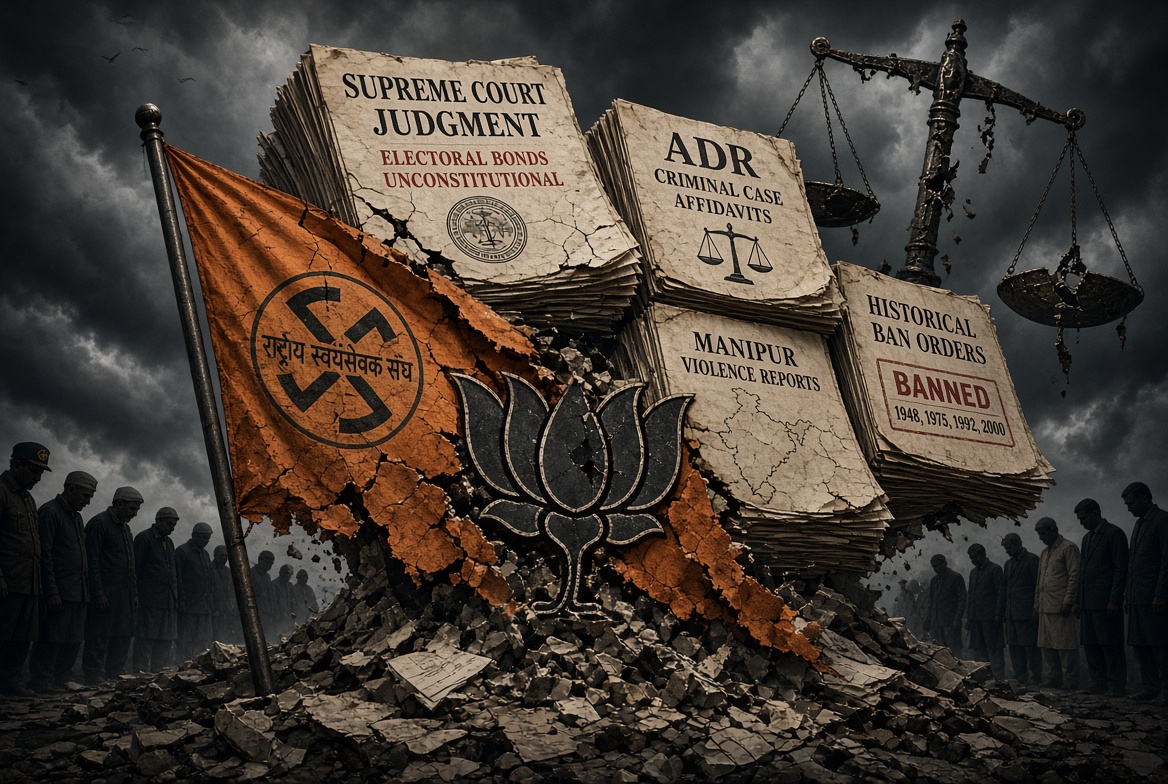
India does not belong to the Rashtriya Swayamsevak Sangh. It does not belong to the Bharatiya Janata Party. The RSS, founded in 1925, is an unregistered voluntary organisation. The Indian state banned it three times: in 1948 after the assassination of Mahatma Gandhi by Nathuram Godse, a former member, with the official communique stating the purpose was to root out “forces of hate and violence”; in 1975 during the Emergency; and in 1992 after the demolition of the Babri Masjid. Each ban was later lifted. These are matters of public record.
Its political vehicle held national power for most of the past fifteen years. The record of that period is written in court judgments, statutory texts, election affidavits and official statistics.
On 15 February 2024 a five-judge Constitution Bench of the Supreme Court of India unanimously struck down the Electoral Bonds scheme introduced by the BJP-led government. The Court held that absolute anonymity violated voters’ right to information under Article 19(1)(a) and that unlimited corporate contributions were arbitrary and violated Article 14. The BJP was the largest beneficiary. The judgment ordered disclosure. That finding stands.
The Citizenship Amendment Act, 2019, creates a fast-track path to citizenship for Hindus, Sikhs, Buddhists, Jains, Parsis and Christians from Pakistan, Bangladesh and Afghanistan who entered India on or before 31 December 2014, while excluding Muslims from that religious classification. The text of the law is explicit.
In 2023 the law governing appointment of the Chief Election Commissioner replaced the Chief Justice of India on the selection committee with a Union Cabinet minister. Gyanesh Kumar became the first CEC appointed under this Act in February 2025. Opposition members of the committee recorded objections. The validity of the Act remains under challenge. Special Intensive Revision of electoral rolls has produced further controversy and reported internal objections within the Commission.
Association for Democratic Reforms analyses of self-sworn affidavits show that in the 2024 Lok Sabha 251 of 543 MPs (46 percent) declared criminal cases; 170 faced serious charges. Of the BJP’s 240 winners, 94 (39 percent) declared cases and 63 (26 percent) serious ones. Across sitting MPs and MLAs the BJP accounted for the highest number with cases related to crimes against women (54). Many cases remain pending. The pattern of candidates facing rape, murder, attempt-to-murder and related charges is documented across parties; the BJP holds the largest absolute numbers because of its size. The political system as a whole has long treated such cases as compatible with public office.
Amit Shah was named by the CBI as an accused in the Sohrabuddin Sheikh encounter case. He was discharged in December 2014. Remaining accused were later acquitted. The Supreme Court has declined to reopen the discharge. Courts found the prosecution’s case insufficient.
Manipur’s ethnic violence between Meitei and Kuki-Zo communities began in May 2023 under a BJP state government. Deaths exceeded 250 and displacements reached tens of thousands. Arms were looted from police stations. Central forces were deployed; the state chief minister remained in place for an extended period before resigning. The conflict has not been fully resolved years later.
The 2024 NEET-UG examination saw confirmed paper leaks, including in Bihar. The CBI filed chargesheets and made arrests. The education minister eventually took moral responsibility for loss of faith after initial denials of large-scale irregularities.
NCRB data for 2024 recorded 10,546 suicides in the farm sector. The numbers remain high in Maharashtra, Karnataka and other states. The agrarian distress is decades old and continues.
Pegasus spyware allegations surfaced in 2021 via leaked lists that included numbers of opposition figures and journalists. Forensic analysis confirmed infection or targeting on some Indian phones. The Supreme Court ordered an inquiry. The government did not confirm use.
Adani Group companies faced Hindenburg Research allegations in 2023. SEBI investigated and dismissed key claims of stock manipulation and related-party violations. Stocks recovered. Political allegations of preferential treatment continue; no court has convicted the group of the fraud alleged by the short-seller.
Pulwama (February 2019) killed 40 CRPF personnel. Jaish-e-Mohammad claimed responsibility; the NIA chargesheet named Pakistan-based leadership. Intelligence inputs existed that were not acted upon effectively according to reporting. Official findings point to Pakistani-based planning. Claims of government orchestration remain unproven.
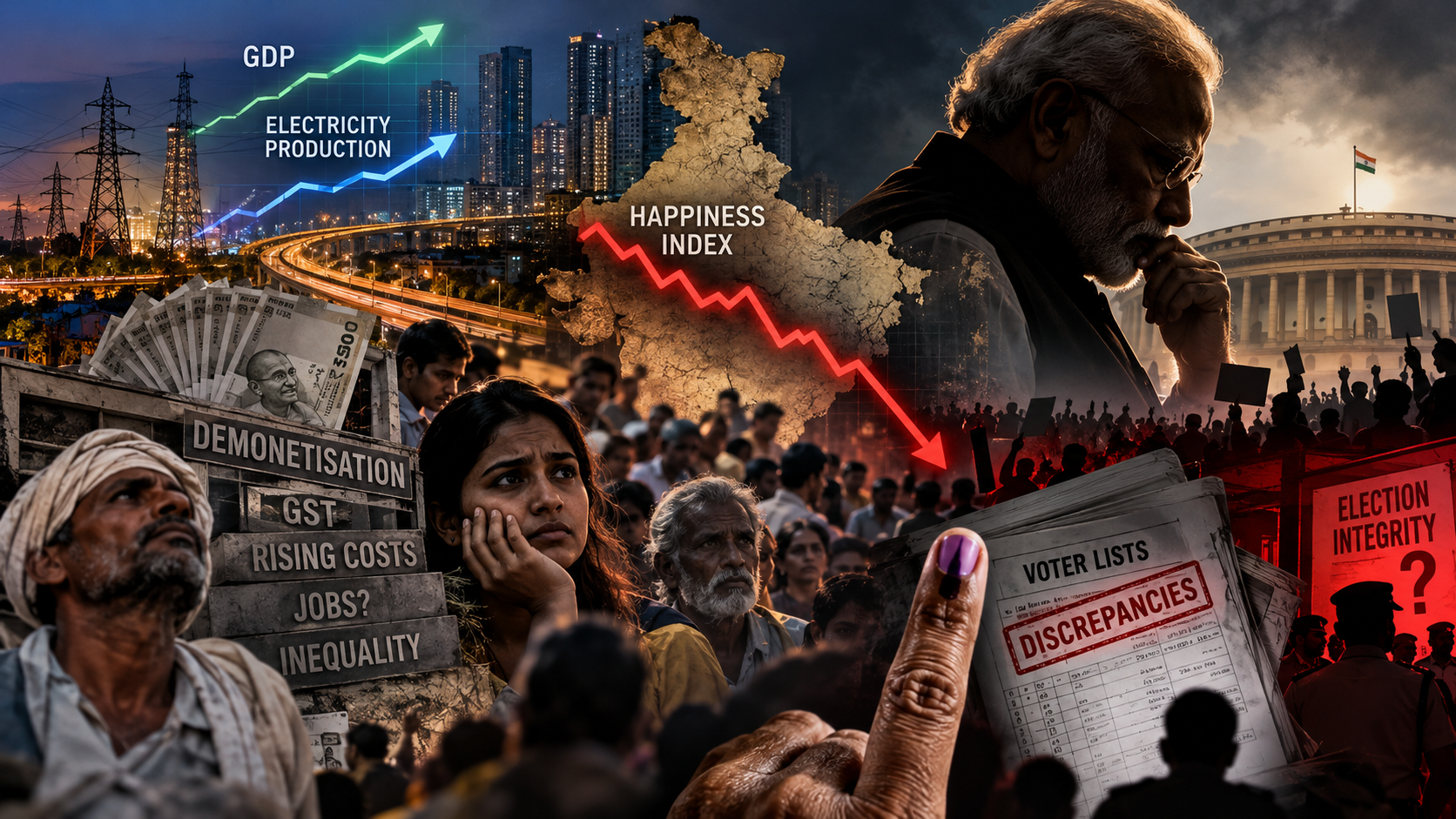
The cumulative public record—an organisation banned thrice, a funding scheme declared unconstitutional, a citizenship law that classifies by religion, an election-commission appointment process rewritten to favour the executive, high numbers of candidates with serious criminal cases, prolonged ethnic violence, examination leaks, persistent farm-sector suicides and unresolved surveillance allegations—shows an ecosystem that concentrated power while expanding opacity and selective accountability. Younger generations inherited higher stakes in examinations that leaked, institutions whose independence was reduced by design, and a public culture in which large-scale violence and agrarian distress continued.
The author holds that the intentions visible from the organisation’s history and the governing record have been malign in their effects on equal citizenship and institutional trust. The past fifteen years are unforgivable in their consequences for Gen Z and Gen Alpha. When this ecosystem leaves office, the documented record will remain. India is greater than any unregistered organisation or the party that draws its cadre from it.