

Original Coverage & Source Attribution: www.jpost.com
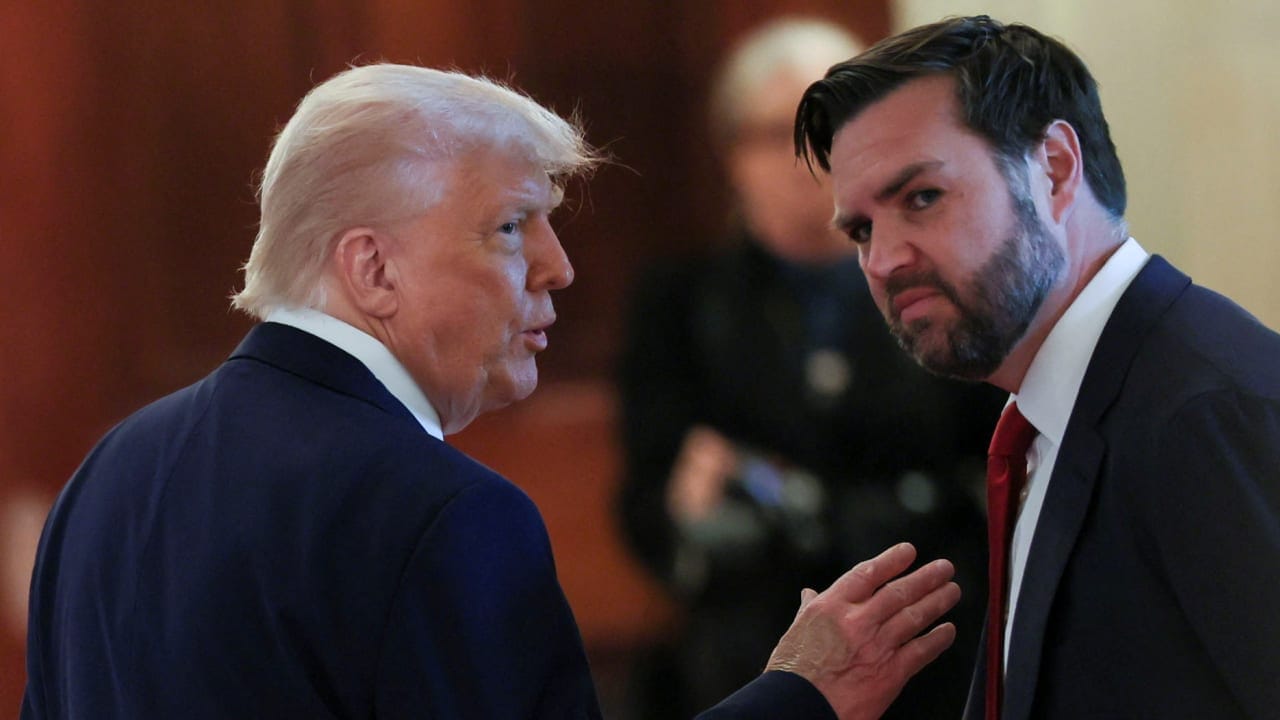
Although US President Donald Trump has sought to destroy Islamic terrorism and its foremost global sponsor, the Islamic Republic, he confirmed Wednesday that Vice President JD Vance had written to a senior official of Iran’s occupying and repressive regime, days before the midterm elections, under the latest delusion and mirage called “peace negotiations.”
For the vice president of a nation considered the cradle of democracy and the rule of law to contact Mohsen Rezaei, secretary of Iran’s Supreme National Security Council, an Islamic criminal, and veteran terrorist of the Mansouroun group, is grotesque.
Trump said Vance had sought his approval: “I said if you want to do that, that’s OK.” What value does writing to a terrorist have? What credibility does it confer? What has happened in the White House that the delusion persists that “destroying and changing the regime in Tehran” remains taboo?
What stands in the way? The White House’s willingness to endure such humiliation by a criminal sect in the 21st century is astonishing. Is there fear? Of what? Is there a deal? Is this a game?
Rezaei is a former commander of the Islamic Revolutionary Guard Corps, and his influence in Tehran is growing. On Sunday, he met with a delegation from Pakistan, Saudi Arabia, and Turkey. But that is not the whole story.
In 2005, I sought to cooperate with Langley and told two prominent Iran desk officials that examining the government’s layers was essential to understanding the ruling establishment. In 2012, a Langley official met me in Athens, and our meetings continued in Washington.
We exchanged photographs, including one of my 2003 meeting with Rezaei following the American invasion of Iraq. My research then concerned Iraq, and former Iraqi president Jalal Talabani had arranged the meeting. General (ret.) Michael Hayden, former CIA director, also visited Iraq, and I saw him at Talabani’s residence, where he gave numerous gifts to Hayden and his family.
Although the Barzanis (affiliated with the Quds Force), the KDPI and Komala (connected to the regime’s Supreme National Security Council in Tehran), and the People’s Mojahedin Organization of Iran (MEK) cropped the photograph, removed Talabani’s representative and Iraq’s ambassador to Tehran, and placed me beside Rezaei, they did not know Langley possessed the original photograph and knew the circumstances of the meeting.
Such is the backward culture, immorality, and cesspool of the fake, self-proclaimed Iranian opposition, and nothing can be done about it. Throughout my friendly relationship with Langley, I consistently advised that if regime change was the goal, attention must focus on the government’s layers in Tehran.
Apparently, I was an uninvited guest, and we parted respectfully. Yet my respect endured.
Later, through my Middle East research and conversations with political and intelligence figures, I learned that Rezaei was eager to visit America after sending his son there. He also sought contacts with former SAVAK figures.
His son was a guest of the Constitutional Party in America and even met the crown prince, which did not escape Langley’s attention. Rezaei wanted the Washington Institute to invite him to discuss the Iran-Iraq War. The CIA opposed it because Rezaei’s name, alongside Ahmad Vahidi’s, had surfaced in connection with the AMIA bombing in Argentina.
He wanted former SAVAK and CIA figures to meet him in Pakistan, but the American Embassy there was unprepared, and the meetings were canceled.
The CIA knew that during the war’s early years, Rezaei had assassinated anyone he suspected of Soviet ties. He was among the ignorant, uneducated military commanders who deliberately prolonged the Iran-Iraq War, inadvertently contributing to the erosion of Ruhollah Khomeini’s regime.
Rezaei always distrusted and resented Langley. He believed they intended to eliminate him. His faction helped pave the way for Qasem Soleimani’s elimination, as intelligence reached the CIA from the labyrinthine IRGC intelligence offices in Tehran.
During Gina Haspel’s tenure, that intelligence enabled the veteran CIA counterterrorism official to eliminate Soleimani on Trump’s orders. Ostensibly, Rezaei has opposed negotiations with the United States and threatened this month to expand Iranian attacks against targets in neighboring Arab countries, including data centers and internet cables.
The CIA knows this unruly, obstinate, cowardly rogue, his willingness to make deals, and his incalculable corruption.
Although the timing of Vance’s contact and the contents of the letter remain unclear, judging by his mindset, one can assume the message proposed a new negotiating framework. Vance seems not to have listened to the radio, read a newspaper, or heard the news in 50 years, unaware that Tehran sponsors terrorism.
His ears belong to the Islamic Republic’s notorious lobbyists on American soil. Just as former president Joe Biden sought to study the fictional Hidden Imam, a mythical figure invented by the Shi’ite mullahs, Vance imagines diplomacy is possible with Islamic terrorists like Vahidi and Rezaei.
For now, through lies, deception, and trickery, they have kept Mojtaba Khamenei’s name alive, although he probably does not actually exist, while neither the Mossad nor the CIA wishes to expose the matter. IRGC terrorists run the country, but the regime is a paper tiger.
‘Another little Epic Fury’
Meanwhile, power struggles within the junta are intense. The mullahs and the IRGC have read Trump’s cards, and however often he threatens to resume bombing Iran after the November 3 congressional elections, declaring, “We may do another little Epic Fury,” his warnings fall on deaf ears.
Trump is adrift and eager for an agreement, even one of just two lines, while the Shi’ite mullahs and the IRGC mock him, offer no concessions, and undermine his credibility among Iranians and internationally. Vance bears part of the blame, continuing to contact regime hardliners to revive dead, fruitless, protracted, and deceitful negotiations.
He fails to grasp that the Islamic Caliphate of the Shi’ite mullahs is fundamentally one entity, with neither hardliners nor moderates. He refuses to recognize that the junta controls the hard core of power.
What will history say about the White House seeking to revive peace negotiations in 2026 by contacting Rezaei, an Iranian Islamic terrorist, through a diplomatic channel? A futile effort.
The letter was sent at Trump’s direction, with his knowledge of this shameful, nauseating, fake diplomatic initiative. Where else does anyone seek common ground to avert war and engage a terrorist ruling within a warmongering, crisis-producing regime?
Unfortunately, neither Trump nor Vance understands the nature and mentality of the hard core ruling the Islamic Caliphate and religious dictatorship of the Shi’ite mullahs under the Islamic Republic. They cannot even explain the rationale for such an undertaking. This is no diplomatic initiative; merely a game of words.
It is irresponsible and immoral to describe contacting a terrorist and criminal as “an effort to provide humanitarian assistance.” Medical equipment and essential supplies never reach Iranian patients, and this regime is fundamentally the enemy of Iran and Iranians.
Ninety million people, subjected to oppression, repression, executions, and tyranny, crying out for life or death, await freedom. Amid their revolution, Trump and Vance’s voices sound like a discordant tune, a brand of shame.
Washington’s conditions for ending the war with Tehran’s warmongering, crisis-producing regime seem equally meaningless: wars must first be won, then negotiated, not fought without objectives or plans. One day, Vance will surely wake at eight in the morning to learn that the Shi’ite mullahs have built their atomic bomb.
He still fails to recognize that the Shi’ite mullahs and the IRGC will announce their nuclear weapon. If securing commitments from terrorists means anything, why not let them establish charitable, educational, and medical centers in America for Muslims worldwide?
Someone should remind Vance that Rezaei once hunted Americans alongside his Mansouroun terrorists in pre-revolutionary Iran. Or does the White House now intend to reward such a man with a weekend at Camp David?
The writer is a Middle East political analyst. His latest book, Tehran’s Dictator, examines the theocratic era of Ali Khamenei (1989-2026). @EQFard



