

Original Coverage & Source Attribution: www.btpm.org
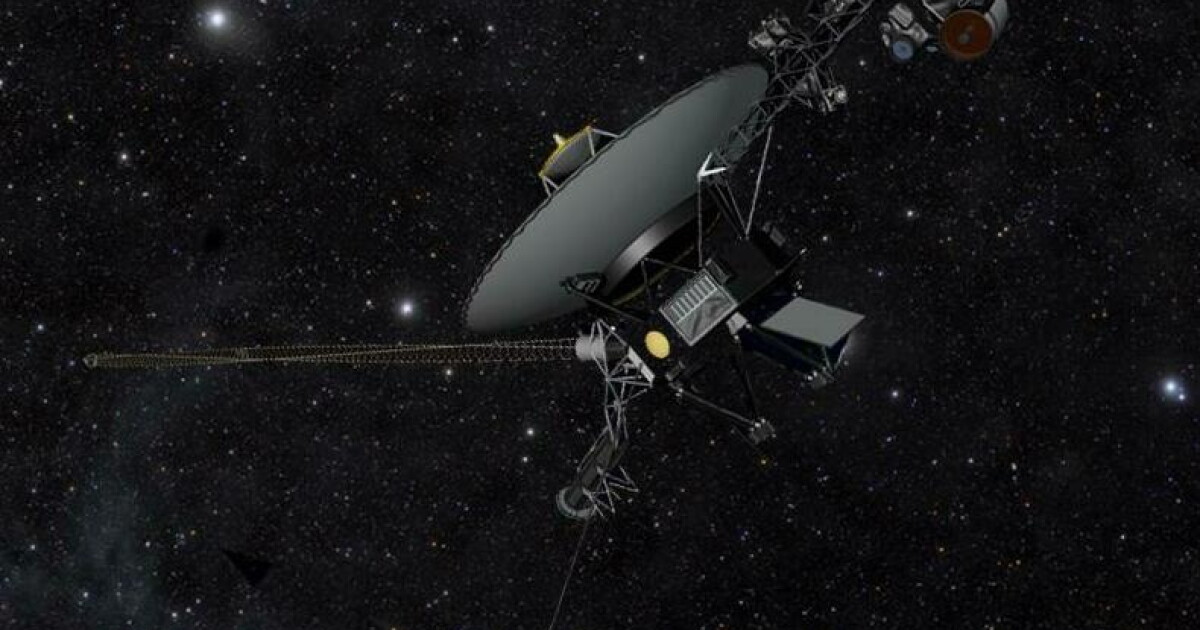
Voyager One was launched in 1977 and flew by the planets Jupiter and Saturn in 1979 and 1980, respectively, before continuing on a trajectory away from Earth and eventually out of the Solar System. On Wednesday, November 18, the spacecraft became the first human-made object to travel a distance beyond one light day.
“That’s the distance it takes light to travel in one day’s time,” explained Tim Collins, a board member of the Buffalo Astronomical Association. “Basically, when you send a signal to Voyager One, which they’re still doing, it takes one day to get there, and it takes one day to get the response.”
NASA indeed continues to send and receive data from Voyager One nearly five decades later, covering a distance of more than 16 billion miles.
Powered by plutonium, Voyager One began its journey operating on about 470 watts of electricity. Due to half-life decay of that plutonium, the spacecraft now runs on only a fraction of that original wattage. Over the years controllers on Earth have shut down eight of the ten scientific instruments aboard Voyager One. It is expected to run out of sufficient power to operate its remaining functional equipment sometime within the next few years.
Even on much lower power, and so far away, NASA is still receiving data.
“It can still measure the strength of magnetic fields in interstellar space. That’s one of the things being looked at, and also plasma waves too, to give you an idea of what the density of plasma in space is right now,” Collins said. “They’re really the only two things left on Voyager One that are still working and still able to conduct any kind of scientific experiment.”
Voyager One took plenty of photographs of Jupiter and Saturn, as well as some of their moons. Perhaps one of its most iconic pictures was among its last, the “Pale Blue Dot” image of Earth snapped on February 14, 1990 from about 3.7 billion miles away.
Voyager Two, launched 16 days before Voyager One, has also entered interstellar space. That spacecraft also visited Jupiter and Saturn but then also flew by Uranus and Neptune. It’s currently about 13.4 billion miles from Earth and is not expected to clear the light day mark for a few more years.
“We’re looking at maybe 2035, approximately, before Voyager 2 reaches that line,” Collins said. “For Pioneer 10 and 11, early 2040s to late 2040s for those two, and New Horizons somewhere around 2063, which is after the next appearance of Halley’s Comet.”



