

Original Coverage & Source Attribution: www.newyorker.com
Professional authors are, in some sense, the original work-from-home knowledge workers. As we approach a post-pandemic world in which telecommuting will be more common, we might observe with concern how far these writers are willing to go to escape having to work in their actual homes.
The retreat to eccentric near-home workplaces has been a common experience during the pandemic, and we’ve learned that performing useful cognitive work is a fragile endeavor, one in which environment matters. “I don’t want anything in there,” Angelou said, when elaborating on her spartan hotel habit. “I go into the room and I feel as if all my beliefs are suspended. Nothing holds me to anything.” The home is filled with the familiar, and the familiar snares our attention, destabilizing the subtle neuronal dance required to think clearly. When we pass the laundry basket outside our home office (a.k.a. our bedroom), our brain shifts toward a household-chores context, even when we would like to maintain focus on our e-mail, or an upcoming Zoom meeting, or whatever else that needs to get done. This phenomenon is a consequence of the associative nature of our brains. Because the laundry basket is embedded in a thick, stress-inducing matrix of under-attended household tasks, it creates what the neuroscientist Daniel Levitin describes as “a traffic jam of neural nodes trying to get through to consciousness.” Angelou, by shifting her work to a hotel room with bare walls, was cultivating an effective mental space to compose poetry by calming her relational-memory system.
Home is also rich in salient interruption. The human brain is adept at filtering out superfluous incoming information, but if this superfluous information is relevant to us it becomes difficult to ignore. The cognitive-science pioneer E. Colin Cherry famously dubbed this “the cocktail party problem”—in reference to the common experience of suddenly cueing your attention to the sound of your own name popping up in conversation across the room at a noisy party—and it helps explain why it’s possible to work productively for hours at a bustling coffee shop, only to have your attention hijacked when you hear a familiar topic arise in a neighboring conversation. Viewed through this perspective, your home, at times, can feel like a coffee shop in which all the patrons are talking about things that you care about. Benchley’s willingness to put up with the bangs and clangs of furnace assembly makes more sense once you learn that he had two young kids in the house during this period. The sound of hammers is not nearly so arresting as the sound of your own kids’ whining.
Historically, writing was one of only a small number of professions that required demanding cognitive work outside the context of an office or workshop. The coronavirus pandemic has radically increased the amount of knowledge work that will be conducted at home, with one recent survey of hiring managers predicting that more than twenty-five per cent of the United States workforce will remain remote next fall. The same motives that drove Angelou to a bare-walled hotel room and Benchley to a furnace-supply company will now suddenly apply at a large scale. This matters. Many workers won’t be returning to an office anytime soon, but having them relocate their efforts entirely to their homes for the long run might be unexpectedly misery-inducing and unproductive. We need to consider a third option for our current moment, and if we look to authors for inspiration then one such alternative emerges: work from near home.
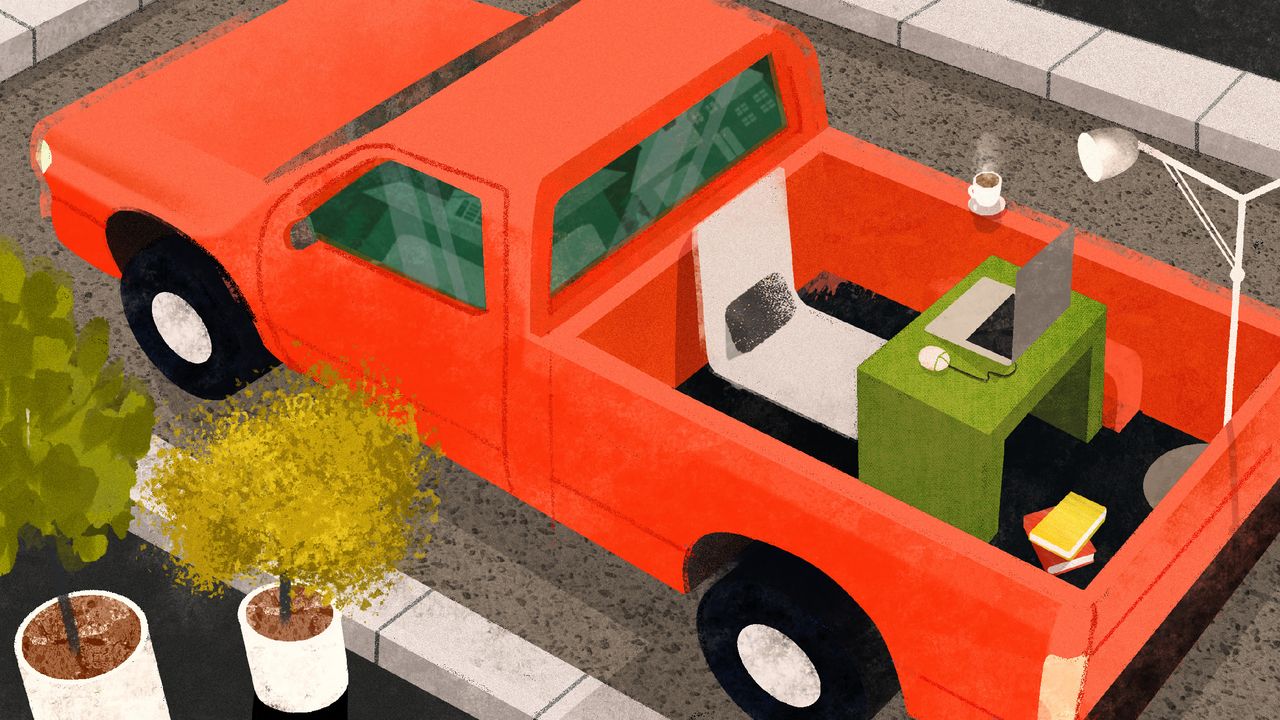
Here’s my proposal: organizations that allow remote work should not only encourage these employees to find professional spaces near (but distinct from) their homes—they should also directly subsidize these cognitive escapes. The cost need not be prohibitive. If we turn back to our author examples, we see that a workspace doesn’t need to be aesthetically pleasing, or well-equipped, or air-conditioned (or even have walls or a roof!) in order to support better work than what’s possible at home. A co-working space, a small office above a Main Street store, a rented garage apartment, or even a spruced-up shed can enable a much more satisfying and effective experience tackling cognitive work than the laptop on the kitchen table, or the home-office desk in the bedroom. Not all work needs to be completed in these near-home locations—Steinbeck, for example, had a standard office that he used in addition to his fishing boat—but simply having the opportunity to reset your environment when needed can make a big difference for the type of efforts typical of this new class of remote workers.



