Original Coverage & Source Attribution: www.hellenicshippingnews.com
Schedule reliability has fallen to near record lows in recent months, while port congestion has built up. In this opinion piece, Drewry experts draw the main lessons from the operational problems of the 2026 peak season to inform concerned shippers, forwarders, carriers and ports.
Look at it from the viewpoint of a shipper moving goods by containership on the Asia-Europe route. The proportion of ships on this route which arrived on the scheduled day of arrival declined from 51% in May to just 31% in September (average of all ports and all carriers), according to the Drewry Container Capacity Insight.
Even the Gemini alliance, which has a higher-than-average track record for on-time arrivals, managed just 34% in September.
All the ocean carriers under-perform on schedule adherence on this route.
Shippers and forwarders are increasingly aware that, not only are the ships arriving late, but also a proportion of the intended sailings do not happen (so-called “blank sailings”). If we combine the 2 types of unpredicted changes and delays, then the proportion of performed and on-time sailings on the Asia-Europe route falls to about 29% in September.
Not all carriers and alliances are the same. The Asia-Europe trade’s schedule reliability scores by carrier in September ranged between 19% and 38% and the proportion of sailings not cancelled ranged between 0% and 23%, according to Drewry’s analysis for this route.
Informed and realistic shippers and forwarders, therefore, must conclude that the best they can do is to monitor and compare their providers’ shaky schedule adherence, switch to those who are above-average when possible… and build “buffer time” in their supply chains. This is because the cargo will, more often than not, arrive later than promised by the carrier at the time of booking. Peak season buffer time may need to be longer, too.
If ocean carriers are under-performing on schedule adherence, they can still say that many ports and terminals, particularly in Asia, have been gridlocked during the summer, making it impossible to meet scheduled arrivals and departures for their ships.
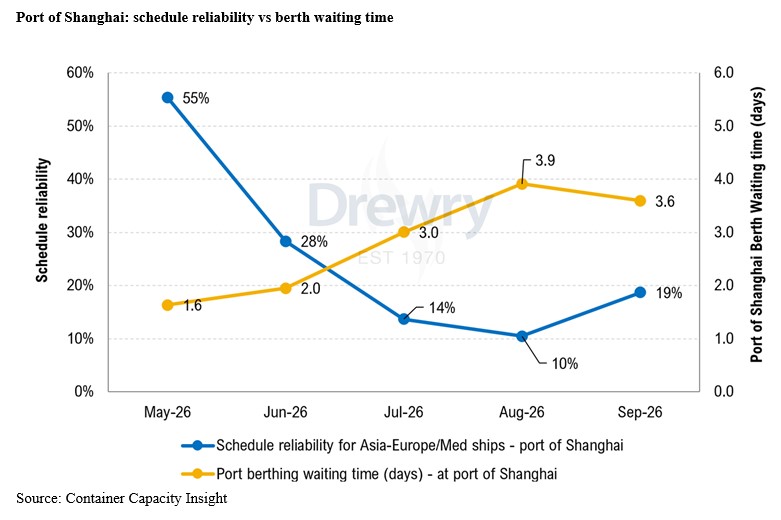
The data below shows the reverse relationship between schedule reliability for ships arriving at the port of Shanghai and berthing waiting times at the port of Shanghai.
The picture is fairly clear: when berth congestion in the port of Shanghai rose from about 1.6 to 3.9 days, Shanghai reliability collapsed from 55% to 10%. The all-ports figure on schedule reliability for all Asia-Europe ships also followed it down.
By contrast, there is no close statistical correlation between berth congestion at the port of Rotterdam, Europe’s largest container port, and Asia-Europe schedule reliability for ships arriving at the port Rotterdam. The lesson then is that it is critical to watch and monitor port congestion at the big Asian ports – as this influences schedule reliability on many routes.
Another lesson is the somewhat counter-intuitive link between the worsening of port congestion in Shanghai during the peak season and the increase in the proportion of Asia-Europe sailings not cancelled.
Looking at this from a carrier viewpoint, the logic is that cargo volumes were strong in the peak season, port congestion got worse in Asia, but the carriers could make higher profits by throwing more ship capacity at the market and cancelling fewer sailings… which must have made port congestion worse.
Another conclusion, Drewry believes, is that recent months have shown that timely operations by ports and by ocean carriers did not rank at the top of their priorities. (See Drewry’s recent opinion piece on this here www.drewry.co.uk/news/port-congestion-is-getting-worse-in-container-shipping-who-is-responsible )
Our view: Schedule reliability and port congestion are likely to remain significant challenges for the industry, and there is little to suggest that these pressures will disappear anytime soon.
For shippers, the question is what they can do differently. Simply allowing more time is one option, but it doesn’t necessarily address where the risks sit within their supply chains.
At Drewry, we are looking more closely at how carrier performance, port congestion and network exposure can be brought together to give shippers a clearer picture of where they may be vulnerable. It is not about predicting every disruption, but about understanding the risks and making better-informed decisions.
Ultimately, the aim should be to move away from simply reacting to delays and towards building those risks into carrier selection, procurement strategies and contingency planning.
After all, knowing that a vessel is likely to be late is useful. Understanding what that delay means for your supply chain, and what you can do about it, is far more valuable.
Note
Unlike other market intelligence providers, who calculate schedule reliability by comparing actual times of arrival (ATA) and estimated times of arrival (ATA) published around 15 days before the arrival, the Drewry Container Capacity Insight online tool follows a more demanding methodology which aims to compare ATA vs ETA published close to the time of booking. Therefore Drewry collects ETAs between 2 weeks and 6 weeks before vessel arrival.
Source: Drewry