

Original Coverage & Source Attribution: the-decoder.com
AI models keep getting better, but putting them to work mostly creates friction, a new Anthropic report finds. Review bottlenecks, employee pushback, security risks, and outdated custom tools are dragging down many enterprise projects.
Anthropic’s researchers conducted 66 in-person interviews at 58 US companies for the qualitative study, from AI startups to established firms in law, construction, finance, medicine, and manufacturing. The authors note that the sample isn’t representative because every participant is an Anthropic customer. Still, it offers a detailed look at nearly 300 real-world AI deployments.
The findings from the “Working with AI” report amount to a reality check for anyone expecting quick efficiency gains. Respondents say 55 percent of the deployments studied produced higher output or better quality. But almost one in five (19 percent) still delivers no business value. Those deployments get stuck in internal bottlenecks (6 percent), lose their time savings to review work (5 percent), or have unclear effects (8 percent).
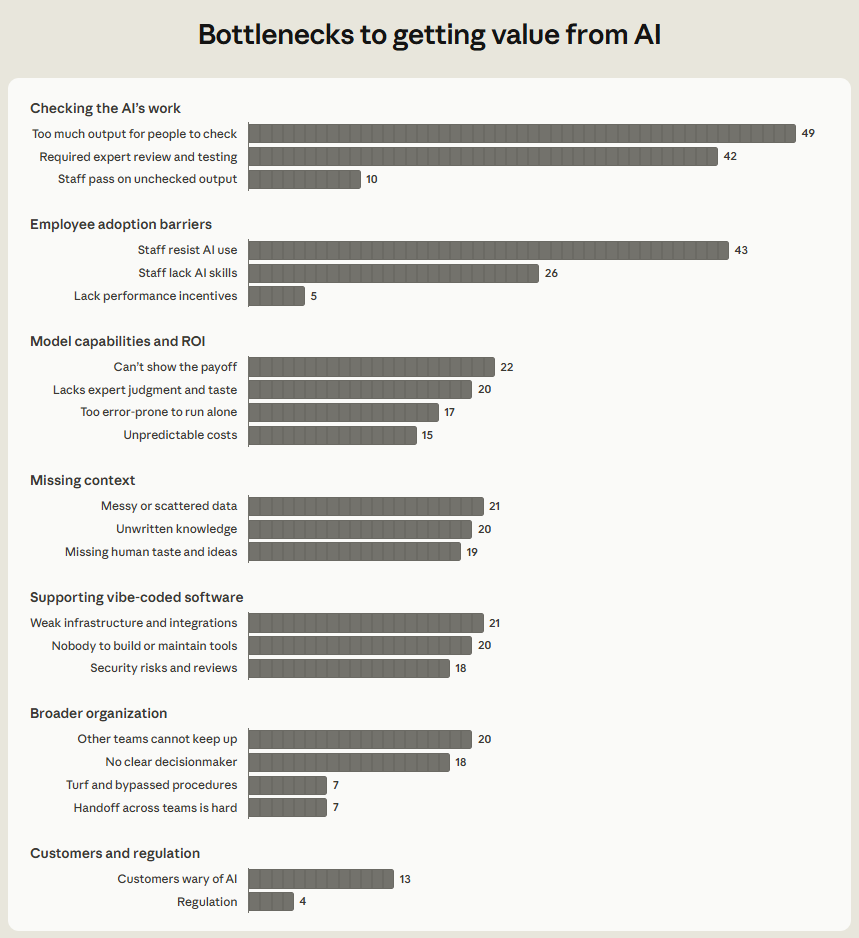
External hurdles like regulation (4 mentions) and skeptical customers (13 mentions) barely came up. The real pain happens inside the companies themselves, according to the report.
AI output overwhelms reviewers and sparks workplace friction
The most common obstacle cited in Anthropic’s full report (PDF) is the volume of AI output that humans still need to check (49 mentions). Employee resistance (43 mentions) and required expert reviews and testing (42 mentions) rank close behind. In one case, an AI agent added one stray “S” to an API call and derailed a carefully planned software release.
AI also tends to speed up only parts of a workflow while other departments fall behind (20 mentions). One industrial equipment maker found that AI could translate its product interface text into 10 languages with ease. The company shut the feature back down because nobody on staff could field customer support calls in those languages.

That uneven pace breeds day-to-day conflict as power users flood coworkers with AI-generated text. The report mentions “Claude grenades” and “Claude cannons,” as when an employee casually sends IT seven pages of AI-written instructions.
Skeptics push back and refuse to read AI-written emails at all. One frustrated executive put it bluntly, saying, “A mediocre engineer with an AI is a menace to society.”
Anthropic’s findings echo the broader “workslop” debate. In a survey by BetterUp Labs and the Stanford Social Media Lab, 40 percent of US workers said they regularly receive shallow AI content from colleagues. Workers spend an average of nearly two hours dealing with each incident, and the survey found that trust within teams takes a hit.
Job fears drive quiet resistance among employees
Employee resistance is the second most common obstacle in Anthropic’s study, with 43 mentions. Pushback is most visible when companies roll out AI from the top down to automate entire workflows.
Only two of the 58 companies reported direct layoffs tied to AI automation, and five dismissed workers who refused to use AI. But the hiring impact is already visible. Two-thirds of the companies surveyed are hiring fewer people because of AI. Nine firms also cut outside contractors, mostly offshore roles in software development, customer support, design, and legal services.
That creates a dilemma for skilled workers, the report says. They’re asked to use their knowledge to build and review the very AI systems that could make their own jobs obsolete. “If I’m open to this, I’m essentially building my own coffin,” one employee told the researchers. One manager said she woke up at 3 a.m. worried about her career and asked Claude how she could protect herself from being replaced.
In practice, that fear triggers both open and quiet pushback. When one company tried to speed up application reviews with AI so it could skip 90 percent of its planned hires, human reviewers dragged their feet. Some still took more than 10 minutes per case when two minutes would have been enough.
At one law firm, conflict staff pushed back against an AI workflow that left them to handle complex potential conflicts previously passed to attorneys. The firm shelved the agent and returned to its old process.
Workers pocket time savings as top-down automation stalls
Other employees keep AI-driven time savings for themselves, the report says. In roughly a tenth of the cases studied, the benefits went directly to workers in the form of more pleasant work or simply less of it. Another frustrated executive said their employees deliberately hide AI gains. “They don’t want you to know, because they want to use those 10 hours a week to go walk their dog,” the executive said.
The Decoder newsletter
The AI week in five minutes
Every week, our editors pick the AI news that matters. No hype, no spam.
Free and weekly. Unsubscribe any time.
Workers also worry about tighter monitoring. Several companies use AI to track staff closely, with daily reports on hourly throughput and error rates, for example, or automated scoring of customer calls. One executive called it a “panopticon effect” in an interview.
Many top-down automation projects also turn out to be brittle. Expensive custom tools often become obsolete within months as AI models improve rapidly, or they end up as rarely used “zombie” apps. “It’s almost like we’re trying to throw darts at a spinning dart board,” one executive said of those investments.
Employee-built AI apps turn into maintenance and security traps
Handing employees AI tools and counting on grassroots initiative only goes so far, Anthropic’s researchers say. Nontechnical staff do report impressive wins from “vibe coding,” building their own tools with plain-language prompts. One accountant built an app to automate an 80-hour audit of workplace retirement plan contributions.
But standalone projects like that often fall apart in the last mile. Months later, the accountant’s prototype still wasn’t in production because an outside contractor had to build the final version. Companies frequently lack stable technical infrastructure (21 mentions) and staff for maintenance and support (20 mentions). The operations lead at a large law firm considered building custom recruiting dashboards but said off-the-shelf software at $30 to $100 a month is less work to maintain.
Security risks are also growing (18 mentions). “Every single employee now is a developer… creating additional attack surface every day,” one data security chief warned. Individual workers usually lack the authority to change how work is divided across a company.
Gains stay small unless companies restructure how they work
Anthropic’s data shows a clear link between bigger organizational changes and higher self-reported value from AI. Simple tools that fit into daily work without structural changes, such as presentation tools and quick data queries, often bring only small gains, respondents said.
The report outlines three ways companies are reshaping their organizations around AI. Some broaden job roles so individuals or small teams own entire workflows, cutting coordination overhead.
Others shift employees toward tasks AI can’t handle, like strategic decisions, customer relationships, and quality review. Still others build shared, secure data and IT infrastructure so nontechnical staff can work with clean data instead of drowning in a mess of it (21 mentions).
Even this approach doesn’t guarantee against job losses, Anthropic’s researchers acknowledge. Across all three strategies, though, the report’s central finding holds: the biggest pain points in AI adoption don’t come from weak technology but surface where companies try to force new tools into old structures.
Our “AI Radar #2” report on why AI productivity disappears between benchmarks and balance sheets shows how individual time savings and measurable productivity gains can diverge. Workers who use generative AI save an average of 5.4 percent of their work time, according to that analysis. It’s still not clear whether or when that potential will show up in measured productivity data, the authors note.



