

Original Coverage & Source Attribution: healthjournalism.org
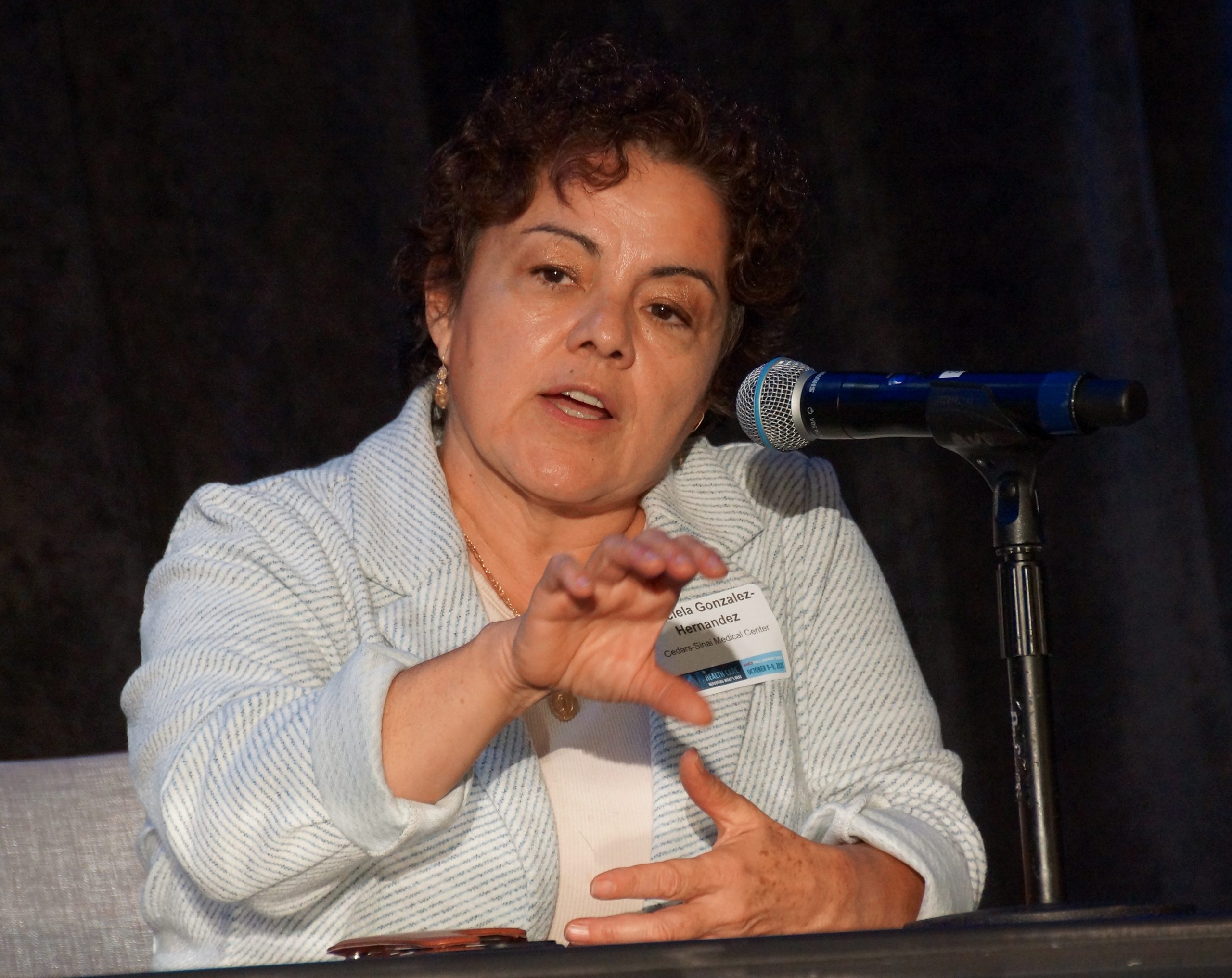
Graciela Gonzalez-Hernandez, Ph.D., professor and vice chair of research and education in computational biomedicine at Cedars-Sinai Medical Center, discusses the role of artificial intelligence in medical education during AHCJ’s fall summit in Los Angeles (Photo by Erica Tricarico/AHCJ)
- Moderator: Eli Cahan, M.D., M.Sc., investigative journalist, Rolling Stone; fellow in neonatal intensive care, Stanford University
- Tina Hernandez-Boussard, Ph.D., associate dean of research and professor of biomedical informatics, Stanford University
- Graciela Gonzalez-Hernandez, Ph.D., professor and vice chair of research and education in computational biomedicine, Cedars-Sinai Medical Center
When a team of American medical residents lost power during a mission trip in Uganda, their AI tool for interpreting heart scans went completely dark. Left to read the scans manually, the doctors hesitated, unsure of their skills.
Tina Hernandez-Boussard, Ph.D., associate dean of research at Stanford University, shared this story at AHCJ’s fall summit in Los Angeles to highlight a growing dilemma: how do we train future doctors to leverage AI without losing core clinical instincts when technology fails?
Health care leaders agree AI will assist physicians, not replace them. As Hernandez-Boussard put it, “AI is not going to replace radiologists, but it’s going to replace the radiologist that doesn’t know how to use AI.” Still, fitting AI into an already packed medical school curriculum isn’t easy.
The technology holds clinical promise — such as helping physicians identify rare conditions, reduce their administrative workload, and reason through clinical information more quickly. But it also risks short-circuiting the learning process medical students need to build foundational clinical skills.
A recent study found that 71% of 15,000 family medicine residents surveyed used AI in the past month for tasks like clinical decision support and searching through medical literature. Yet, just over a third had received any formal training on using AI over the previous six months. Researchers caution this can lead to “never-skilling” — where trainees rely on automated outputs instead of developing essential clinical reasoning.
Hernandez-Bousard compared the shift in training to modern commercial aviation.
“The pilot, they rely on autopilot all the time, but we know again and again [that] sometimes that fails and you have to be able to take the steering wheel and drive it home,” she said.
Some educators try to police AI use rather than adapt their teaching methods — an approach fellow panelist Graciella Gonzalez Hernandez, Ph.D., described as futile.
“If we spend our time, or the students’ time, their energy, and their intellectual capacity on ‘how I’m going to cheat my professor and make it look like I didn’t use AI,’ we’re just wasting our time,” said Gonzalez Hernandez, professor and vice chair of research and education in computational biomedicine at Cedars-Sinai Medical Center.
She added that faculty should serve as facilitators who teach responsible AI use.
Johns Hopkins Medicine announced a partnership on Oct. 13 with OpenEvidence — a medical AI platform for physicians — a step the prestigious academic institution said would help reimagine medical education and deliberately train future clinicians in an “AI native environment.”
“The arrival of AI, in many ways, invites us back to the bedside with new tools and capabilities we have yet to fully imagine,” said Sanjay Desai, M.D., vice dean for education at Johns Hopkins Medicine, in a press release.
“Working with OpenEvidence enables us to design and inspire, very deliberately, the model of education and the practice of medicine for this new era.”
But preserving human judgment is essential, Gonzalez Hernandez said, so that doctors can effectively use AI systems and spot errors or hallucinations when they occur. It’s why some educators are designing exercises that strip away digital tools to ensure that future physicians do not become passive observers. Some scenarios “are run with paper, pencil and a heart,” she said.
Gonzalez Hernandez added that automated medical systems remain reflections of human capability and expertise.
“There’s nothing artificial about AI,” she said. “There’s actually a whole base of human knowledge behind it.”
The full recordings of this panel discussion and more from AHCJ’s fall summit 2026 are available on our website.



