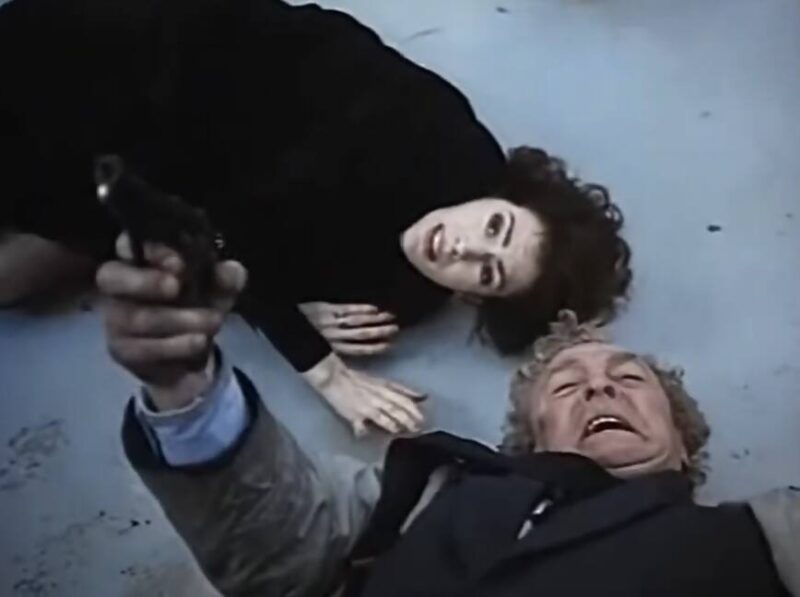
Original Coverage & Source Attribution: filmstories.co.uk
In 1992, Michael Caine teamed up with Sean Young and an uncredited block of frozen urine for the thriller Blue Ice. We take a fond look back:
The 1990s were Caine’s last decade as a consistent leading man before he moved more permanently into supporting actor elder statesman territory. The decade features some of his most forgotten work, but it also contains one of his most beloved and enduring roles as Scrooge in The Muppet Christmas Carol, his second Best Supporting Actor Academy Award win for The Cider House Rules, a return to his iconic spy character Harry Palmer for two TV movies, the villain role opposite Steven Seagal in Seagal’s directorial debut and the role he was born to play: yes, Joseph Stalin. Join me as I delve into Caine’s 1990s to see what gems I can unearth and what’s perhaps best left hidden.
NB: Spoilers for Blue Ice lie ahead.
Directed by: Russell Mulcahy (Razorback, Highlander, The Shadow, Resident Evil: Extinction)
Tagline: If Harry’s past ever catches up with him, he won’t live long enough to regret it.
Other Featured Geezers: Sean Young as Stacy Mansdorf, Ian Holm as Sir Hector, Bob Hoskins as Sam Garcia, Jack Shepherd as Stevens, Bobby Short as Buddy, Sam Kelly as George, Alun Armstrong as Osgood, Patricia Hayes as Old Woman.
What’s it all about, Alfie?: Caine is Harry Anders, a former cockney spy (to clarify, he’s still a cockney, just no longer a spy) who was fired from the Secret Service for putting a corny joke into action. “A Czech agent broke the rules. He hurt the wife of one of my sources. They asked me to ignore it. I couldn’t. I took him up onto the roof of my office building and the Czech bounced.”
Now, Harry owns a buzzing London jazz club, but he’s unwittingly dragged back into the world of espionage after a chance meeting with a beautiful American ambassador’s wife, Stacy (Sean Young), who apparently needs help dealing with a blackmailer. But, as is often the case with beautiful American ambassador’s wives called Stacy, all is not as it seems.
There are murders, a suspicious Royal Mail van containing assassins (the real post office scandal, take on that Mr Bates!), and a surprise appearance by a gun-toting Bob Hoskins near a Haagen-Dazs van. It’s all kicking off in Blue Ice, but with nary a Tango Ice Blast in sight.
Caine-ness: Caine is first billed, followed by Sean Young, and Caine’s the main draw for this otherwise unassuming B-movie. He may be the lead, but it’s still something of a step down from the type of higher profile films that he was headlining during his Hollywood heyday.
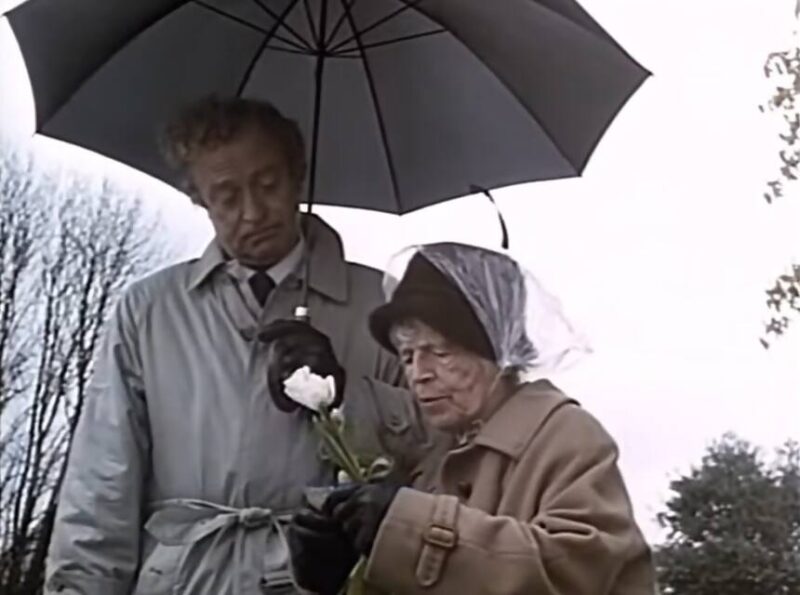
Caine, as Harry Anders, first appears two minutes in, attending a funeral in a rainy graveyard, holding an umbrella and carrying flowers. Initially we don’t see his face, only his lower body as he approaches an old lady (played by Patricia Hayes, who cornered the market in playing old ladies during her prime in films such as A Fish Called Wanda).
“Friend of yours?” She asks, referring to the deceased.
“Customer. Well, ex-customer,” Harry replies.
Then the lady asks what the bloke died of and, buckle in, because this is where we get Caine saying the title of the film, and this big moment suitably coincides with us seeing Caine’s face for the first time as he responds, “Blue ice”.
Now, I don’t know about you, but I didn’t know what blue ice actually was, and so was surprised by Harry’s subsequent explanation of what the title means.
“He was sitting in his car outside a warehouse at Heathrow airport, when this great big chunk of ice, the size of a refrigerator, broke off a jumbo jet toilet compartment and crashed straight through the roof of his Jaguar. Stone dead.”

Alternatively, this film could have perhaps been called Ice Lolli-poop or Haagen-Piz. Both would have been more honest marketing.
You may be asking, since this is the film’s title and something established in the first act, will this film be about Harry taking on the corrupt plane toilet manufacturing industry to avenge his friend? Sadly, it isn’t, and blue ice is treated more as a metaphor for the film’s subsequent events. Thus the airlines are free to deposit frozen blocks of human waste and disinfect onto unsuspecting British taxpayers.
Fortunately, we are saved from contemplating these free-falling biowaste horrors for too long by the distracting light relief of Caine’s breezy and charismatic central performance, such as when the old lady asks if Harry’s joking about the blue ice. He snaps back, affronted, that if he was joking would he be standing there, “£20 out for a wreath?”
But we then get our first indication that Harry may have something of a dark and dangerous background as, after the lady says that the death was tragic, Harry counters with, “Not really, he was a violent bastard. The only reason he was at the airport was that he was planning a cargo heist.”
We soon find out even more about Harry. His true passion is jazz, and we see him listening, while driving around London and scatting along, to some muzak level parp that could be taken from the album “Now That’s What I call British Gas Hold Music 92”.

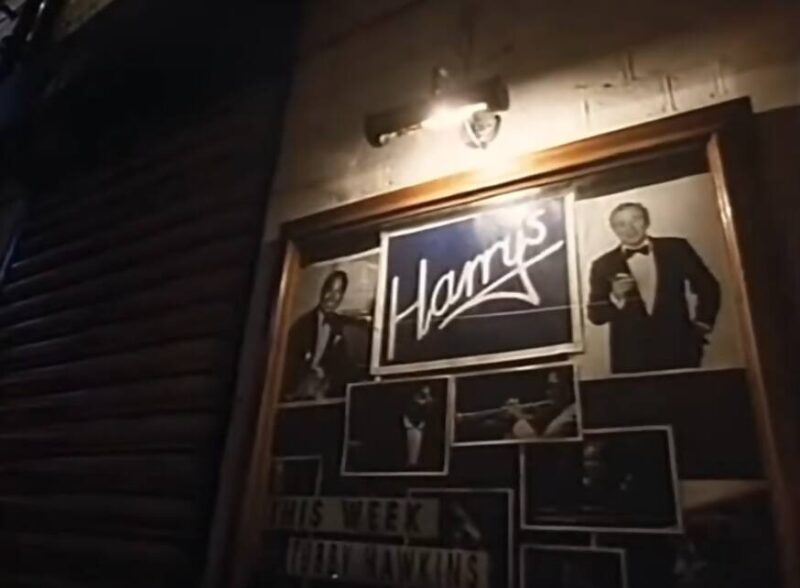
Harry also owns his very own jazz bar, called Harry’s (he’s not the most creative chap), which he waxes lyrical about. He’s clearly a canny businessman, and has all the main demographics covered: “I’ve got high court judges sitting out there alongside some of the worst villains in London. Lords, hookers, there’s a guy over there drives a refuse truck, there’s a Chinese man with one leg, what do they all have in common? Loving jazz, like I do.”
Caine also gets to be proper cockney Caine in this role, and even gets a scene explaining rhyming slang to Stacy, including the classic apples and pears. When she asks what a tea leaf is, he explains, and says that when they find this thief they will “break his dairy farm.”
There’s been a hint at the darker side of Harry right from his opening conversation with the nosy pensioner, but he’s mostly affable throughout. When they catch the aforementioned tea leaf, and take him out the back of his club, Harry brandishes a metal bar, and asks if the thief prefers cards or football. He’ll be lenient and break his arms if he likes football, and break his legs if it’s cards. So even when he’s threatening grievous bodily harm, he’s still a considerate bloke.
He does occasionally get more aggressive though, slapping a toast holder out of his slimy old boss Sir Hector’s (Ian Holm) hand and breaking into the house of the agent who drugged him and smashing all of his beloved vinyl records. They both arguably deserve this treatment, though.
But basically, Harry is pretty chill. After attending the funeral of Sir Hector, the man who betrayed and tried to kill him, Stacy questions why Harry’s not angry, and he casually says it’s because it wasn’t personal and “losers get angry”.
Other key aspects of Harry’s personality are his love of cooking and his philosophical relationship towards it. Stacy admiring his dinner prep says “you’re an artist, eh?”, to which he responds; “It’s not a question of art. It’s a question of respect. The way that I see it is, is some poor crayfish is giving up its life so that we can enjoy langoustine Provencal for dinner, the least the guy who’s cooking it can do is appreciate the sacrifice.”
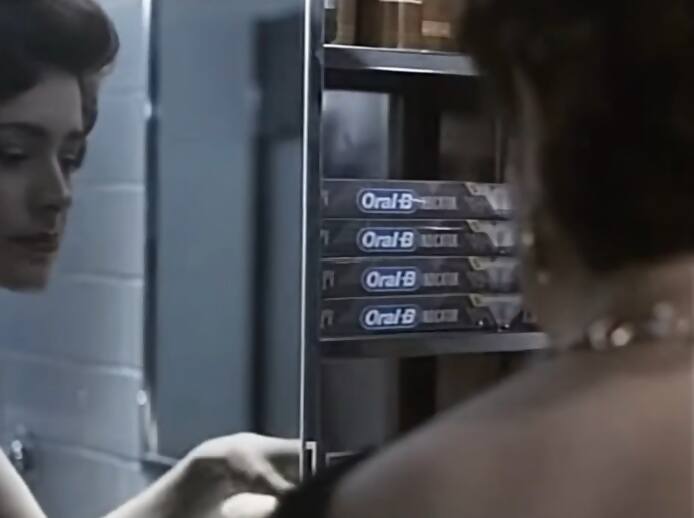
There are also a lot of Oral B products in his bathroom cabinet, which suggests either a deep commitment to oral hygiene or an unspoken history as a toothpaste spokesperson. There’s so much character depth here.

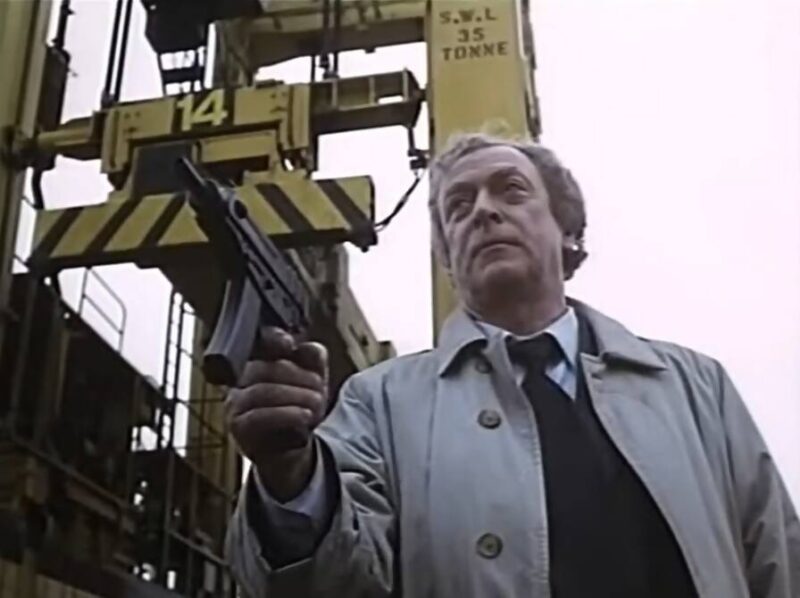
Harry gets to do a spot of action: clambering over rooftops, jumping out of the way of trains just in time, punching a man into some bins before nearly being hit by Royal Mail van, all that usual action gubbins. But Caine, who was pushing 60 at the time, is showing his age for an action star and does look a little silly running around with an Uzi in his raincoat, faffing about at the docks, running around some shipping containers and rolling under a van.
Overall, though, Caine is fully committed to this nonsense, and his funny, breezy performance makes this ultimately quite an enjoyable watch. There are moments of unintentionally so-bad-it’s-good laughs, but it’s mostly intentional humour, and Blue Ice has a cheap and cheerful charm.
Caine-nections: Here Caine plays a bar owner. He played a bartender (who may have also owned that bar, his business interests weren’t declared) in Mr Destiny (1990).
This is the fourth time that Caine has been in a film with Bob Hoskins (after The Honorary Consul (1983), Sweet Liberty (1986) and Mona Lisa (1986)). Hoskins has been a scene-stealing delight in all of them.
Caine’s playing a spy called Harry again after his iconic Harry Palmer films (The Ipcress File (1965), Funeral in Berlin (1966), Billion Dollar Brain (1967)). Like Palmer, this Harry is also a passionate home chef.
Composer Michael Kamen was also the composer for Mona Lisa (1986).
James Simmons also appeared in The Whistle Blower (1986), another spy thriller.
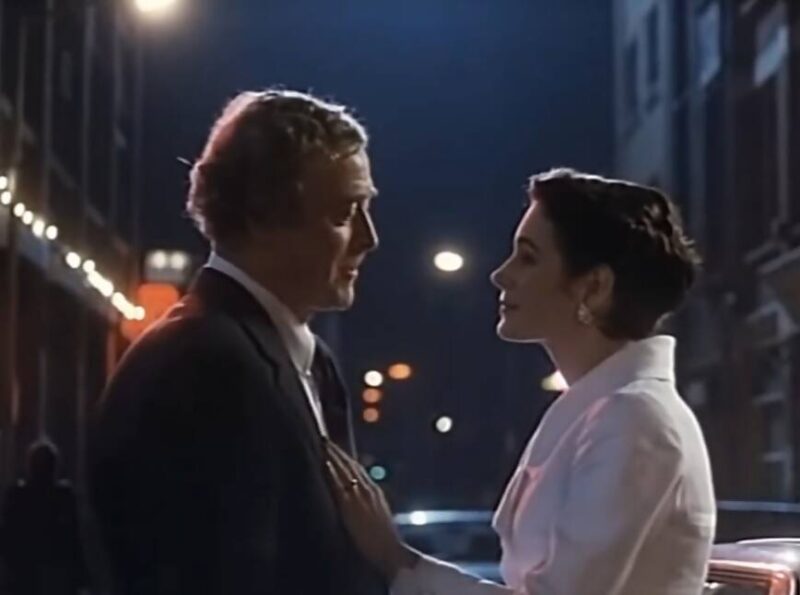
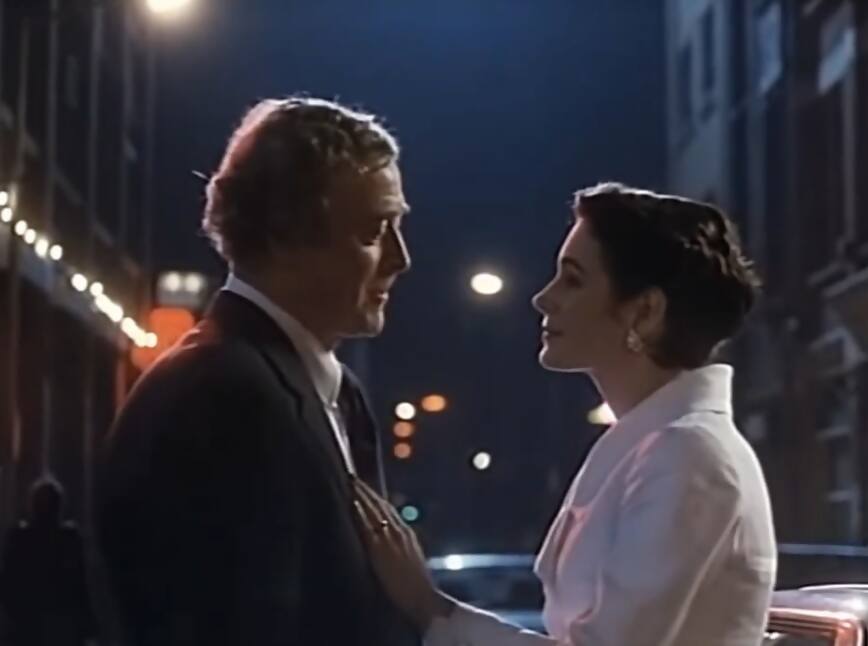
Best Non-Caine Actor: Sean Young is the female lead – the seductive femme fatale Stacy – but unfortunately her and Caine don’t have the most believable chemistry. It’s not helped by him looking his age (which is nearly 30 years older than Young). Although when we see Stacy’s white-haired ambassador husband, he looks even older than Harry, so clearly she has a thing for pensioners.
In an early scene in which Harry and Stacy are getting to know each other in the romantic atmosphere of Harry’s closed bar, and textually there is meant to be sizzling erotic tension building, we instead see Caine and Young blankly stare at each other, silently expressing no perceivable emotions.
Harry seems a tad awkward around her, and I wouldn’t be surprised if this is Caine the actor and not the character, realising that the age-gap romance is looking a little daft. He also may have been a little intimidated by Young, who was known to be occasionally intense. I’d certainly be intimidated by the way that she snaps at a spoon like a turtle while Harry is offering her a taste of his cooking.
“Is that too hot for you?”
“Not too hot for me Harry, I love hot.”
This is just some of the clunky dialogue Young and Caine valiantly try, and fail, to make sexy.
Their sex scenes are also cringeworthy. First a nude Stacy and a clothed Harry embrace on the floor of Harry’s flat (while a very nice-looking meal goes to waste). This seems to suggest that Harry’s kink is to have sex fully dressed.
Or perhaps only one of them has to be dressed as, later on, Stacy walks in on Harry when he’s nude in the shower and she’s clothed. They embrace, under a lightly dripping shower, some jazz plays, and this is one of the least sexy things I’ve ever seen put to film.
Harry also indulges in some misjudged pillow talk when he says to Stacy that she is blue ice, thankfully she hasn’t read the Wikipedia article and so doesn’t know that he’s just compared her to a frozen block of aeroplane piss. When she asks what blue ice is he tactfully pivots; “it’s when something unexpected and wonderful falls on you from out of the clear blue sky and changes your life.”
Smooth, Harry. Smooth.
Harry, on the whole, doesn’t have the best romantic instincts and/or sense of smell seeing as he also takes Stacy for a romantic stroll through a fish market and proceeds to kiss her whilst he’s holding two giant crabs (one in each hand).
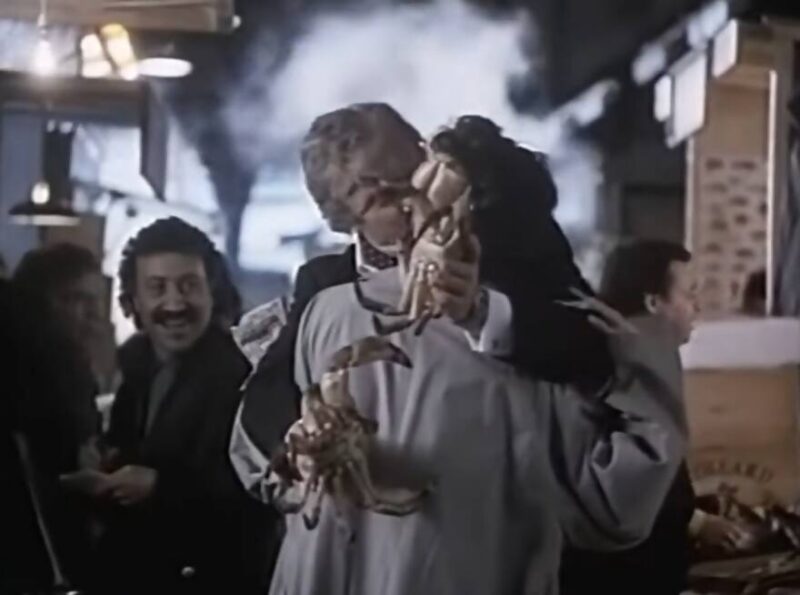
However, by their final scene there is a bit more chemistry between the two, when Stacy reveals that she must go back to America. There is a genuine sense of connection and regret in this moment.
I feel mean for criticising Young, as she seems to have been a troubled individual in her personal life. I have really enjoyed her in other roles such as Blade Runner (1982) and Ace Ventura: Pet Detective (1994), even though her character in that hasn’t aged well. She hasn’t appeared in many high-profile roles in the past couple of decades after being branded “difficult” by Hollywood. She certainly does seem to be an eccentric, but I’m not sure how much of that reputation was a product of the misogyny of the times. She was also one of Harvey Weinstein’s accusers, and getting on the wrong side of that ogre certainly wouldn’t have helped her career. Eccentric male actors certainly got away with openly doing worse things than Young without it ending their careers.
However, although she looks the part, she’s not at her best here. It’s a thankless and underwritten role and she sadly doesn’t manage to elevate it above the stereotyped femme fatale cliché.
Caine has much better chemistry with his old pal Bob Hoskins who shows up briefly halfway through the film.

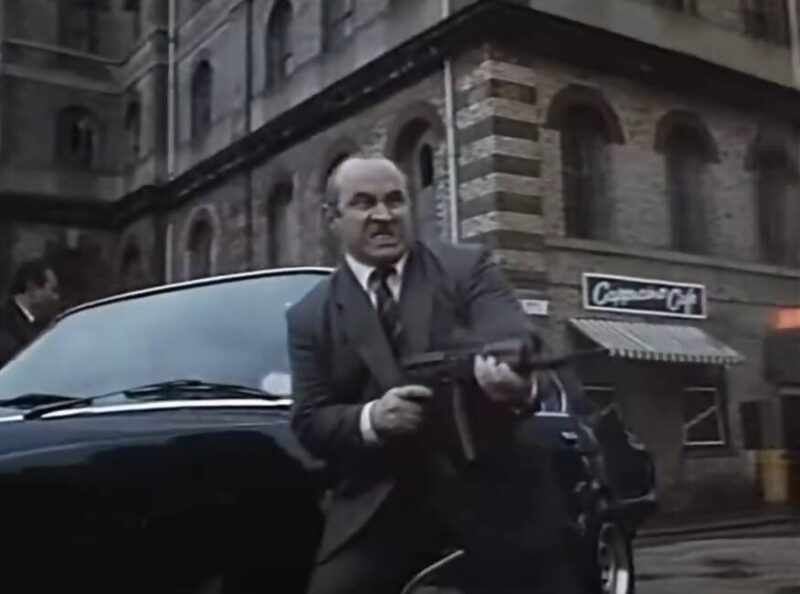
When Hoskins first appears, it seems like another film has just started playing. In his first scene he blows up a car with a big gun, mowing people down in the street near a Haagen-Dazs van. This unexplained scene comes out of nowhere, a shocking explosion of violence about 40 minutes in, but it turns out that we’re just witnessing a training exercise that Hoskins’ character, the incongruously named Sam Garcia, has orchestrated. Hoskins, as expected, is great in his brief appearance but I would have liked to have seen much more of him.
Ian Holm is the main villain but also isn’t in enough of the film for my liking. Hhe does get to eat a nice big breakfast at an airport, though, which I can only imagine was in his contract, before his toast holder is rudely slapped out of his hand by Harry.
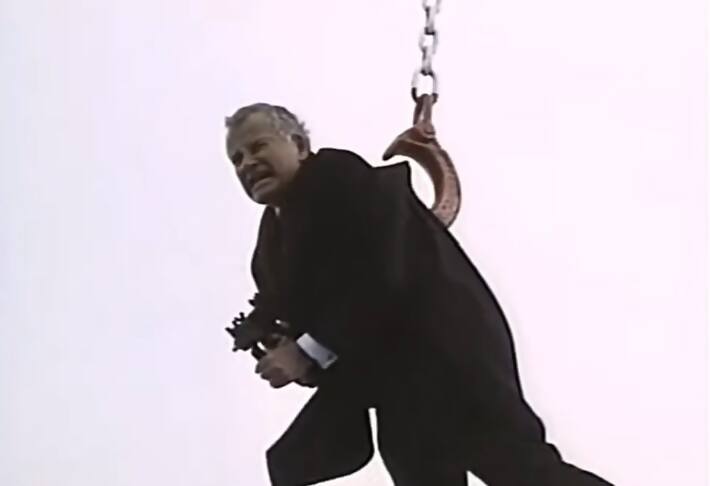
He goes a bit cartoony during the climax, when in the dark bowels of a ship surrounded by pipes hissing steam, Holm’s creepy disembodied voice starts singing “I do like to be beside the seaside” for no particular reason. He then accidentally gets hoisted on a big hook and flails around in the air shooting a gun for a bit like he’s a gangland Frank Spencer during the climax of a lost gritty Some Mothers Do Ave’ Em episode.

Rounding out the cast are recognisable British character actors Jack Shepherd, Alun Armstrong and Sam Kelly along with pianist and cabaret singer Bobby Short as Harry’s piano playing buddy Buddy; “He’s a very bad piano player. If he had a work permit, they’d kick him out the country. But he doesn’t, so I’m stuck with him.”
My Bleedin’ Thoughts: Although not a conventionally good film, this was much better than anticipated, it’s cheap and cheesy but never boring.
Credit must go to director Russell Mulcahy, perhaps best known for Highlander (1986) and his work directing iconic music videos such as The Buggles’ Video Killed the Radio Star, Duran Duran’s Hungry Like The Wolf, Elton John’s I’m Still Standing and Bonnie Tyler’s Total Eclipse Of The Heart.
His kinetic flair is evident throughout the film, such as the first scene in Harry’s club, which starts with a classic zoom out from a musical instrument, and is filled with energy as the camera moves around the joint. There’s also some peak Mulchay music video use of mood lighting and shadows, especially during the scene at the sinister hotel where a murder has taken place.
Mulcahy’s creativity is best displayed during Harry’s hallucination, featuring multiple Michael Caines (including a saxophone playing one), as it allows for trippy visuals like a piano lid smashing to pieces as it slams down on Stacy’s fingers and Jack Shepherd leering into camera while singing a song. It’s a genuinely cool sequence and is what I’ll most remember.
The final scene, with Harry at the airport, raising a glass of champagne to Stacy’s departing plane before he drives away, is a massive missed opportunity for the film to end with a chunk of blue ice landing on him in what could have been a cautionary tale for the ages.
Because that doesn’t happen, this film ultimately didn’t do for blue ice what Jaws did for sharks, and as a society we’re still unaware of the dangers of falling frozen urine. Perhaps this review will finally help spread the word. Tell a friend, save a friend.
Trivia (Courtesy of IMDB): The Rolling Stones’ Charlie Watts appears as a drummer in Harry’s club.
Roger Lloyd Pack was listed in the UK trades as being cast in this but ultimately doesn’t appear. I think this might hold the record for least essential bit of IMDB Trivia that I’ve shared in one of these articles.

Overall Thoughts: Pretty naff but made very enjoyable by an amusing central Caine performance and some quirky directing from Mulcahy. Fun disposable nonsense.
Rating: 3/5 Romantic Strolls Through a Fish Market
Where You Can Watch This: This seems impossible to watch in decent quality in the UK, as it isn’t streamable or purchasable on region 2 physical media, but it is viewable on YouTube.
Up Next: Tis the season! It’s my most rewatched Caine film, a steadfast December tradition, it’s the festive masterpiece; The Muppet Christmas Carol.
A video essay version of this article can be found on YouTube.