
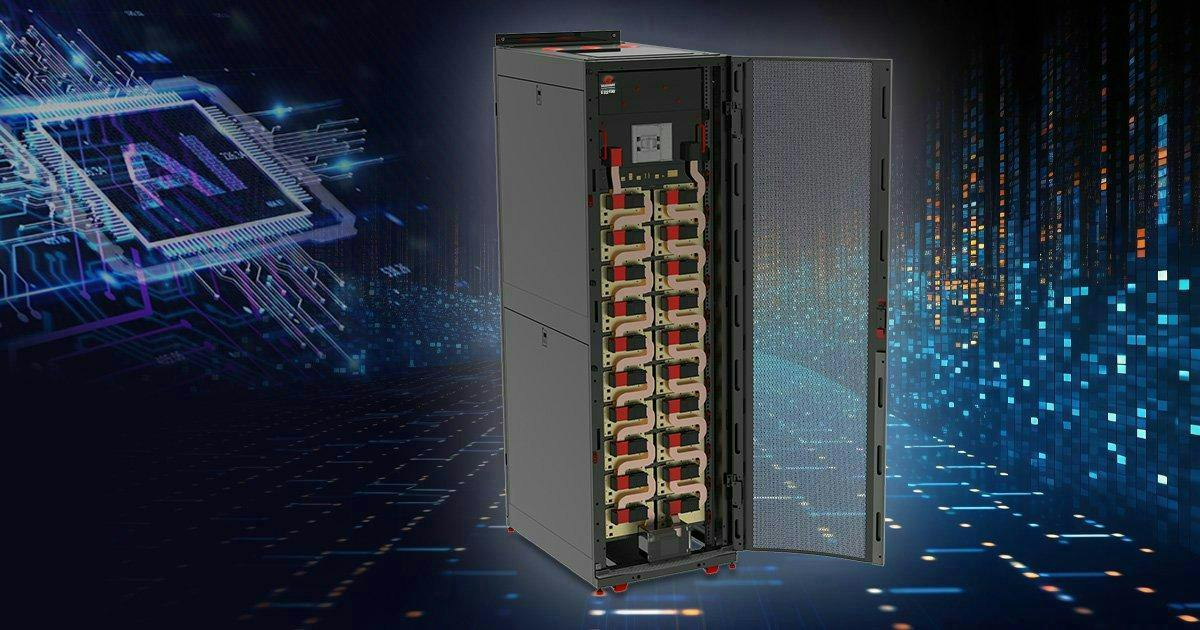
Musashi Energy Solutions’ ESS400 energy storage system uses hybrid supercapacitors to provide high-power, fast-response energy storage for data centers and AI computing environments, including short-duration backup and dynamic peak-load support.
Original Coverage & Source Attribution: www.datacenterfrontier.com
AI Turns the Power Problem Into a Transient Problem
At the heart of the issue is the changing behavior of the IT load. In a conventional data center, DeLattre said, large numbers of independent loads create a relatively predictable electrical profile. AI clusters introduce much greater synchronization.
As GPUs begin processing a common workload, large numbers of accelerators can increase their power consumption simultaneously. Instead of asking the electrical infrastructure to serve a relatively smooth load, the facility can experience fast power pulses moving through the system.
Hybrid supercapacitors are intended to act as a buffer between that dynamic compute load and the infrastructure supplying it. During an upward transient, storage provides some of the incremental power demanded by the IT load. When demand falls, the storage system recharges.
The objective is not to create additional energy. It is to keep every upstream component — from the UPS to generators and ultimately the utility connection — from having to respond directly to every rapid change taking place inside the AI cluster.
From the perspective of the upstream power source, DeLattre said, the goal is to make a highly dynamic AI load appear significantly smoother. That distinction between energy and power is central to Musashi’s argument for hybrid supercapacitors.
A conventional supercapacitor, also known as an electric double-layer capacitor, can deliver very high power almost instantly but stores relatively little energy. A lithium-ion battery can store considerably more energy, but DeLattre argues that it is less suited to being aggressively charged and discharged tens or hundreds of thousands of times.
Musashi’s hybrid technology uses a capacitor architecture with a lithium-doped graphite electrode intended to increase energy density while preserving the fast response and high cycling capability associated with capacitors. DeLattre reduces the distinction to a simple formulation.
“Batteries are very good at storing energy,” he said. “Supercapacitors or hybrid supercapacitors are very good at managing power.” Increasingly, he argues, managing power is precisely the problem AI infrastructure needs to solve.
From Backup Insurance to Active Power Infrastructure
That represents a significant departure from the historical role of storage inside the data center. For decades, batteries associated with uninterruptible power systems have essentially functioned as insurance. The utility fails, the UPS carries the critical load while backup generation starts and, if everything works as intended, the batteries return to standby.
AI potentially reverses that model. Instead of sitting idle until an emergency, energy storage can become part of normal data center operation, cycling repeatedly as it buffers compute peaks, stabilizes electrical buses and prevents fast-changing IT demand from propagating through the rest of the facility.
That changes the characteristics operators need from the storage itself. Response time becomes important. So does recharge speed. Cycle life becomes significantly more consequential if an asset expected to operate occasionally must instead charge and discharge repeatedly throughout its service life.
“We’re moving from energy storage as a backup infrastructure to really now energy storage … as part of an active power infrastructure,” DeLattre said.
That distinction also changes how storage economics should be evaluated. DeLattre said operators looking at frequently cycled storage need to consider more than acquisition cost. Footprint, maintenance, cooling requirements, replacement intervals and operational risk can all become part of the calculation.
Musashi says its system can exceed 100,000 cycles at 100% depth of discharge and potentially reach much higher cycle counts when operated at shallower depths of discharge over a 15-year design life.
Those figures are manufacturer specifications, but they illustrate the underlying question operators increasingly face: What happens to storage economics when the battery or capacitor is no longer waiting for a rare outage, but working every day?
The answer becomes even more significant if one storage asset can perform more than one job — providing short-duration resiliency while also managing normal AI power fluctuations.
At that point, DeLattre said, energy storage starts becoming “an infrastructure decision rather than simply a component comparison.”
Where You Manage the Transient Matters
Another emerging question is where that storage should physically sit. DeLattre does not expect a single answer. At the UPS level, high-power storage can provide ride-through during the interval between loss of utility service and generators accepting load. But AI is also creating interest in placing storage considerably closer to the compute itself.
DeLattre pointed to Musashi’s work with power-system providers including Flex and Delta, where capacitive energy storage can be positioned near server systems. The closer a buffer is placed to the origin of the transient, the less of that rapid change has to travel through the upstream electrical system.
“The biggest lesson we’ve learned … is where you manage the transient matters,” DeLattre said. That concept could become increasingly important as AI rack densities rise. A transient handled near the processor or rack does not have to propagate through multiple conversion stages, power distribution equipment and ultimately the facility-level power system before being addressed.
Musashi is also working with DG Matrix on architectures that combine storage with intelligent solid-state power electronics. In that model, the power system can coordinate the load and different forms of storage at a higher level, with the same basic objective: allowing the AI compute environment to behave dynamically without forcing the entire electrical infrastructure supplying it to behave the same way.
The eventual result may look less like a centralized battery room and more like distributed energy storage embedded at multiple points throughout the power architecture. Different technologies could occupy different layers because each layer is solving a different problem.
Can Storage Get More Compute From Existing Megawatts?
That architecture becomes particularly interesting in an industry where securing utility capacity has emerged as one of the central constraints on AI infrastructure development. Energy storage cannot solve a fundamental shortage of generation.
DeLattre is explicit about that limitation. If a data center needs an additional 10 MW continuously, storage does not eliminate the need to provide those 10 MW from the grid, onsite generation or another energy source.
Short-duration peaks are a different problem. Consider a data center whose average consumption remains within its available utility capacity but whose AI workloads occasionally create brief excursions above that envelope.
Rather than forcing the upstream infrastructure to follow every peak, a high-power storage system could supply incremental power during the excursion and recharge when demand falls.
The power source would see something closer to the facility’s average load instead of the instantaneous demand of the compute environment. For operators, the attraction is straightforward: potentially extracting more productive compute from an electrical envelope they have already secured.
“If you need 10 additional megawatts continuously, you’re still going to need 10 additional megawatts,” DeLattre said.
But needing those 10 MW for only a matter of seconds presents a fundamentally different engineering problem. This is also where electrical infrastructure and AI performance begin to intersect.
One alternative to energy buffering is software-based power management that prevents GPUs from ramping as aggressively. DeLattre argues that throttling accelerators to make their electrical behavior easier to manage can reduce the efficiency and performance of the compute resource operators paid to install.
Storage potentially moves that compromise elsewhere: allow the GPUs to operate dynamically while using the power system to prevent those dynamics from being imposed directly on the grid or generator.
Does the AI Data Center Still Need Minutes of UPS Runtime?
The distinction between power and energy raises another, more provocative question. How much UPS runtime does a modern data center actually require?
Data center operators have traditionally designed UPS systems around minutes of battery runtime. But DeLattre argues that the industry should at least reconsider that assumption where the primary mission of the UPS is to bridge the transition to backup generation.
If generators can reliably start and accept the load in seconds, he asks, does every facility need several minutes of stored energy, or does it principally need enough power to span the transfer? Those are different design objectives.
Musashi’s ES400 provides an example of the type of system DeLattre has in mind. The 400-kW platform can provide approximately 33 seconds of discharge at 333 kW, according to DeLattre, with systems capable of being paralleled where additional power capacity is required.
He describes generator startup and transfer as typically occurring within roughly 10 to 20 seconds. The argument does not mean minutes of UPS battery runtime are universally unnecessary. Data center resiliency requirements vary by topology, operating philosophy, generator architecture and the failure conditions a system is designed to withstand.
But the rise of AI gives operators another reason to separate two questions that have often been packaged together: How much energy needs to be stored, and how much power must be available instantly?
If storage is also going to absorb AI transients thousands of times rather than simply wait for a utility outage, optimizing those two requirements separately becomes more compelling.
Seconds, Not Hours
None of that makes batteries obsolete. In fact, DeLattre’s view of the emerging energy storage architecture depends on different technologies doing different jobs.
If an operator needs to run a data center for four hours following a grid outage, he said, a hybrid supercapacitor would be the wrong solution. Batteries, generators, fuel cells or other longer-duration resources make considerably more sense.
Similarly, hybrid supercapacitors are unlikely to be economically attractive for shifting energy consumption across periods measured in hours.
Their useful territory sits at the other end of the spectrum. A lot of power, delivered almost immediately, for a relatively short duration. And, increasingly important for AI, capable of doing it repeatedly. “Think seconds instead of hours,” DeLattre said.
The distinction matters because the AI power challenge is creating several problems that have traditionally been grouped under the broad heading of energy storage.
Resiliency is one problem. Long-duration backup is another. Grid interaction is another. Short-duration ride-through is another. Rapid GPU-driven power transients are yet another.
There is little reason to assume one storage chemistry or one physical storage system will be optimal for all of them.
From the Battery Room to an Energy Storage Architecture
That may ultimately be the most important change AI brings to data center energy storage. DeLattre expects that within three to five years, operators may talk less about “the UPS battery” or “the battery room” and increasingly about an overall energy storage architecture.
Some storage could provide longer-duration backup. Some could support the utility interface. Some could supply short-duration ride-through. And some could sit extremely close to processors, absorbing rapid changes in demand before they ever reach the rest of the electrical system.
That evolution would coincide with other changes already being contemplated for high-density AI infrastructure, including higher-voltage DC architectures, solid-state transformers, fewer power-conversion stages, onsite generation and increasingly intelligent power management.
In that environment, high-power storage becomes less of a static reserve and more of a control mechanism. That does not establish hybrid supercapacitors as the answer to every AI power problem. DeLattre himself argues against that conclusion.
Instead, the more significant possibility is that AI is dismantling the assumption that “energy storage” is one thing with one job. As compute becomes more dynamic, the electrical architecture serving it may have to become more specialized as well.
The battery room may not disappear. But it may become only one layer in a much broader energy storage system built around the behavior of AI itself.