

Original Coverage & Source Attribution: fintechnews.sg
Free Newsletter
Get the hottest Fintech Singapore News once a month in your Inbox
India’s fintech industry is undergoing a profound transformation driven by several major forces.
A new report by PwC looks at these trends, outlining structural shifts expected to shape the Indian fintech through 2030, including the advent of programmable digital infrastructure, the rise of proprietary intelligence, and the shift towards orchestration.
Programmable digital infrastructure
India’s public infrastructure is moving from static rails that move money and verify identity to programmable rails that carry conditions, purposes, and logic. This infrastructure enables payments to settle under specific terms, such as the recipient being an authorized fair-price shop, eligible commodities, or within a defined window, by enforcing conditions within the money itself instead of relying on later reconciliation.
Currently, this infrastructure includes several rails, including the retail e-rupee, a central bank digital currency (CBDC) launched in 2022, the Unified Lending Interface (ULI), a digital lending interface enabling consent-based, frictionless sharing of borrower data between financial lenders and authorized data custodians; and UPI Circle, a delegated payment feature that allows a primary bank-linked user to authorize trusted secondary users to make Unified Payment Interface (UPI) payments from their account.
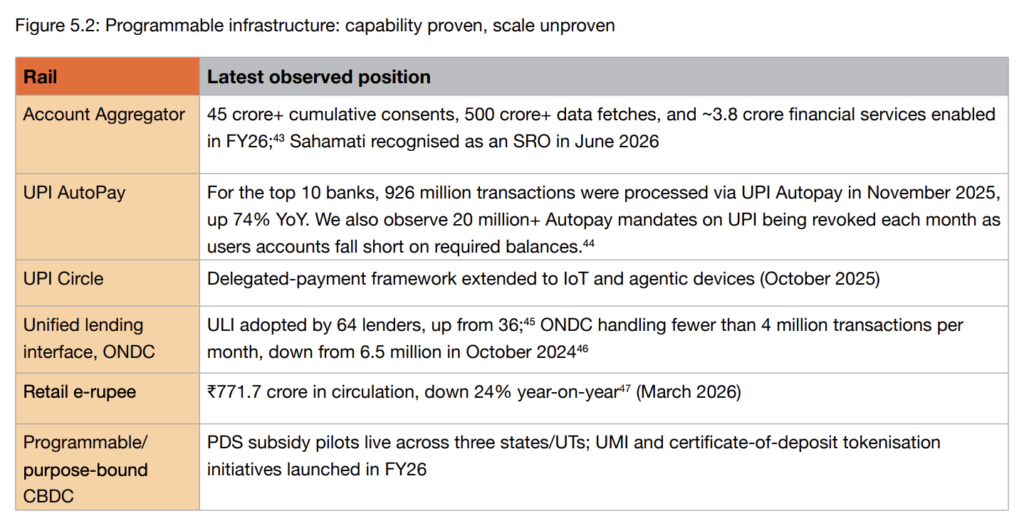
These rails are now expanding. In particular, use cases tied to the Reserve Bank of India (RBI)’s programmable CBDC are growing, extending to public distribution system food subsidies in Gujarat, Puducherry, and Chandigarh during fiscal year 2026 with tokens redeemable against eligible commodities.
The central bank also developed the Unified Markets Interface for asset tokenization, and launched a pilot on tokenization of certificates of deposits last year. Most recently, the RBI and the Securities and Exchange Board of India (SEBI) introduced “Demat 2.0”, a pilot program testing the tokenization of corporate bonds and quicker settlement using CBDC and blockchain technology.
According to PwC, these trends will carry several implications through 2030. These implications include programmable money scaling through government transfers and business-to-business (B2B) settlement, credit rails reaching significant scale, and the Unified Agent Protocol (UAP) extending India’s pattern of standardizing foundational financial capabilities.
The proposed UAP, unveiled in September 2026, aims to create a common, interoperable system for registering, verifying and authorizing artificial intelligence (AI) agents that transact through UPI.
From data to proprietary intelligence
PwC also highlights a shift from mere data access to proprietary intelligence. In particular, Account Aggregator (AA), a framework that lets users share their digital financial data between different institutions instantly using their explicit consent, has made financial data portable, recording more than 450 million cumulative consents and over 5 billion data fetches by June 2026.
That data that supported generation of Indian lending propositions is now available to licensed participants on largely standardized terms and at negligible marginal cost. Combined with cheap computing lowering barriers for challengers, these trends are eroding incumbent privileges around data access.
This creates a new competitive divide, not simply between incumbents and challengers, but between organizations that have successfully unified fragmented legacy systems into coherent enterprise views and those that have not. Ultimately, the winners will be those who are able to convert data into superior decisions, outcomes, and customer experiences, PwC argues.
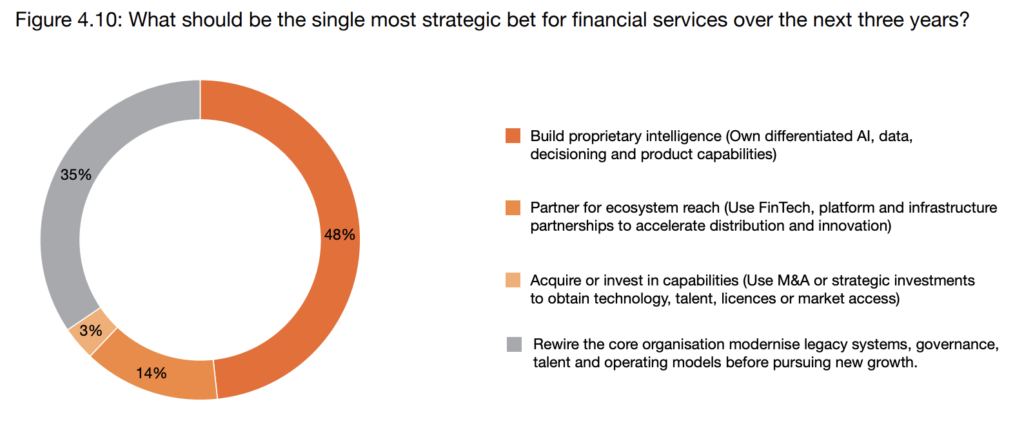
Further underlying this trend, results from a survey conducted by the firm found that the single most important strategic bet over the next three years cited by 48% of participants is building proprietary intelligence capabilities. Another third is prioritizing rewiring the core organization to operate effectively in an AI-enabled environment.
A shift of focus towards orchestration
Another trend outlined by PwC is the migration of value away from customer-facing distribution and towards merchant relationships and orchestration.
According to the firm, the strategic imperative is now shifting from competing for screens to owning the ledger. Ultimately, the winners in this shift will be merchant-side orchestrators with pricing power over relationships rather than transactions, infrastructure providers that become the default plumbing, and lenders who can plug balance sheets into flows originated by others under the new co-lending regime.
This trend is being combined with the rise of agentic commerce, which has prompted major networks and platforms to compete for control of agent identity and authorization. In the age of AI agents, those who verify agents govern the trust layer relied upon downstream, PwC says.
Trust architecture
Finally, firms will distinguish themselves not by detecting fraud using identical signals but by managing the remaining exposure, through their liability posture, redress quality, and the speed and grace of resolution.
Furthermore, areas traditionally viewed as unavoidable business expenses will be transformed into new revenue streams. This means that businesses will get to monetize fraud and risk decisioning, consent and privacy infrastructure, assurance and audit services, and dispute and redress operations.
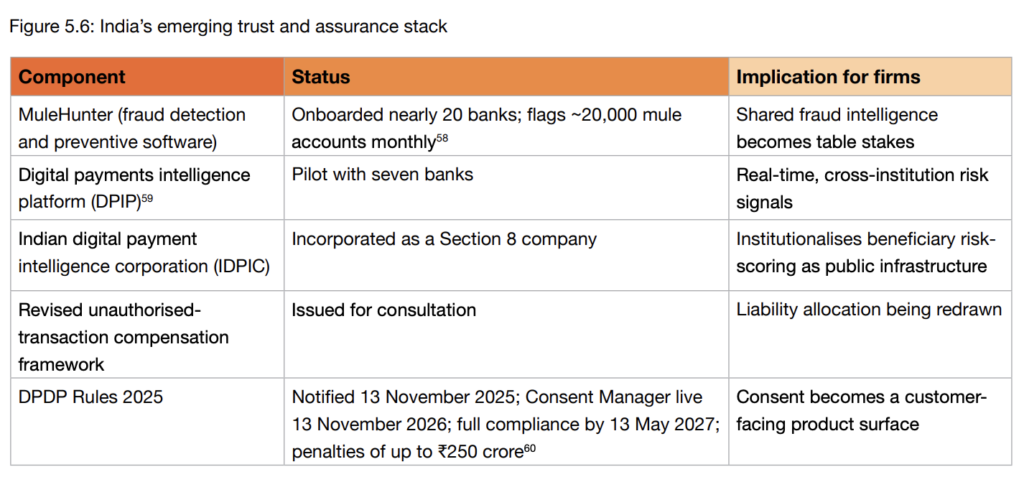
These trends are emerging as the Indian government expands the country’s trust and assurance stack. This stack currently comprises MuleHunter, an AI and machine learning-powered platform introduced by the RBI to detect, and block fraudulent mule bank accounts used for money laundering and digital cybercrimes; the Digital Payments Intelligence Platform (DPIP), a real-time, AI-driven fraud prevention system developed by the central bank through the Reserve Bank Innovation Hub (RBIH) to combat surging digital payment frauds; and the Indian Digital Payment Intelligence Corporation (IDPIC), an entity set up by the government to combat cyber financial fraud and which oversees the DPIP.
Frontier technologies
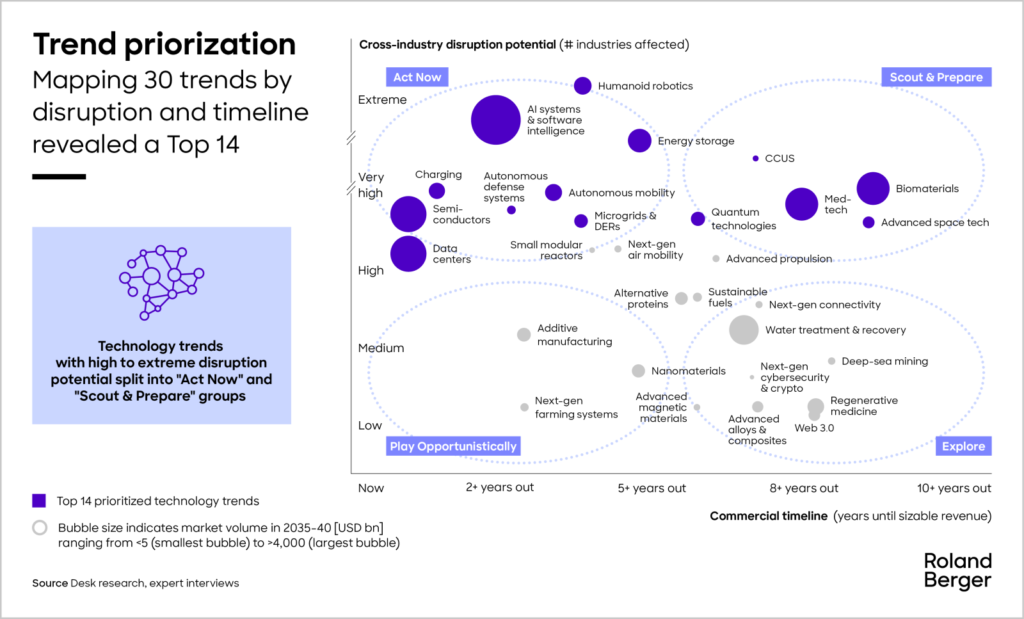
Globally, advances in technology are reshaping the economy and society by boosting productivity, connectivity, and consumer expectations. Management consultancy Roland Berger believes that 30 emerging trends are poised to define the technology agenda through 2040. These industries, which include AI systems and software intelligence, semiconductors, humanoid robotics, medtech, and energy storage, are set to see their combined markets expand tenfold, soaring from EUR 2.5 trillion (US$2.8 trillion) today to more than EUR 20 trillion (US$22.5 trillion) by 2040.
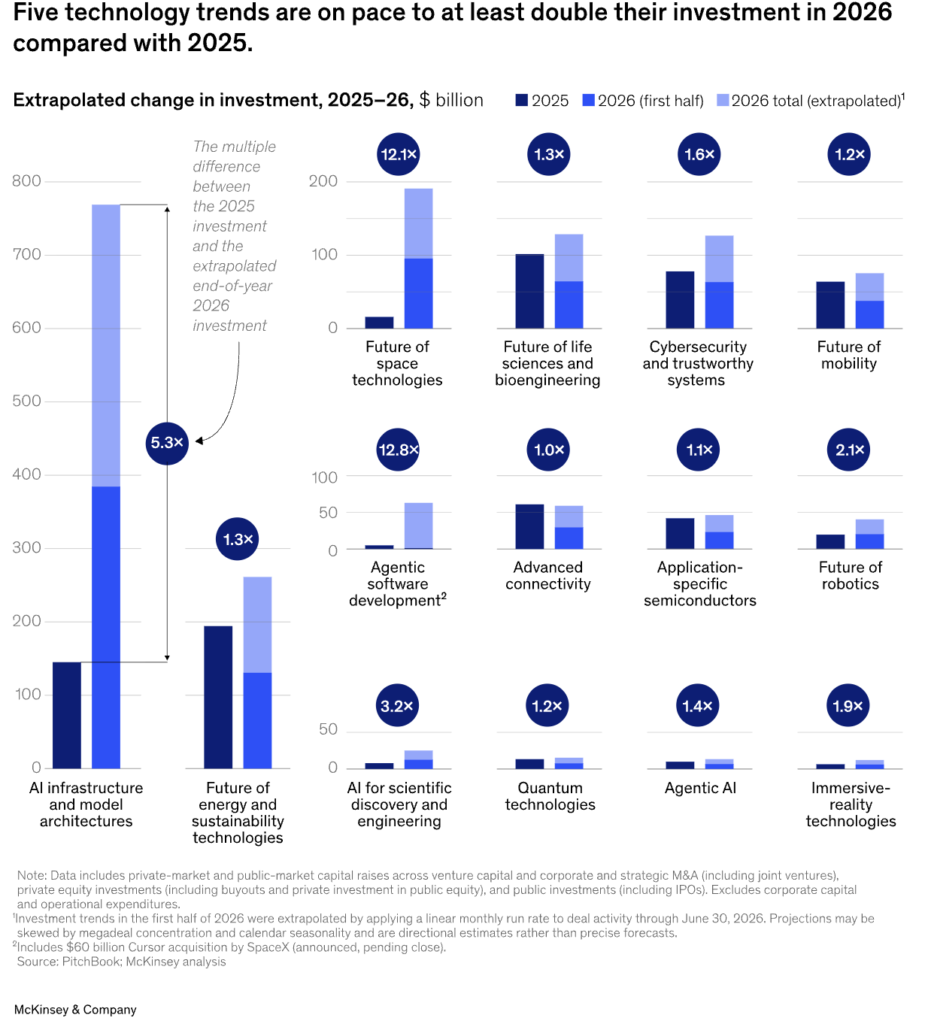
McKinsey highlights five trends in particular expected to gain strong momentum in 2026, each likely to attract more than double the investment compared with 2025. Agentic software development attracted US$9.9 billion in equity investment in 2025 and is expected to surge 12.85-fold this year; investment in future space technologies is projected to rise 12.1-fold from US$15.7 billion in 2025; and funding to AI infrastructure and model architectures is set to increase 5.3-fold from US$145 billion.
Featured image: Edited by Fintech News Singapore, based on image by magnific via Magnific
{
“@context”: “https://schema.org”,
“@type”: “NewsArticle”,
“headline”: “What will Reshape the Indian Fintech Sector Through 2030?”,
“datePublished”: “2026-10-07 03:49:00”,
“image”: “https://fintechnewssg-22e90.kxcdn.com/wp-content/uploads/2026/10/Programmable-Infrastructure-Proprietary-Intelligence-Poised-to-Reshape-the-Indian-Fintech-Sector-Through-2030.webp”,
“author”: {
“@type”: “Organization”,
“name”: “Pune.Media Editorial Desk”,
“url”: “https://pune.media”
},
“publisher”: {
“@type”: “Organization”,
“name”: “Pune.Media”,
“logo”: {
“@type”: “ImageObject”,
“url”: “https://pune.media/wp-content/uploads/logo.png”
}
},
“isBasedOn”: “https://fintechnews.sg/138640/fintech-india/reshape-the-indian-fintech-sector-through-2030/”,
“mainEntityOfPage”: “https://fintechnews.sg/138640/fintech-india/reshape-the-indian-fintech-sector-through-2030/”,
“creativeWorkStatus”: “Editorial-assisted Curation”,
“comment”: {
“@type”: “Comment”,
“text”: “This article was curated, verified, and structured under organizational human editorial guidelines by the Pune.Media Editorial Desk.”
}
}