Original Coverage & Source Attribution: foreignpolicy.com
When I first started studying contemporary France as a graduate student in 2006, the country was still reeling from a convulsion of urban violence triggered by the deaths of two teenagers in an electrical substation as they were hiding from police. For several weeks in late 2005, the country had gone up in flames as angry young people protested against police violence, racism, social inequality, and the broken promises of France’s social contract.
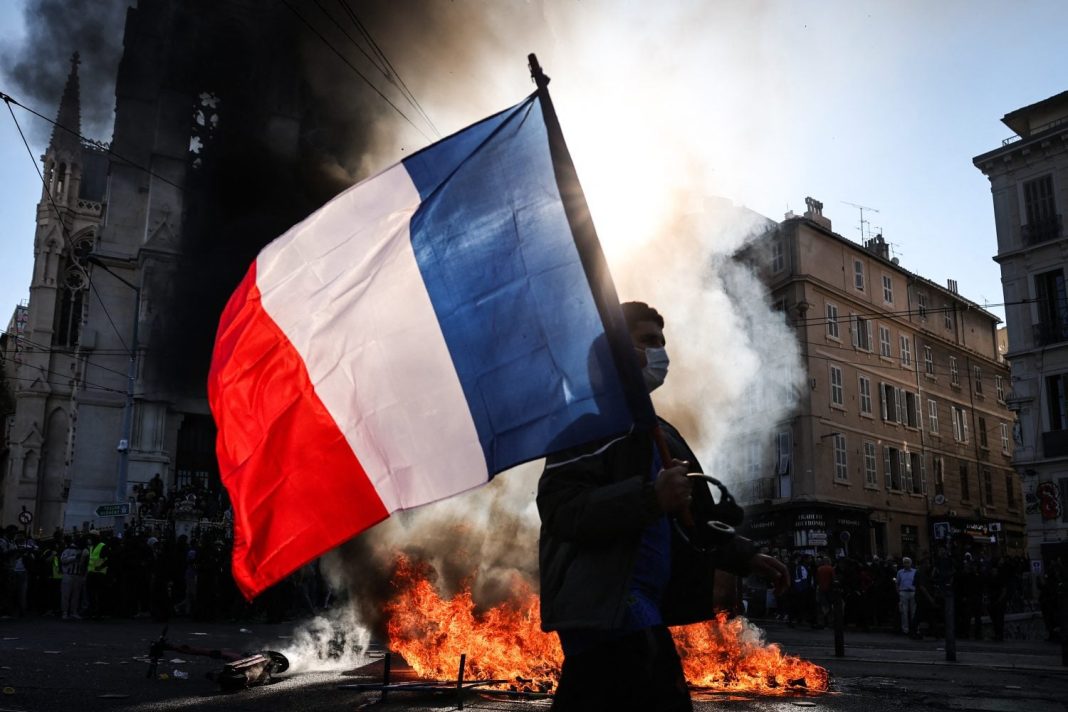
Fast forward 20 years, and the images of France being broadcast to the world are the same. What began as a protest by high school students has escalated into a nationwide cry of exasperation, punctuated by looting, the ritual burning of public buildings, and a cascade of violence meted out by riot police armed with smoke grenades and tear gas.
No less predictable has been the cascade of hot takes by commentators, politicians, shock jocks, and activists, all looking to capitalize on the spectacle of French people taking to the streets. For the most part, this has involved endless platitudes about the French—who are said to be especially revolutionary or pathological, depending on your view—or outright untruths about a supposed invasion of migrants destroying French and Western civilization.
For those of us who have worked on contemporary France for much of our careers, the rush to commentary is exhausting. But it does at least highlight one of the signature questions of our field: Why is it that modern France seems to be a land of protest? And no less importantly, why does anyone still care about what happens in a medium-sized European country that has long ceased to be a global power?
The answer to the first question—about the omnipresence of protest—does not have an easy answer, but the facts are beyond doubt. According to Armed Conflict Location & Event Data, which monitors political violence and protests worldwide, there have been about 20 protests a day in France in recent years. These are often small and localized, but sometimes they are nationwide, with hundreds of thousands of people taking part.
Crucially, protesting is an activity for everyone in France. The idea that only young left-wing activists march in the streets is wildly inaccurate: Some of the biggest protest movements of the last 50 years have been led by the right, most famously the huge demonstrations against reforms to private schooling in 1984 and same-sex marriage in 2013.
For such a culture of protest to develop across the political spectrum, two basic elements are needed: the politicization of the fight against injustice and a belief in the power of the street. Both of these have been present in France for a long time.
The idea that opposition to any perceived injustice must be politicized—and that any such politicization can take the form of insurrectionary violence—has a long and distinguished pedigree in France. It was the French, after all, who first showed the world what ideology-driven revolutionary insurrection looked like. France also bequeathed to the world the perennial distinction between “right” and “left,” a divide that became the basic coordinates of parliamentary and extra-parliamentary politics worldwide. Time and again, from 1789 onward, the French have made protest more than the sum of its parts.
This politicization of discontent has not translated into stable institutions. France has had multiple republics and dictatorships since the French Revolution; compared with other Western countries, it has had relatively weak intermediary bodies. It is not a land of strong political parties or powerful trade unions. In fact, rates of union membership in France have long been much lower than elsewhere in Europe. Contrary to widely held perceptions of the French as perpetually “on strike,” the speed with which popular protest develops is an indication of the weakness of institutions that might channel discontent.
The presence of a strongly authoritarian, centralized state has not helped. For at least a century, if not more, the French state has been top-heavy and technocratic. Its grand plans for reconstruction after World War II, for instance, were elaborated by the central government with no real popular consultation, and the foundation of today’s constitutional settlement—the Fifth Republic—was explicitly anti-democratic in its elevation of presidential authority and the subservient role given to the French Parliament when it was devised in 1958.
All of which means that protest is one of the few ways in which French people can make themselves heard beyond the ballot box. Memories of earlier struggles are passed down through the generations as older activists tell their youthful comrades stories of their first protest, parents come out in support of their children, and teachers stand in solidarity with their students. As any good French protester knows, the symbols, language, and power of protest resonate across decades and even centuries.
And it sometimes works: Protesters do get their way, and reforms do get reversed. Every French government knows—and fears—the judgment of the street, which can be harsh and uncompromising.
This is one of the reasons that French governments frequently take preemptive action in the form of violent, sometimes murderous, repression. From the crushing of the Paris Commune in 1871 to today’s police violence, the French authorities often shoot first and ask questions later. Remarkably resistant to 21st-century de-escalation strategies, they still operate according to 19th-century ideas about the irrational mob, and they see everyone from schoolchildren to football fans as a potential threat.
Yet this only hardens the resolve of protesters. Some take to outright violence, joining petty criminals in the destruction of private and public property, while others record TikTok videos in front of riot police, lampooning a state that sees its citizens as a perpetual nuisance.
Of course, many contemporary protest movements go through a similar cycle. At the same time as the protests in France were taking place, hundreds of thousands of young Indians were launching their own movement to protest against another authoritarian state—and they met with an equally robust response.
So why do protests in France continue to capture the public imagination?
Some of this no doubt has to do with a tendency, especially in the Anglosphere, to imagine France as a volatile dystopia. Much of 19th-century British politics was built around a myth of stability that was positively contrasted with France’s revolutionary upheavals, and this characterization of France is still very much alive. More recently, the great conservative intellectual Roger Scruton attributed more or less his entire political outlook to his experiences in Paris during May 1968.
But there is something deeper than simply prejudice and national stereotypes. Despite its much-reduced global status, France has managed to maintain its status as the vanguard of European radical politics on both sides of the political spectrum. Protesters in Paris—like the teenager Elwan, whose eloquent paean to left-wing politics quickly went viral—appear to be more articulate than their peers elsewhere, and the intensity of their revolutionary symbolism gives them global appeal.
It is surely no coincidence that much of the protest imagery of the contemporary far left is French in origin. So is one of the biggest slogans of the global far right—the “Great Replacement” theory, which posits that a cabal of liberal elites seeks to replace the native population with migrants.
Although the French do not have a monopoly on protest—far from it—they have spent more time than anyone else packaging it for public consumption, and their ideas continue to shape political movements around the world. This alone makes it worth examining closely what happens on the streets of Paris, Lyon, and Marseille.