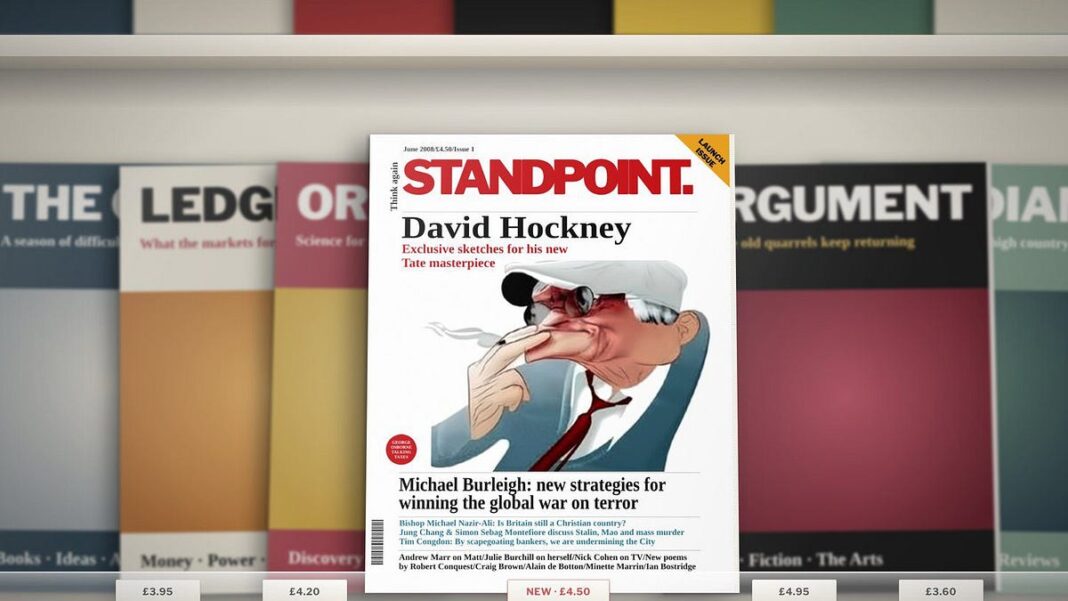
Original Coverage & Source Attribution: rozenberg.substack.com
You were once a subscriber to Standpoint, an email reminded me yesterday. “The last printed issue appeared in 2021. We are writing to tell you that it has returned under new management.”
But only online, the email explained. “New writing is now being published at standpointmag.co.uk and it is free to read. The full archive is there too, from the first issue in 2008.”
Well — not quite.
I did indeed receive the magazine monthly — but not because I had a paid subscription. Standpoint paid me, somewhat erratically as I recall, to write a column from 2010 to 2013. There were also some online pieces for a website that never quite took off.
As for the full archive, that’s currently a work in progress. A search for my own contributions produced a few columns with unconventional typography and no by-lines. Some were written by me; others not.
Artificial intelligence was clearly at work. It has also supplied the illustrations. This one, illustrating a piece about the Supreme Court, is typical:
It has that strange mixture of reality and fantasy that we associate with the current state of AI-generated imagery. The justices’ ceremonial robes look quite convincing but they do not come with a requirement to wear the same suits, shoes, shirts and ties — not least for the female members of the court, who seem to have been banished. The carved frontage of the building behind them, with its implausible statuary, bears a passing resemblance to the facade of the Supreme Court in Parliament Square. But the entrance seems to have become detached from the building itself, which can be seen in the background.
The new website’s writers and owners, a company registered in Belize, are similarly ill-defined. But Michael Mosbacher, who co-founded the original Standpoint with Daniel Johnson, has written a useful reminder of the title’s heritage.
To help the magazine repopulate its rather patchy archive, I am republishing a tribute, first seen by Standpoint readers in 2010, to one of the most distinguished judges I have ever known. New readers start here:
It seemed sadly fitting that Lord Bingham should die on September 11 — and not just because that date commemorates the greatest contemporary challenge to the rule of law, the principle that Bingham expounded and defended above all.
It was also the day on which Jews were reading the passage, almost at the end of the Hebrew Bible, in which another great law-giver is told by God that he will view the promised land from on high but die without entering it. Bingham’s promise was the UK Supreme Court — though he was never to enter it except as a visitor, looking down from the gallery above.
Unlike Moses, Bingham never lost his temper in public. He was denied his rightful place in the new court only because he had already reached the compulsory retirement age of 75 when it opened 12 months ago. If its launch had not been delayed by a year, Bingham would have become the first president of the court that he, above all, had urged as a replacement for the House of Lords appellate committee.
“My own view,” he told me in 2005, “is that in 25 years everyone will think it astonishing that we should have endured, until now, with our top court formally constituted as a committee of one house of the legislature”.
But it was as the senior judge of that top court — from 2000 to 2008 — that Bingham made his greatest contribution to English jurisprudence. He took up the post just four months before Labour brought into force the Human Rights Act, a reform he had publicly supported as far back as 1993.
The choice of Bingham as senior law lord was part of an inspired three-way move by Lord Irvine, the last lord chancellor with power to make such appointments. Bingham had been an impressive lord chief justice of England and Wales, although criminal law was not the area best suited to his talents and it was rumoured in 2000 that he was thinking of retiring early. If Irvine had not intervened and the UK’s highest court had continued to select its senior member on the principle of Buggins’ turn, the law lords would have been led by judges who were responsible for the Pinochet debacle — the lowest moment in the court’s 133-year history.
Instead, Irvine decided that Bingham would become senior law lord and his successor as lord chief justice would be Lord Woolf, also moving to a post to which he was seen as better suited. Woolf was replaced as master of the rolls by Lord Phillips, Bingham’s eventual successor.
Bingham presided over nearly 200 appeals involving the Human Rights Act but the one that made the greatest impact was the Belmarsh case, named after the prison in which suspected foreign terrorists were being held indefinitely under post-9/11 anti-terrorism laws. The Court of Appeal had judged their detention lawful. But, shortly before Christmas 2004, Bingham and his fellow law lords found it disproportionate and discriminatory — and therefore incompatible with the detainees’ human rights.
Rejecting the government’s submission that it was not for the courts to assess the threat of terrorism and the appropriate response, Bingham said “the function of independent judges charged to interpret and apply the law is universally recognised as a cardinal feature of the modern democratic state, a cornerstone of the rule of law itself”.
A month later, the government announced a new system of control orders — in effect, house arrest. But Charles Clarke, the home secretary, disclosed subsequently that he had been “frustrated at the inability to have general conversations of principle with the law lords”. Shortly afterwards, I bumped into Bingham on the Central Line and he agreed to explain Clarke’s cryptic remarks in an interview he was due to give me at Gray’s Inn the following month.
It turned out that Clarke was trying to open a “back channel” with the judiciary, hoping to learn what sort of restrictions on terrorist suspects a court would regard as lawful. But, as Lord Judge, the lord chief justice, remarked in a BBC tribute to his predecessor, Bingham could not get ministers to understand that it would be extremely difficult for judges to rule on legislation that they had helped to draft.
The senior law lord had been told that the home secretary wanted a “purely social meeting” with the law lords. “One was, perhaps, a little sceptical,” he told the Gray’s Inn lawyers, much to their amusement.
It was a typical Bingham remark — as modest as it was devastating. Unfailingly courteous, he sometimes seemed to be living on a higher plane than mere mortals. That, sadly, proved not to be the case. But Bingham the judge will live on forever.