

Original Coverage & Source Attribution: eutoday.net
The proposed acquisition of Lukoil’s international assets by a US government-backed consortium raises questions about the true priorities of Washington’s diplomatic engagement with Moscow. While negotiations over Ukraine have failed to produce a ceasefire, a multibillion-dollar commercial agreement offers Russia a mechanism for recovering the value of sanctioned financial assets.
The announcement on 25 November of an agreement to acquire the international assets of Russian oil giant Lukoil puts Washington’s diplomatic engagement with Moscow in a different perspective.
For nearly two years, successive rounds of negotiations involving US presidential envoy Steve Witkoff and Donald Trump’s son-in-law Jared Kushner have generated expectations of a breakthrough in ending Russia’s war against Ukraine. Yet Moscow’s principal territorial demands remain substantially unchanged.
Commercial negotiations, by contrast, have produced a tangible result.
The convergence of these two negotiating tracks raises the possibility that the Ukrainian peace process provided diplomatic cover for a broader commercial rapprochement between Washington and Moscow.
The financial architecture of the Lukoil deal
The proposed acquisition involves four participants: Todd Boehly’s investment group Eldridge, the US International Development Finance Corporation (DFC), New York-based Xtellus Partners and the United Arab Emirates-based Catena Investment Holding.
The consortium intends to acquire 100 per cent of Lukoil International GmbH, the Austrian subsidiary through which the Russian company controls its extensive international portfolio.
The assets include oil and gas production projects in 11 countries, refining interests in Bulgaria, Romania and the Netherlands, international oil trading operations and more than 2,000 filling stations across 16 countries.
The most significant element of the agreement is its payment mechanism.
Rather than transferring cash to Lukoil, the consortium proposes exchanging approximately $10 billion in restricted Russian securities for ownership of the international business, whose underlying value has been estimated at between $16 billion and $20 billion.
Western investment funds holding immobilised Russian securities could potentially sell them at substantial discounts, allowing the consortium to acquire productive energy assets at considerably below their estimated value.
Lukoil, meanwhile, would recover financial value from assets whose accessibility has been restricted by Western sanctions.
Under the reported terms, the securities would be deposited in a custodial account in the United Arab Emirates, potentially becoming available to Lukoil after five years or following the lifting of sanctions.
If implemented as described, the mechanism could establish a route towards restoring Russian corporate wealth without making its eventual recovery explicitly conditional upon Moscow ending its aggression against Ukraine.
This arrangement appears to contradict the US Treasury’s published conditions, which require proceeds owed to Lukoil to remain under American jurisdiction until sanctions are lifted.
Ukraine negotiations as diplomatic cover
The connection between the diplomatic and commercial tracks is not merely chronological.
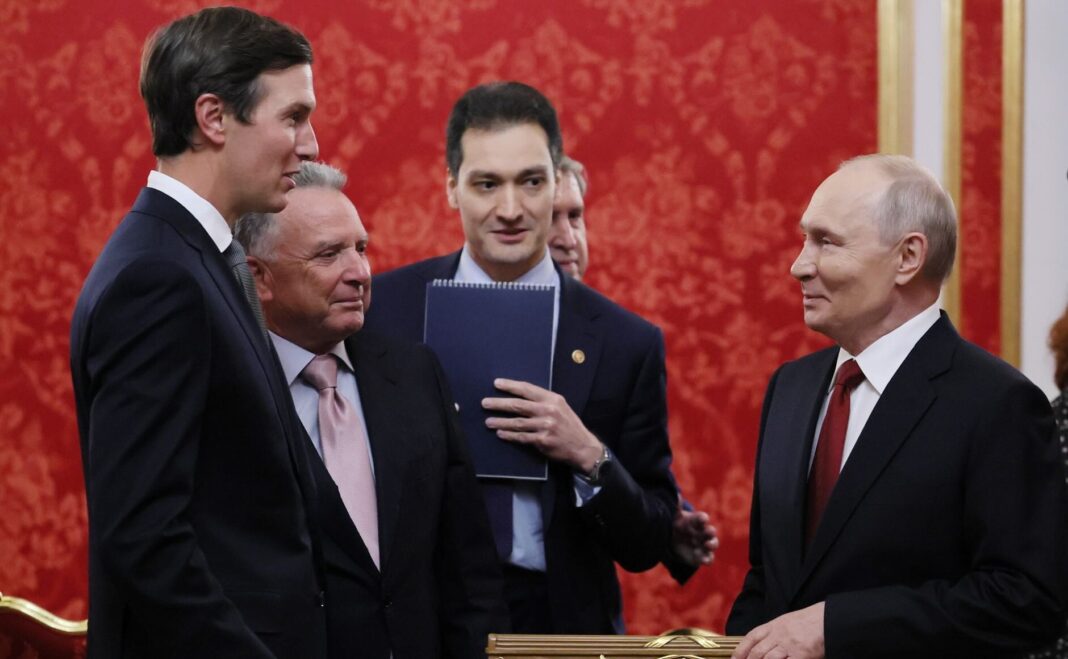
According to an analysis published by the Centre for Strategic and International Studies, Putin personally raised the Lukoil transaction with Witkoff and Kushner during their visit to the Kremlin on 5 September 2026. A senior Trump administration official subsequently confirmed that both men had participated directly in negotiating aspects of the agreement involving the DFC.
The significance of this disclosure is considerable. The individuals entrusted with negotiating an end to Russia’s war against Ukraine were simultaneously involved in discussions concerning a commercial transaction from which the United States government and private American investors stand to benefit.
Kushner’s interview with Axel Springer chief executive Mathias Döpfner, released on the same day as the Lukoil announcement, provides further political context.
His characterisation of the conflict as a European proxy war against Russia, together with his emphasis on Putin’s ambitions for a broader international security settlement, suggests a negotiating agenda extending beyond Ukrainian sovereignty and territorial integrity.
The possibility that the peace negotiations served as political cover for commercial arrangements with Moscow therefore warrants serious examination. Although the available evidence does not establish that the Lukoil acquisition was their primary purpose, it establishes a direct connection between the two negotiating processes.
Political connections and competing interests
The consortium’s composition raises additional questions.
Boehly has contributed approximately $2 million to political causes supporting Trump. Xtellus Partners originated from a 2018 management buyout of the American operations of Russia’s state-owned VTB Capital.
Two previously identified prospective participants, interests associated with Sheikh Tahnoon bin Zayed al-Nahyan and the Syrian-Qatari Al-Khayyat brothers, disappeared from the final consortium.
The Al-Khayyat brothers are involved in a major property development with Kushner in Albania, while Sheikh Tahnoon has investment connections to World Liberty Financial, the cryptocurrency business associated with the Trump and Witkoff families.
Their replacement by Catena Investment Holding leaves questions concerning the consortium’s ultimate beneficial ownership.
Meanwhile, the DFC is expected to receive an equity interest of approximately 15 per cent without committing capital upfront. Washington would consequently acquire a commercial interest in a transaction whose regulatory approval rests with its own administration.
Congress could obstruct the agreement
On 25 November, Gregory Meeks, the ranking Democrat on the House Foreign Affairs Committee, called for the immediate termination of the DFC’s participation, accusing the administration of circumventing congressional restrictions on investment in Russia.
The incoming Congress, which convenes on 3 January 2027, could challenge the transaction through legislative restrictions, budgetary conditions and investigative hearings.
Such hearings could examine communications between the American negotiators and the Kremlin, the selection of consortium members, the involvement of federal institutions and the relationship between commercial negotiations and Washington’s Ukraine policy.
The strategic consequences for Europe
Removing European refineries and other strategic energy infrastructure from Russian ownership could serve legitimate European security interests.
However, the wider implications of the transaction extend beyond ownership of energy infrastructure.
Sanctions were intended to increase the economic cost of Russia’s aggression and strengthen the West’s negotiating position. The Lukoil agreement risks converting that economic pressure into a source of commercial advantage for politically connected investors, while providing Moscow with a mechanism for recovering restricted assets.
For European governments, the implications are particularly significant. An American administration acquiring financial interests through transactions with sanctioned Russian companies could face competing commercial and security considerations when determining future policy towards Moscow.
The original premise of Washington’s economic diplomacy was that commercial co-operation would follow political concessions from Russia. The Lukoil agreement suggests that this sequence is being reversed.
Moscow has yet to deliver a ceasefire, withdraw its territorial demands or abandon its military objectives in Ukraine. Nevertheless, negotiations over a $10 billion commercial transaction have reached the agreement stage.
After nearly two years of American diplomatic engagement, the most substantial negotiated agreement with Moscow concerns Russian oil assets rather than peace in Ukraine.