Original Coverage & Source Attribution: www.arabnews.com
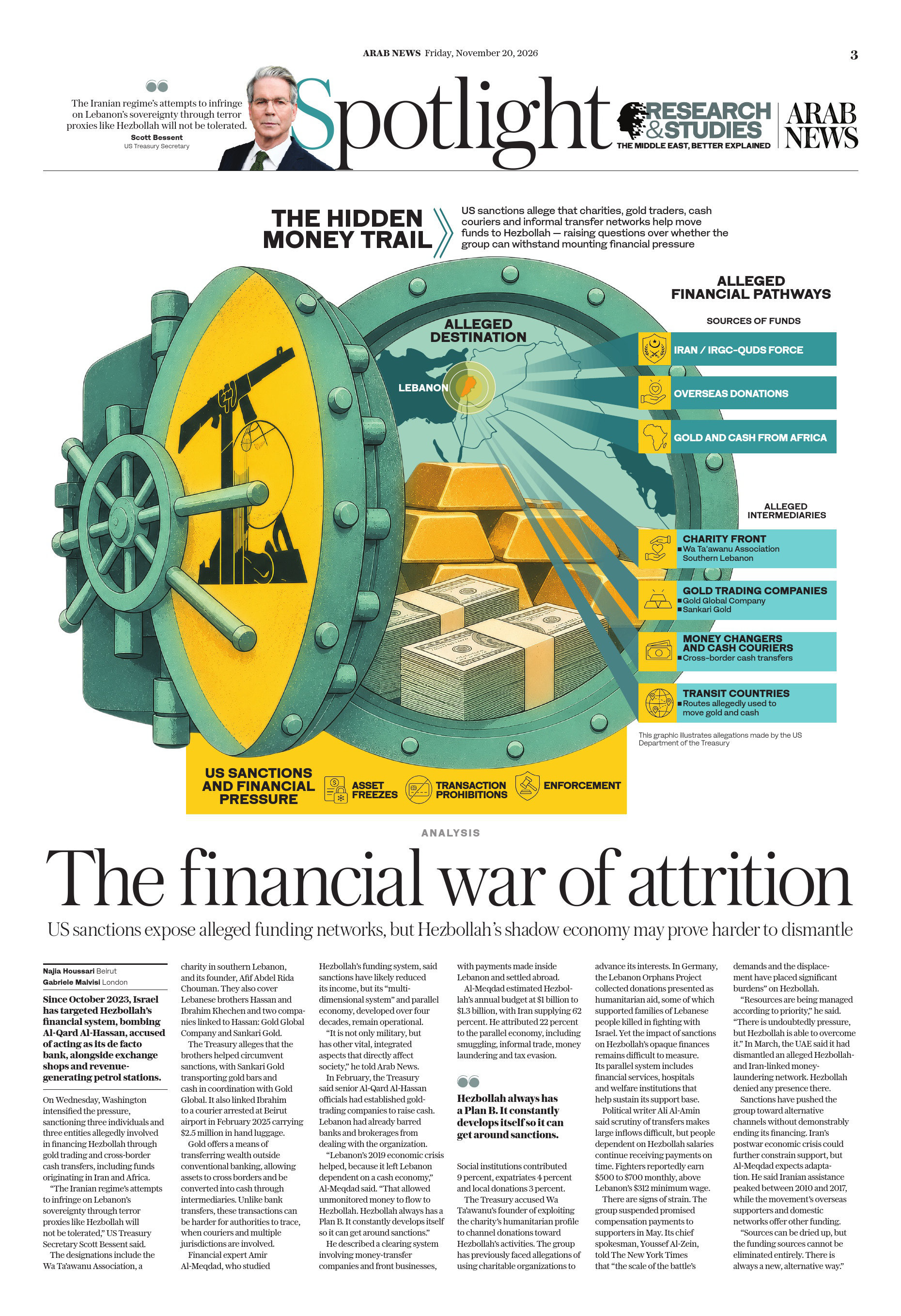
LONDON/DUBAI: Since the start of their direct confrontation in October 2023, Israel has targeted Hezbollah’s financial system.
It has bombed Al-Qard Al-Hassan, long accused of acting as the group’s de facto bank, as well as exchange shops used by Iran to funnel money and petrol stations that generated revenue.
On Wednesday, Washington stepped up the pressure, sanctioning three individuals and three entities accused of working for Hezbollah.
The network allegedly used gold trading and cross-border cash movements from African countries to fund the group, including money from Iran’s Islamic Revolutionary Guard Corps (IRGC) and its Quds Force.
The measures reflect a broader US approach. Washington is looking beyond conventional financial institutions to the channels used to move money and assets outside the banking system — a tactic that raises fresh questions about Hezbollah’s economic resilience and its ability to circumvent sanctions.
“The Iranian regime’s attempts to infringe on Lebanon’s sovereignty through terror proxies like Hezbollah will not be tolerated,” US Treasury Secretary Scott Bessent said late on Wednesday.
“The US government will continue to disrupt Iran’s attempts to exert influence in the region and fund its proxies.”
The designations cover the Wa Ta’awanu Association, a charity operating in southern Lebanon, and its founder, Afif Abdel Rida Chouman.
They also cover two Lebanese brothers, Hassan and Ibrahim Khechen, whom Washington accuses of aiding Hezbollah through a gold and cash smuggling network.
Two companies linked to Hassan Khechen were also sanctioned: Gold Global Company and Sankari Gold Kuyumculuk Ticaret Limited Sirketi, known as Sankari Gold.
The Treasury said the brothers helped bypass international sanctions and obtain funds outside established financial channels.
It said Sankari Gold helped transport gold bars and cash in coordination with Gold Global, which Hassan Khechen manages.
The arrangement allegedly allowed assets to be converted into liquid funds for Hezbollah’s activities.
The Treasury also highlighted Ibrahim Khechen’s alleged role in the cash-transfer network. It said he was linked to a courier arrested at Beirut airport in February 2025 after authorities found $2.5 million in a carry-on bag.
Washington saw the case as evidence of the network’s reliance on cross-border cash transfers outside conventional banking.
Gold gives networks seeking to avoid banking restrictions another way to transfer wealth.
It can be traded and carried across borders, then converted into cash through intermediary companies and markets. Tracking such transactions can be harder than monitoring bank transfers.
Financial expert Amir Al-Meqdad, who prepared a study earlier this year on Hezbollah’s salary and funding system, told Arab News that US sanctions have likely reduced the group’s funding.
But he said its “multi-dimensional system” and parallel economy, built over 40 years, remain largely operational.
“It is not only military, but has other vital, integrated aspects that directly affect society,” he said.
The group has long relied on a complex financial network that operates independently of Iranian funding, though its full extent remains largely unknown.
The gold trade is one piece of a wider puzzle. In February, weeks before the latest Israel-Hezbollah war, the Treasury said senior Al-Qard Al-Hassan officials had set up a chain of gold-trading companies to raise cash.
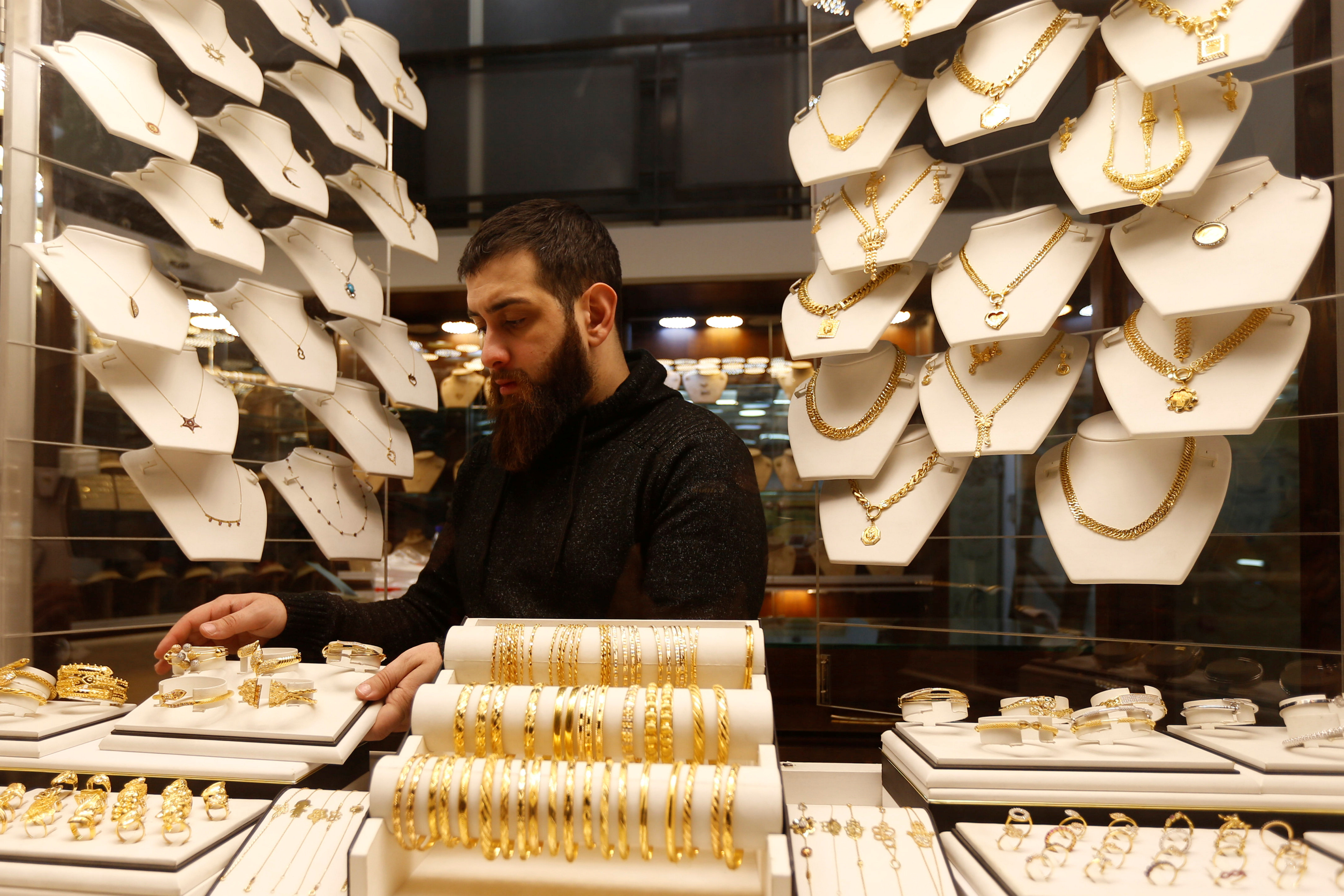
Ledgers reviewed by The New York Times, along with assessments by analysts who track Hezbollah’s cash economy, indicated that gold sales have climbed over the past year.
Israeli and US officials said Hezbollah also wanted to convert gold because Israeli strikes had destroyed much of its foreign currency and gold reserves.
Last year, Lebanon barred banks and brokerages from dealing with Al-Qard Al-Hassan, further isolating Hezbollah from the formal financial system.
However, Al-Meqdad pointed out that Hezbollah’s reliance on the Lebanese banking system ended after banks that served as fronts for transferring its money, such as the Lebanese Canadian Bank and Jammal Trust, were closed.
“Lebanon’s 2019 economic crisis helped, because it left Lebanon dependent on a cash economy,” he said. “That allowed unmonitored money to flow to Hezbollah. Hezbollah always has a Plan B. It constantly develops itself so it can get around sanctions.”
He said the group has built its own clearing system alongside more traditional methods, such as money-transfer companies and front businesses.
“When a party outside Lebanon wants to transfer money for Hezbollah inside Lebanon, it agrees with a company inside Lebanon to pay the money to the party, while settlement takes place abroad.
“There is also trade-based value transfer, which is still used. Commercial companies are opened as fronts to move financial value. We see dozens of commercial businesses open left and right across Lebanese territory without any regard for losses, used as cover for transferring Hezbollah’s money.”
Al-Meqdad estimated the party’s annual budget at $1 billion to $1.3 billion. He said Iranian support accounts for 62 percent.
The parallel economy accounts for 22 percent. It covers smuggling, trade in prohibited goods, money laundering, informal trade, unmonitored overseas networks, Al-Qard Al-Hassan, Jihad Al-Binaa, and customs and tax evasion.
Social institutions provide 9 percent, expatriates 4 percent and local donations 3 percent.
The sanctions also reveal the extent of the network beyond commercial entities.
The Treasury specifically targeted the Wa Ta’awanu Association and its founder, Afif Abdel Rida Chouman.
It accused him of coordinating the organization’s work to exploit its humanitarian profile and channel funds from “outside donors towards Hezbollah’s activities.”
“Wa Ta’awanu provides a pretext for Hezbollah’s militant activities in the pilot zones, preventing disarmament and inhibiting Lebanese government efforts to safeguard these areas,” the US said.
Hezbollah has previously been accused of using charities to serve its interests, though not necessarily to directly fund its field operations.
In Germany, the Lebanon Orphans Project collected donations through local banks and presented them as humanitarian aid.
These funds were used in part to support the families of Lebanese people killed in attacks or battles with the Israeli army.
After being outlawed by German authorities in 2014, it subsequently rebranded itself as “Colors for Orphans.”
While the latest sanctions fit Washington’s long-running effort to choke Hezbollah’s finances, the damage to the group’s secretive system remains largely a matter of guesswork.
Hezbollah has built a financial system parallel to Lebanon’s, with banks, hospitals and a sprawling welfare network that has long underpinned support among its base.
The group and Iran have both proven resilient, bouncing back militarily and finding new ways to keep money flowing.
Political writer Ali Al-Amin told Arab News that monitoring of transfers to and from Lebanon makes regular large inflows difficult.
Even so, he said, those who depend on the party’s salaries still receive them on time each month.
He estimated that Hezbollah needs hundreds of thousands of dollars a month to pay fighters, the wounded, the families of “martyrs,” staff and party-affiliated institutions, as well as to finance the war effort. He said the money reaches people without delay.
Fighters reportedly receive monthly cash salaries of $500 to $700, well above Lebanon’s minimum wage of $312.
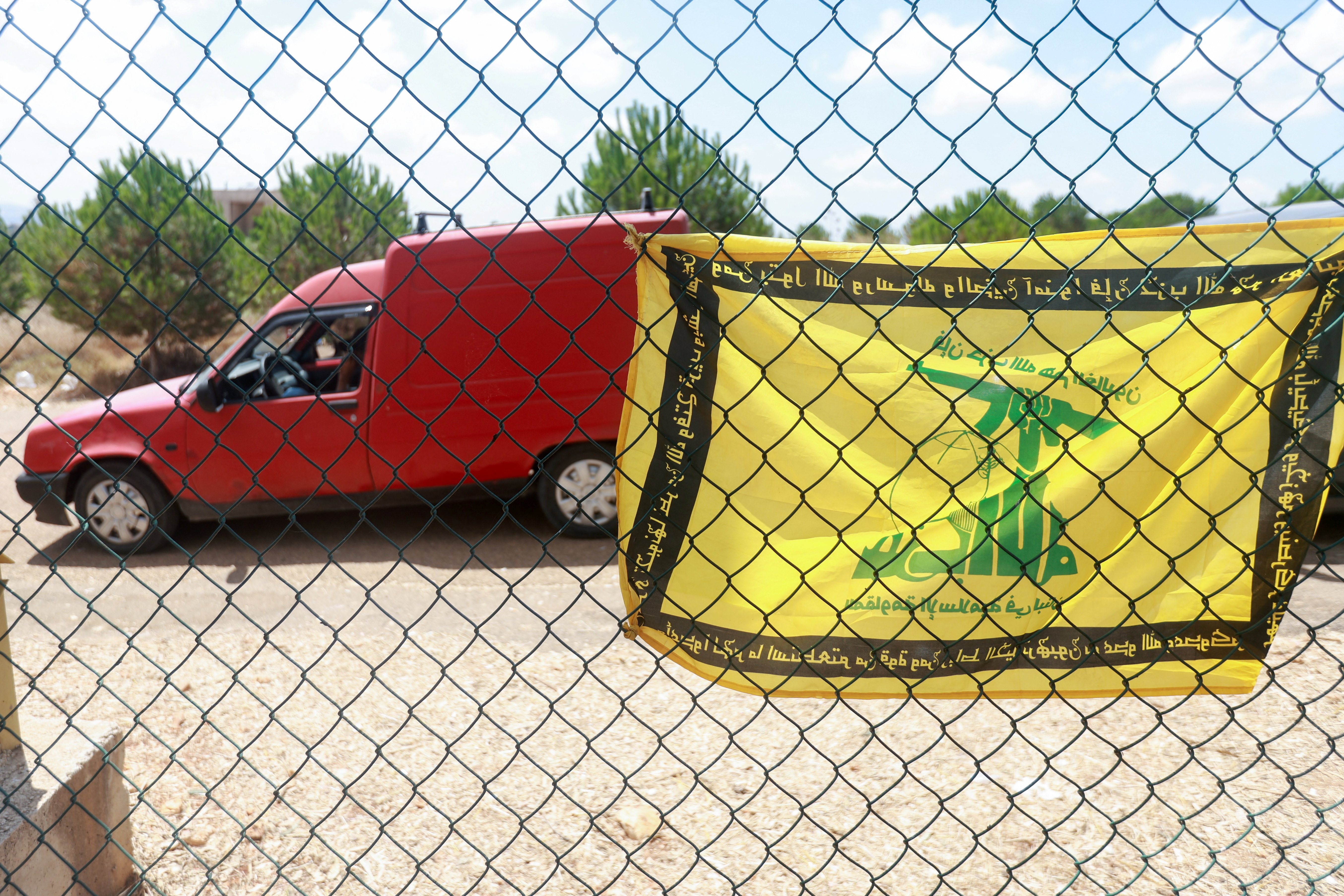
But there are signs of strain. Some experts saw a glimpse of the group’s eroding financial capacity when it halted compensation payments it had pledged to supporters in May.
Chief spokesman Youssef Al-Zein told The New York Times that “the scale of the battle’s demands and the displacement have placed significant burdens” on the group.
“Resources are being managed according to priority,” he said. “There is undoubtedly pressure, but Hezbollah is able to overcome it.”
Pressure is also building abroad. In March, the UAE said it had dismantled a Hezbollah- and Iran-linked network operating under a commercial front to launder money and threaten the country’s financial stability.
Hezbollah denied having any presence in the UAE.
Each round of measures has so far pushed the group toward new channels rather than ending its funding.
Even so, how long Hezbollah can keep paying its way remains an open question, particularly as Iran faces its own postwar economic crisis.
Al-Meqdad said Iranian support, which peaked between 2010 and 2017, may shrink further as Tehran grapples with that crisis. But he expects Hezbollah to adapt.
“Hezbollah has many ways of funding itself, because there is a whole community that believes in it and contributes, inside Lebanon and abroad,” he said.
“Sources can be dried up, but the funding sources cannot be eliminated entirely. There is always a new, alternative way.”