Original Coverage & Source Attribution: nypost.com
Hollywood, they say, is dying. But at my local Starbucks in LA, the creative culture of Tinseltown is very much alive.
LA seems to have developed a peculiar enthusiasm for writing its own obituary. Studios are cutting spending. Film production is migrating elsewhere.
But I’m still holding out hope for Hollywood, even as jobs disappear. Because the entertainment industry and the creative culture that sustains it are not the same thing, and the latter is very much alive.
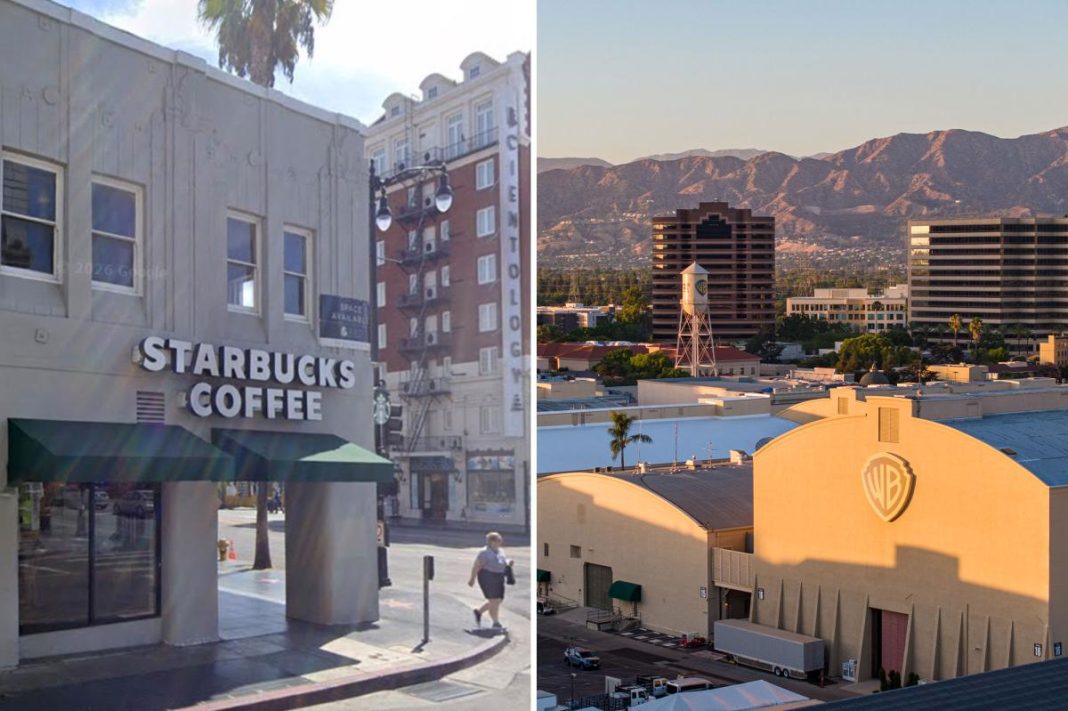
I meet the people at the heart of Hollywood every time I go to my local Starbucks on McCadden Place and Hollywood Boulevard.
The most familiar face at the register is one of those cheerful twenty-three-year-olds whose untainted happiness makes you feel both ancient and vaguely protective of him.
He has a more seasoned colleague who says he is “thirty, but emotionally forty.”
I didn’t learn he was an actor until I asked how he was doing, and he said he felt like he just fell off a horse.
“Don’t we all,” I replied.
“No, literally,” he said. “I fell off a horse yesterday.”
He was learning to ride for a film role, he explained. And with that fact, he opened up his green apron.
The Actor — as I began to call him — is also taking clowning classes, although he specified “not the big red nose kind.” Think Buster Keaton-style clowning in the vein of performance art. The guy drizzling caramel syrup at 8:00 a.m. is an immersive theater actor.
And as for my beaming barista at the register — well, it turns out that he makes short films.
The Filmmaker is shooting a film and has another in post-production. He enjoys making films about musicians.
He works the register, sending orders to the Actor for candy-colored atrocities that seem to have forgotten their coffee ancestry. But theirs is more than a barista bond.
The Filmmaker recently helped the Actor staff a feature film project. He is also planning a music video with two other musician baristas.
That this constellation of quirky entertainers came to exist under the roof of one soulless corporate coffee chain can only lead me to one conclusion.
It is one that I realize will be unpopular and deeply uncool, so let me preface it by saying I’ve lived here nine years. Long enough to have witnessed a calamity or two.
This is still a fantastic town.
It’s not that the decline of the entertainment industry is imaginary. For most of the twentieth century, filmmakers had little choice but to come to LA for the big studios and jobs.
Beginning in the 1990s, Hollywood began losing productions to cities offering lower costs and generous tax incentives.
LA no longer has a monopoly on the cinematic universe.
But something survived the industry’s decentralization: the concentration of people who want to make things.
My baristas aren’t waiting for Hollywood to give them jobs. They’re making films and recruiting one another for projects, all while wearing identical green aprons.
Production might be moving to lower-cost locales like Vancouver, Atlanta, and Nashville. But Vancouver doesn’t feel like LA. And Nashville feels like a parade of bachelorette parties in cowboy boots that make me feel emotionally sixty.
Culture is a curious thing. It is tied to industries, sure. But it is also woven too deeply into a city’s identity to disappear with the industries that gave rise to it.
Detroit remains the Motor City long after its auto industry declined. Chicago lost the great stockyards and steel mills that made it the City of Big Shoulders, but not the rough-and-tumble character beneath them.
If Chicago is solid steel, LA is a collective mirage. Our culture was built on a desire for illusion, the peculiar human capacity to inhabit fictions.
So it appears different to each set of eyes.
That’s another way of saying: LA is a feeling.
The Filmmaker told me recently that he has many artistic regulars who connect with him over their shared pursuits.
He never expected that working at Starbucks would introduce him to so many other creatives, and he’s grateful that this place exists.
So am I.
Mary Dahm is a writer and medical technology publicist based in Los Angeles.