Original Coverage & Source Attribution: www.iranintl.com
Mohamed Fahmy, a journalist and regional affairs analyst, described the visit as an exercise in “coercive diplomacy,” arguing that the alliance was combining negotiations with preparations for a possible military response.
“This may be the last chance before a collective imminent military action,” he told Iran International.
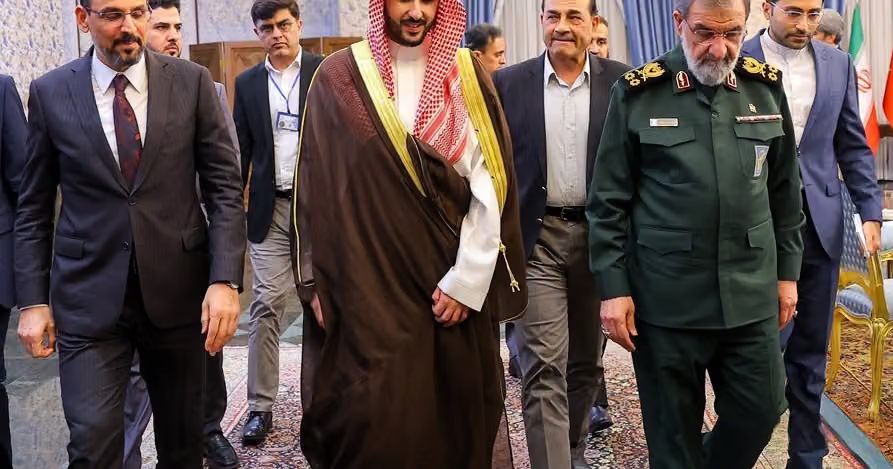
Saudi Defense Minister Khalid bin Salman, Pakistani army chief Asim Munir and Turkish intelligence chief Ibrahim Kalin met Iranian President Masoud Pezeshkian and Supreme National Security Council Secretary Mohsen Rezaei, with Rezaei hosting the four-way talks.
Riyadh said the visit by representatives of the Mecca Joint Defense Agreement was part of efforts to reduce tensions and promote dialogue.
The attacks on Saudi Arabia have presented the first major test of the agreement, signed by Saudi Arabia, Turkey and Pakistan in August, which pledges collective action when a member comes under attack.
Iranian state television reported that the four countries agreed to continue discussions on regional peace and security. No agreement to halt the Houthi attacks was announced.
The talks also unfolded against renewed threats of military action between Washington and Tehran. President Donald Trump has kept open the possibility of renewed strikes, while Iranian officials have warned of retaliation.
“The main objective is pressure,” Fahmy said.
He said Saudi Arabia and its partners were attempting to exhaust diplomatic options while demonstrating that continued Houthi attacks could bring a collective response.
Professor Saad bin Tefla al-Ajmi, a former Kuwaiti information minister, told Iran International that the seniority of the delegation demonstrated the lengths to which Iran’s neighbors were prepared to go to prevent another war.
He described the visit as an extraordinary diplomatic effort to prevent renewed hostilities, but said it could be interpreted in sharply different ways within Tehran, either as evidence of Iranian strength or as an opportunity to pursue a diplomatic settlement.
Iranian hardliners, he said, could portray the arrival of senior Saudi, Turkish and Pakistani officials as evidence that the Islamic Republic had gained the upper hand, forcing its neighbors to seek accommodation on Iranian territory.
A more pragmatic interpretation would see the visit as an opportunity for Tehran to demonstrate a willingness to cooperate with neighboring countries and pursue a diplomatic settlement, while portraying Washington and Israel as responsible if negotiations failed.
“It depends on whose mind you are reading in Tehran now,” al-Ajmi said.
Attacks test the Mecca pact
Al-Ajmi also pointed to a hardening Saudi position toward the Houthis, arguing that Riyadh had exhausted its attempts to accommodate the group.
“I think that they have made their mind that the Houthi will have to go and they can’t take it anymore,” he told Iran International.
Al-Ajmi said Saudi Arabia was seeking international diplomatic and political support while demonstrating that it had been the target of aggression by the Houthis and their Iranian backers.
The urgency of the talks follows a series of deadly attacks on Saudi civilian and strategic infrastructure.
The Houthis claimed fresh attacks Monday on Saudi oil infrastructure and Riyadh airport, although Saudi authorities did not immediately confirm those claims.
The Saudi-led coalition also reported destroying Houthi missile infrastructure in Yemen, while Egypt’s parliament authorized military support to help defend Saudi Arabia, potentially drawing another regional power more directly into the confrontation.
Egypt’s decision, Fahmy argued, adds another dimension to the confrontation, with potential consequences for the country’s already vulnerable economy.
The diplomatic effort may also involve financial concessions.
Israel Hayom reported Monday, citing unnamed Persian Gulf diplomatic sources, that Saudi Arabia was discussing a possible $1 billion payment to the Houthis through Iran as part of a ceasefire arrangement.
The Israeli newspaper said a Saudi official did not confirm any transfer but acknowledged that earlier understandings with the Houthis included financial assistance for public-sector salaries and reconstruction in exchange for an end to attacks.
Iran International could not independently verify the reported $1 billion proposal.
The possibility of a negotiated settlement comes as the Mecca pact’s ability to fulfill its military commitments faces growing scrutiny.
Historian and political analyst Dr. Shahram Kholdi told Iran International that the alliance had failed to deliver the protection promised to its members.
“The Mecca Pact has effectively been a paper tiger,” Kholdi said.
He argued that despite military cooperation among the three countries, Saudi Arabia remained vulnerable to Houthi missile and drone attacks.
Obstacles to a lasting settlement
Kholdi believes the delegation’s principal objective is to persuade Tehran to restrain the Houthis, potentially in exchange for efforts to convince Washington to reconsider some of the conditions preventing renewed US-Iran negotiations.
He said Turkey and Pakistan were reluctant to confront the Houthis directly because of the risk of Iranian retaliation, leaving Saudi Arabia pursuing diplomacy while continuing to face attacks.
Even securing Tehran’s cooperation, however, may not produce a lasting settlement.
Kholdi argued that the Houthis could demand political guarantees amounting to the effective partition of Yemen before agreeing to stop their attacks.
Such an arrangement could leave Saudi Arabia facing an entrenched hostile entity along its southern border, an outcome Riyadh has so far resisted.
Other regional diplomatic efforts have focused on the US-Iran standoff. Qatari officials visited Tehran on Sunday, while Pakistan has continued to serve as an intermediary between the United States and the Islamic Republic.
Disagreements remain over the US naval blockade of Iranian ports, access through the Strait of Hormuz and the terms of a broader settlement addressing Iran’s nuclear program.
Kholdi expects the diplomatic effort could produce a temporary reduction in hostilities, but doubts it will deliver a lasting ceasefire. He warned that even a brief lull could unravel through miscalculation.
The Mecca pact was established to provide collective security. Continued attacks on Saudi Arabia are now testing that commitment while its members pursue talks with Iran.
With no announced agreement to halt the Houthi attacks and the US-Iran standoff unresolved, the risk of a military confrontation extending well beyond Yemen remains.