Original Coverage & Source Attribution: www.kyivpost.com
Russia has begun replenishing military equipment at several storage bases, including facilities near NATO members Estonia, Latvia and Finland, according to satellite imagery analyzed by OSINT researchers as reported by the independent Russian outlet iStories on Saturday, Oct. 17.
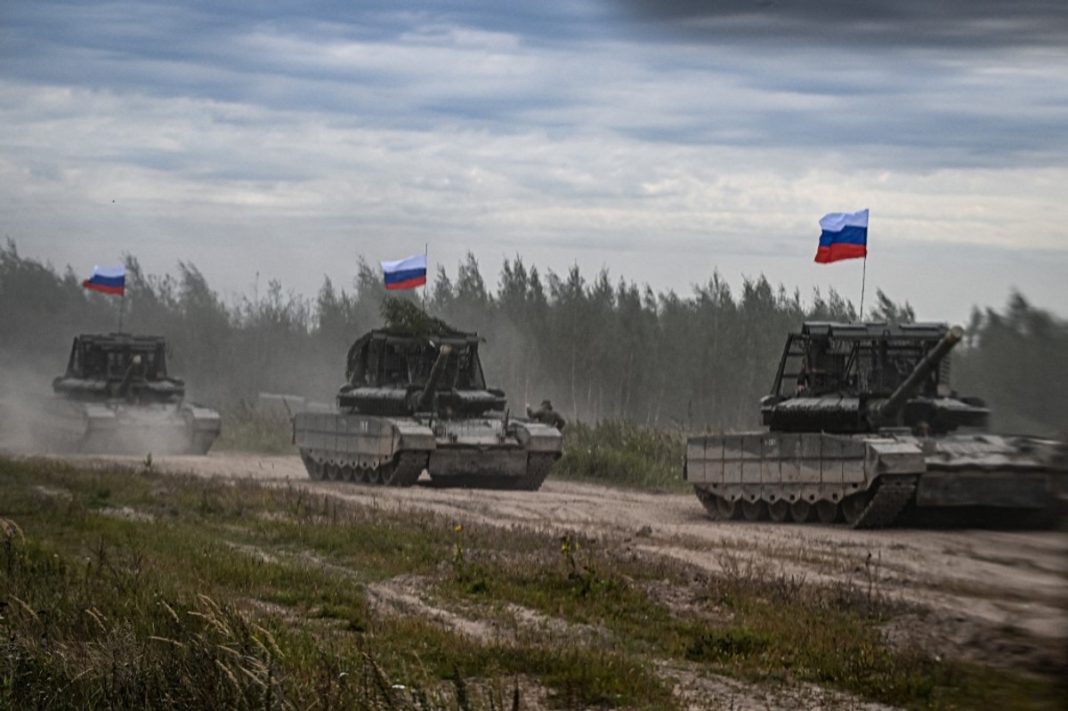
At the 22nd Central Reserve Base in Bui, Kostroma region, satellite images show new T-90M tanks, BTR-82A armored personnel carriers and BMP-3 infantry fighting vehicles arriving between fall 2025 and October 2026. The base is about 500 kilometers (310 miles) from the borders of Estonia and Latvia, according to Radio Free Europe/Radio Liberty journalist Mark Krutov, who compared imagery of the site from October 2025 and October 2026.
Researchers emphasize that the equipment is being sent to storage facilities. It has not been transferred to active military units and is not ready for immediate deployment, iStories reported.
Equipment appears at multiple storage ifaciĺities
The buildup is also visible at bases farther from Russia’s western borders.
At the 349th Central Tank Storage Base in Topchikha, Altai Krai, analysts identified about 78 refurbished T-72B3 tanks and more than 100 BMP-2 infantry fighting vehicles arriving from around June 2026.
The 6018th base has also received BMP-3 and BMD-4 vehicles, iStories reported.
In Karelia, the 374th Mobilization Deployment Support Center – about 185 kilometers (115 miles) from Finland – has been receiving Malva artillery systems and Giatsint-K self-propelled guns since 2025.
Other Topics of Interest
Italy Reduces Visa Processing for Russians to 45 Days
Italy is also said to be the last one to hold out on the EU’s proposed visa ban for Russians.
The observations were made by OSINT analysts Mark Krutov, Jompy and Covert Cabal using satellite imagery. Krutov’s satellite-image comparison shows new T-90M tanks at the Bui base.
Russia adapts its use of armored vehicles
Russian forces used a large share of their stored armored vehicles during the full-scale invasion of Ukraine.
But as drones made tanks and armored vehicles increasingly vulnerable on the battlefield, Russian forces relied more on infantry assaults and small mobile groups, Krutov wrote.
Russian factories have continued producing new equipment and repairing damaged vehicles.
Some of the equipment seen in satellite images is newly manufactured, while other vehicles have been refurbished, according to the researchers.
The renewed accumulation does not by itself show that Russia is preparing to attack a NATO country.
Krutov said the vehicles could theoretically be useful in a future confrontation with NATO, whose militaries have less experience using drones at the scale seen in Ukraine.
He also noted that Russian officials deny plans to attack NATO member states.
In June, journalists from Denmark’s DR, Norway’s NRK, Sweden’s SVT and Estonia’s Delfi reported that Russia was building and modernizing military facilities near northern NATO countries.
The latest satellite imagery adds evidence that some Russian storage bases are receiving equipment, while leaving open how and when it might be used.