Original Coverage & Source Attribution: lansinginstitute.org
Reports that Russian storage bases were replenished with tanks, armored personnel carriers, and artillery systems during 2026 may indicate an important shift in the allocation of resources within Russia’s military-industrial complex. While Russia drew heavily on armored vehicles from its strategic reserves in 2022–2023 to compensate for losses in Ukraine, the current accumulation of newer weapons at storage facilities suggests a possible rebuilding of the armed forces’ mobilization potential.
The geography of this process is particularly significant. According to the reported information, new equipment is being delivered, among other locations, to facilities in Kostroma Oblast and Karelia associated with military infrastructure along the northwestern strategic axis.
The principal strategic threat is not Russia’s immediate readiness to attack NATO but the possible creation of a material foundation for a faster restoration of its offensive capabilities after the war against Ukraine ends or decreases in intensity.
This leads to five preliminary conclusions: Russia may be shifting from predominantly drawing down accumulated reserves to partially rebuilding them. If confirmed, deliveries of new equipment to storage bases would mean that a portion of industrial output is not being sent directly to the Ukrainian front.
The northwestern strategic axis remains important to Russian military planning. Replenishing facilities in Karelia and other regions could support the future deployment of formations oriented toward the Baltic and northern theaters of operations.
The dominance of drones does not mean the abandonment of mechanized warfare. Russian commanders may be adapting current operations to the mass use of unmanned aerial vehicles (UAVs) while preserving heavy equipment for future operations.
Rebuilding reserves gives the Kremlin additional strategic options. Even without an intention to launch an immediate offensive against NATO, accumulating equipment could strengthen Russia’s ability to exert military pressure and sustain a prolonged confrontation.
For NATO, the decisive indicator should be not only the number of Russian troops in Ukraine but also the pace at which reserves are replenished, personnel are trained, and new formations are established.
At the same time, the presence of equipment at storage bases does not prove that an approved plan to attack NATO countries exists. Such a conclusion would require establishing a connection between weapons stockpiling, the organizational deployment of forces, the development of logistics, and corresponding operational preparations.
From Depleted Stockpiles to Replenished Reserves: A Shift in Russia’s Military Model
The first years of Russia’s full-scale war against Ukraine were characterized by extensive use of weapons accumulated during the Soviet era.
Heavy losses of armored vehicles forced Russian commanders to withdraw tanks, infantry fighting vehicles, armored personnel carriers, and artillery systems from long-term storage facilities.
This approach helped replace losses but simultaneously reduced the mobilization reserve intended to equip additional formations in the event of a large-scale war.
If reports of newly delivered T-90M tanks, BTR-82A armored personnel carriers, BMP-3 infantry fighting vehicles, and modern artillery systems at storage bases in 2025–2026 are confirmed, they could indicate a change in the logic of allocating military production.
This could mean simultaneously pursuing three objectives: sustaining ongoing combat operations against Ukraine; replacing losses and reequipping existing military formations; and rebuilding stockpiles for future mobilization deployments.
An especially important indicator is not the total amount of equipment in storage but the relationship between production, losses, deliveries to active units, and accumulation in reserve.
If newly produced tanks are systematically sent into storage despite the continuing war, this could indicate a decision by Russian leaders to earmark part of industrial output for long-term military needs.
There are, however, alternative explanations. Equipment may be temporarily held at bases before allocation to units, undergo acceptance procedures, await additional components, or be intended for formations that have not yet completed their organizational deployment.
Karelia and Kostroma Oblast: The Geography of New Reserves
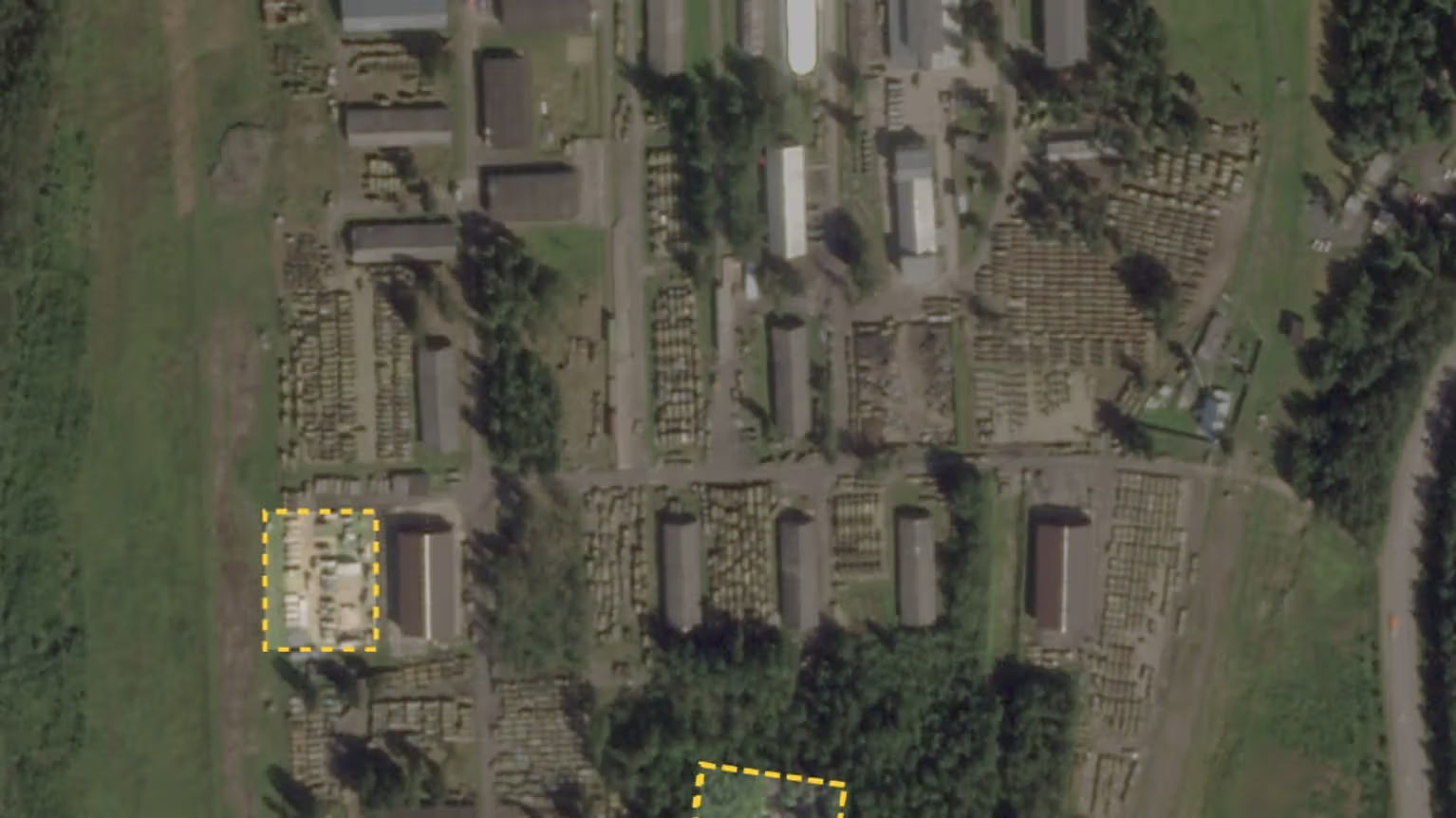
The most significant element of these reports is the replenishment of two Russian military infrastructure facilities.
22nd Central Reserve Base, Buy, Kostroma Oblast
According to the source information, T-90M tanks, BTR-82A armored personnel carriers, BMP-3 infantry fighting vehicles, and armored recovery vehicles appeared here between autumn 2025 and October 2026.
The reported distance to the Estonian and Latvian borders is approximately 500 km.
374th Mobilization Deployment Support Center, Karelia
According to the source information, Malva and Giatsint-K wheeled artillery systems have been arriving here since late 2025.
The reported distance to the Finnish border is approximately 185 km.
The Karelian Axis
Karelia has acquired particular importance since Finland joined NATO in 2023. The extension of Russia’s shared border with the Alliance has created additional defense-planning requirements for Moscow along the northern axis.
The deployment of artillery systems in the region may be associated with rebuilding military infrastructure, equipping new formations, or establishing mobilization stockpiles.
ʼ
The Kostroma Axis
Kostroma Oblast lies deep within European Russia and has a different operational significance from areas immediately adjacent to the border.
Equipment accumulated there could support strategic reserves that could be transferred to various directions if necessary.
It would therefore be premature to interpret the base in Buy as a direct staging ground for an attack on the Baltic states. Its significance depends primarily on transport access, organizational subordination, and the intended allocation of the equipment.
The fundamental distinction between the two facilities is that Karelia is directly relevant to the northern border axis, while Kostroma Oblast may function as a deeper reserve area.
This does not rule out using equipment from both facilities along the same strategic axis, but it does not justify automatically assuming such a purpose.
Is Russia Really Building a New Armored Reserve for War Against NATO?
The replenishment of storage bases must be assessed in the context of the broader reorganization of the Russian armed forces.
In 2024, Russia reestablished the Leningrad Military District as part of its adaptation to Finland’s and Sweden’s accession to NATO.
According to Finnish military intelligence assessments, Russian plans call for a substantial reinforcement of the district, the deployment of a new army corps in Karelia, and the conversion of several brigades into divisions. At the same time, most Russian ground forces remain committed to the war against Ukraine.
This makes it possible to view equipment accumulation in the context of long-term military planning.
Three stages in building military capability must nevertheless be distinguished: equipment accumulation — material reserves; formation of units — personnel, training, and logistics; and operational readiness — coordinated forces with the necessary support.
The arrival of new armored vehicles would primarily confirm the first stage. It does not mean that Russia has already formed additional combat-ready divisions.
That requires trained personnel, command structures, engineering support, ammunition, communications, repair capacity, and the ability to coordinate combat operations.
Russia’s strategic reserve should therefore be understood as potential for future force expansion, rather than as an invasion force already ready for action.
Nevertheless, rebuilding reserves reduces the amount of equipment Russia would have to manufacture or repair after the war against Ukraine ends.
This may be the most important consideration for NATO’s long-term planning.
Why Drone Dominance Does Not Mean the End of the Armored Vehicle Era
The war against Ukraine has demonstrated a fundamental change in the character of ground combat.
The mass use of reconnaissance and attack drones has substantially increased the vulnerability of large mechanized formations, complicated the concentration of forces, and altered the conduct of offensive operations.
In its 2026 review, Finnish military intelligence noted that Russian attacks on the Ukrainian front increasingly rely on infantry supported by drones and electronic warfare systems. This adaptation is partly linked to heavy equipment losses during earlier operations.
It does not follow, however, that tanks, infantry fighting vehicles, and self-propelled artillery have lost their strategic significance.
Armored vehicles remain important for protected troop movement, fire support, exploiting advances, and holding territory. Artillery, meanwhile, retains the ability to deliver sustained fire, particularly when combined with drone reconnaissance.
At the same time, the future employment of mechanized formations will depend on their integration with UAVs, electronic warfare, air defense, and countermeasures against precision strikes.
Russia’s accumulation of armored vehicles therefore does not necessarily signal a return to the prewar model of massed tank offensives.
A more substantiated hypothesis is that Russian commanders seek to preserve the option of employing large mechanized forces while adapting them to an environment of persistent drone surveillance and strikes.
NATO must therefore prepare not for a choice between traditional mechanized warfare and drone warfare, but for their combination.
Why an End to the War in Ukraine Could Accelerate Russia’s Military Recovery
One of the most important conclusions is that the intensity of the war against Ukraine directly affects the pace of Russia’s military recovery.
As long as Russia must sustain large-scale combat operations, a substantial share of its human, material, and financial resources remains tied to the Ukrainian front.
If hostilities cease or substantially decline, Moscow could potentially redistribute some of these resources to other strategic directions.
This could include reequipping new formations, resuming their training, and expanding military infrastructure.
In June 2026, the Institute for the Study of War (ISW) reported an expansion of Russian military facilities along NATO’s northern borders. Its analysts assessed these activities as infrastructure preparations for future force expansion, while noting that large-scale Russian ground operations against the Alliance remained unlikely in the near term.
The Finnish Institute of International Affairs has likewise emphasized that Russia could increase its military presence near Finland after the active phase of the war in Ukraine ends.
This creates an important strategic dilemma for NATO.
On the one hand, an end to the war against Ukraine could reduce the immediate intensity of fighting in Europe.
On the other hand, without robust deterrence mechanisms and oversight of Russian rearmament, it could give Moscow additional opportunities to rebuild its military capabilities.
A cessation of hostilities in Ukraine should therefore not automatically be equated with a reduction in the long-term military threat to NATO’s eastern flank.
Is NATO Underestimating the Pace of Russian Rearmament?
The assertion that NATO is entirely ignoring Russian rearmament is inconsistent with existing assessments by the Alliance’s intelligence services.
In February 2026, Estonia’s Foreign Intelligence Service warned of Russian plans to rebuild its armed forces and alter the military balance in Europe. At the same time, it did not anticipate an imminent Russian attack on NATO countries.
The problem, therefore, is not a lack of awareness of the threat, but a possible gap between threat assessment and the speed of practical defense-capability development.
Of particular importance to NATO are: the pace of expanding weapons and ammunition stockpiles; the capacity of European manufacturers to sustain long-term military production; the availability of trained reserves and military formations; the readiness of logistics infrastructure to rapidly reinforce the eastern flank; and the integration of counter-drone systems, electronic warfare, and air defense into mechanized forces.
Notably, in October 2026, NATO’s Supreme Allied Commander Europe, General Alexus Grynkewich, emphasized the Alliance’s readiness to respond to possible aggression.
Scenarios for the Development of Russian Military Capabilities in 2027–2030
| Scenario | Potential Developments | Implications for NATO |
| Continuation of intensive war against Ukraine | A large share of Russian production is sent to the front; reserves are replenished unevenly | Limited ability to rapidly expand ground forces along other strategic axes |
| Freeze in hostilities | Russia gradually redirects resources toward rebuilding military formations | Greater need to strengthen the eastern flank and monitor Russian rearmament |
| Accelerated rebuilding of the Russian army | Bases expand, new units are formed, and weapons stockpiles grow | Russia gains greater capacity for military pressure and potential escalation |
| Rearmament combined with hybrid pressure | Military buildup is accompanied by sabotage, cyber operations, and information campaigns | NATO must strengthen conventional defenses and critical infrastructure protection simultaneously |