Original Coverage & Source Attribution: www.fool.com
Broadcom: Sustaining Consistent Revenue Expansion
Broadcom (AVGO -3.10%) primarily generates its revenue by innovating, developing, manufacturing, and globally distributing advanced semiconductor solutions and critical infrastructure software that are utilized extensively across enterprise networking, broadband, telecommunications, and industrial automation environments.
It secured a multi-year private cloud partnership with Standard Chartered in July, while simultaneously navigating an expanded European antitrust inquiry in September regarding its newly updated software licensing requirements.
SK Hynix: Experiencing Sharp Revenue Acceleration
SK Hynix (SKHY -6.05%) earns the vast majority of its revenue by researching, designing, manufacturing, and selling a wide variety of advanced memory semiconductor components, including dynamic random-access memory and NAND flash memory products tailored specifically for complex customer applications.
While facing ongoing price pressure on its legacy memory components during recent months, it increased production volumes for its advanced chips in late July and announced a manufacturing technology collaboration with Taiwan Semiconductor Manufacturing Company in September.
Why Revenue Matters for Investors
Revenue serves as a straightforward metric that helps investors clearly understand the total amount of money a company brings in from its core commercial operations before any operational costs, taxes, or daily business expenses are deducted. The metric serves as a fundamental baseline measure of overall customer demand and business growth.
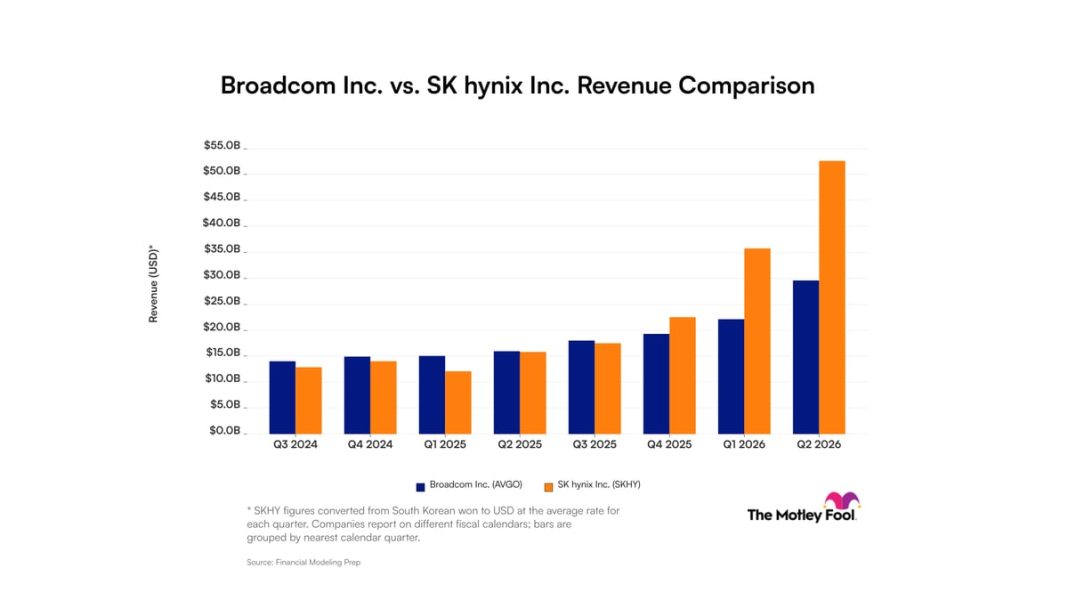
Broadcom vs. SK Hynix Revenue over the last 8 quarters. Figures: SK Hynix shown in U.S. dollars, converted from South Korean won.
Quarterly Revenue Trends for Broadcom and SK Hynix
| Calendar quarter | Broadcom Revenue | SK Hynix Revenue |
|---|---|---|
| Q3 2024 | $14.1 billion (quarter ended Nov. 3, 2024) | $12.9 billion (quarter ended Sept. 30, 2024) |
| Q4 2024 | $14.9 billion (quarter ended Feb. 2, 2025) | $14.1 billion (quarter ended Dec. 31, 2024) |
| Q1 2025 | $15.0 billion (quarter ended May 4, 2025) | $12.1 billion (quarter ended March 31, 2025) |
| Q2 2025 | $16.0 billion (quarter ended Aug. 3, 2025) | $15.8 billion (quarter ended June 30, 2025) |
| Q3 2025 | $18.0 billion (quarter ended Nov. 2, 2025) | $17.6 billion (quarter ended Sept. 30, 2025) |
| Q4 2025 | $19.3 billion (quarter ended Feb. 1, 2026) | $22.6 billion (quarter ended Dec. 31, 2025) |
| Q1 2026 | $22.2 billion (quarter ended May 3, 2026) | $35.7 billion (quarter ended March 31, 2026) |
| Q2 2026 | $29.6 billion (quarter ended Aug. 2, 2026) | $52.6 billion (quarter ended June 30, 2026) |
Data source: Financial Modeling Prep. SK Hynix’s figures are converted from South Korean won to U.S. dollars. Data as of Oct. 13, 2026.
Foolish Take
The revenue trends between Broadcom and SK Hynix reveal the former’s predictable consistency in generating measured quarter-over-quarter growth, while the latter trailed Broadcom until SK Hynix finally overtook the semiconductor leader at the end of last year.
In 2026, SK Hynix has experienced massive revenue growth thanks to the artificial intelligence boom, which has created rising demand for the company’s high-bandwidth memory (HBM) products. HBM is ideal for AI systems, and an industrywide memory shortage has been a tailwind for SK Hynix, pushing its product prices skywards. However, the company’s offerings are prone to cyclical ups and downs. It’s only a matter of time before the downturn hits.
Broadcom may not be seeing the explosive growth of SK Hynix, but it does not rely on commodity pricing. Instead, the company dominates back-end AI data center networking, and because its hardware is paired with infrastructure software through its VMware division, its revenue steps up incrementally and reliably.
Robert Izquierdo has positions in Broadcom, SK Hynix, and Taiwan Semiconductor Manufacturing. The Motley Fool has positions in and recommends Broadcom and Taiwan Semiconductor Manufacturing. The Motley Fool recommends Standard Chartered Plc. The Motley Fool has a disclosure policy.