Original Coverage & Source Attribution: robinjbrooks.substack.com
Thank you for subscribing to my posts. If you’re not yet a paying supporter, please consider becoming one. That’ll allow you to DM me with questions and comments. Your contribution will help cover the cost of the data I use in my posts, which I fund out of my own pocket. Thanks so much for your support and feedback!
There’s two things going on at the moment that are putting stress on global financial markets. The first is that oil prices are rising again as markets worry about oil supply out of the Persian Gulf. As I flagged in yesterday’s post and live stream, this is mostly because the US is standing back from military confrontation ahead of the midterms, which the IRGC is exploiting with increased attacks on ships in the Strait of Hormuz. The solution is for the US to shut down IRGC activity in the Strait, which will bring down shipping costs and thus oil prices. The second is growing anxiety around all the debt that’s been issued for AI and data centers. Lots of this debt is already below par and write-downs look increasingly inevitable. There’s always a risk this spills over into the broader economy, so today’s post is an update on financial stability.
In my past pieces on this topic, I used 2022 as a benchmark for what’s going on in 2026 and I think this is still a useful comparator. Russia’s invasion of Ukraine spiked oil prices, a shock that coincided with the world’s central banks hiking interest rates to combat post-COVID inflation. There’s lots of parallels to now, but there’s also big differences, most obviously that the Persian Gulf is about three times as important for global oil supply as Russia and inflation was more of a problem in 2022 than now.
As in my past posts, I look at what’s happening in spot and options markets. The former is where directional views are expressed, so – if you’re certain oil is going to rise – you’ll go long oil in this market. If, in contrast, you’re worried about rising uncertainty and tail risk, you’ll want to hedge that in options markets. Hedging often runs well ahead of directional views, so the swings in options markets can be more violent than in spot. Thus, if options markets look more or less in line with 2022 – an episode markets navigated successfully – this bodes well for where we are now.
-
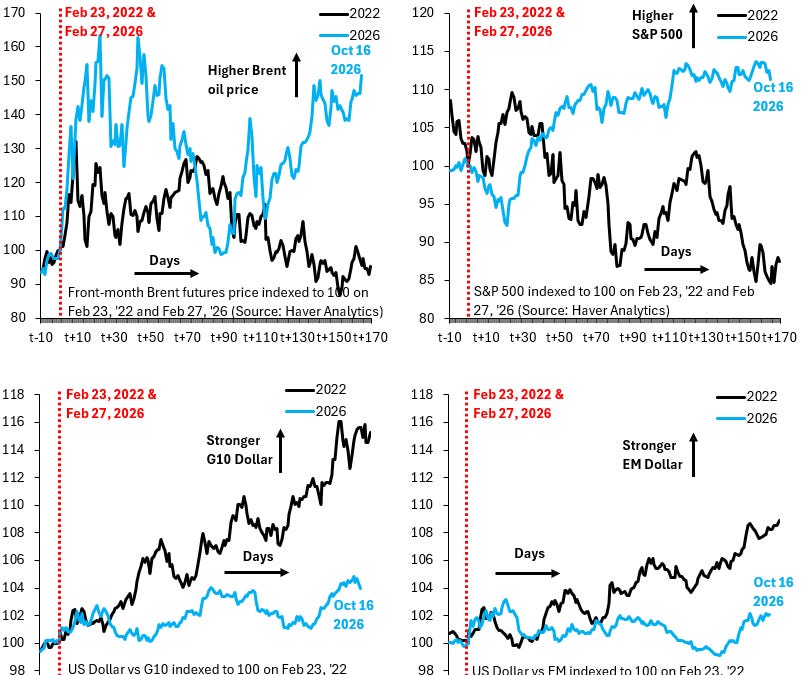
Spot markets: the four charts below show the evolution of the Brent oil price (top left), the S&P 500 (top right), the Dollar versus its G10 peers (bottom left) and the Dollar versus emerging markets (bottom right). The blue line is what’s happening now and the black line is what went on in 2022. In both cases, I’ve indexed things to be 100 the day before war began, which is Feb. 23, 2022, for Ukraine and Feb. 27, 2026, for Iran. The risk premium in Brent is much higher than where it was at this point in 2022, yet the S&P 500 is way higher. That’s in part because the Fed and other central banks aren’t hiking as much, which explains why the Dollar is weaker than where it was in 2022. Overall, given how important the Persian Gulf is for global oil supply and AI debt wobbles, markets are very well behaved.
-
Options markets: the four charts below show 30-day ahead implied volatility for crude oil prices (top left), the S&P 500 (top right), the bond market (bottom left) and high yield corporate debt (bottom right). As above, I’ve indexed things to be 100 the day before war began, i.e. Feb. 23, 2022, for Ukraine and Feb. 27, 2026, for Iran. In the weeks right after the war with Iran began, extreme uncertainty over the path for oil prices caused lots of stress, so it’s reassuring that we’re nowhere near those levels now, even if implied volatility ticked up on Friday, which is the last data point in these charts. Again, it looks like markets are well behaved and I’d be surprised if that changes.
Back in March, at the height of uncertainty in oil markets, I did a meeting with policy makers where the talk was of Japanese oil refiners that were reportedly buying crude at $200 per barrel. At any point in time, there’s all kinds of crazy transactions going on in markets, but it’s important to remember that the price that matters is the midpoint of the distribution, not extreme outliers. That was important then and it’s important now. There’ll be many more stories about AI or data center debt that’s distressed as we go forward. Those stories don’t represent the midpoint of the distribution and they’re not the overall US economy, which has been very resilient in recent years.