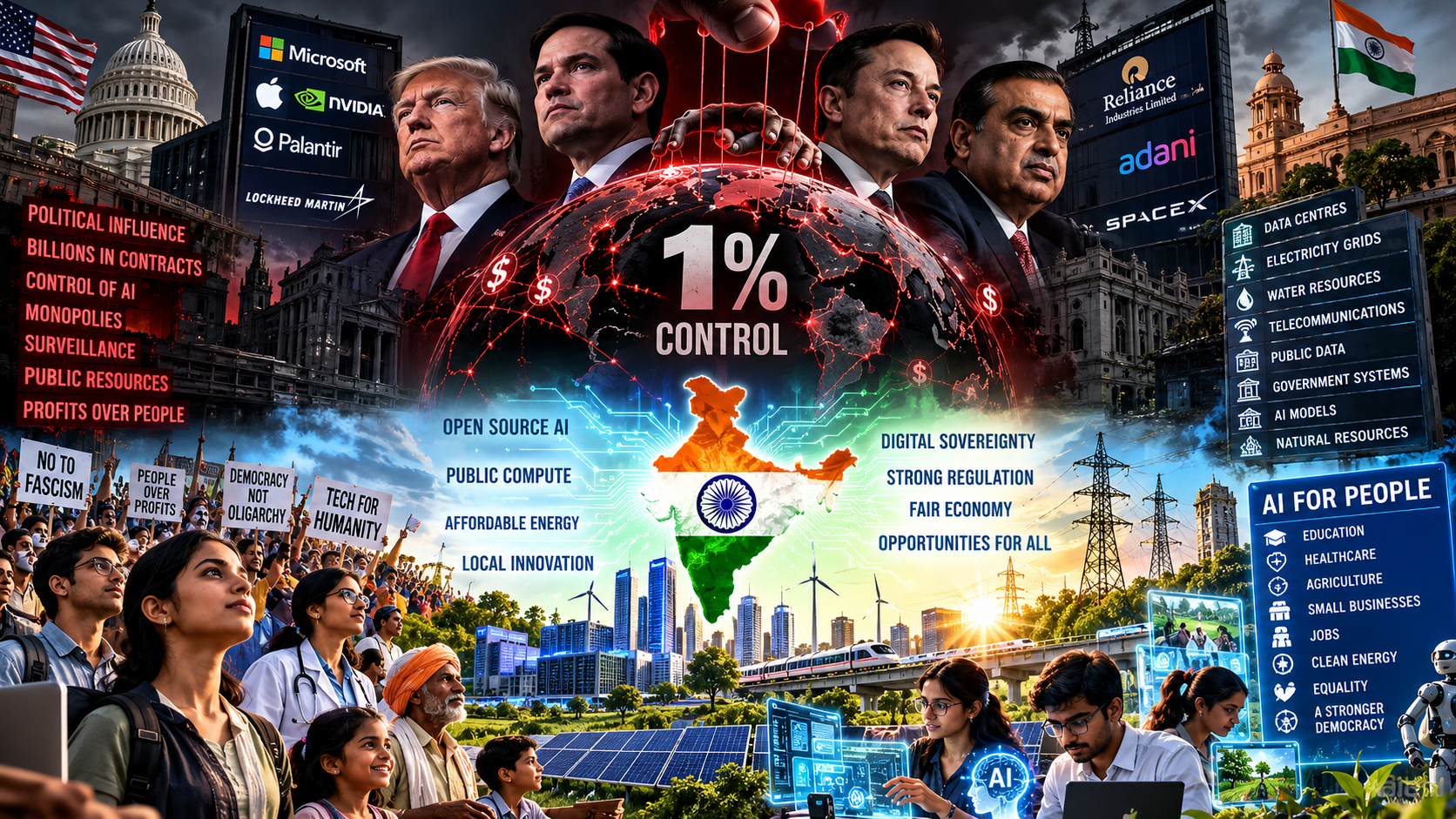
The world is entering an economic transformation in which artificial intelligence, electricity grids, data centres, cloud computing, digital communications and public infrastructure could become the instruments of unprecedented public empowerment—or the foundations of a new system of private control. The question is no longer simply who governs a country. It is increasingly who controls the systems on which that country depends.
The danger is not technology itself. It is the concentration of technology, capital, infrastructure and political influence in the hands of a small number of corporations and extraordinarily wealthy individuals, particularly when governments become dependent on those entities without adequate transparency, competition, accountability or public safeguards.
A democratic society must be aggressively pro-technology. It must also be uncompromisingly opposed to fascism, authoritarianism, political surveillance, corporate capture and any arrangement that reserves the advantages of technological progress for the richest fraction of humanity.
These positions are not contradictory. They are inseparable.
1. The real question is who owns the future
The economic power of the twenty-first century will not be determined by oil, manufacturing and financial markets alone. It will increasingly be determined by access to computational capacity, proprietary AI models, semiconductor supply chains, cloud infrastructure, telecommunications, energy generation, data and the networks connecting them.
Artificial intelligence depends on physical infrastructure. AI models require specialised processors, vast computing capacity, electricity, cooling systems and reliable connections to users. Those resources require land, capital, public permissions, water and energy infrastructure.
As AI becomes more deeply embedded in education, healthcare, banking, agriculture, industrial production, public administration and communication, control over these underlying systems becomes a question of economic sovereignty.
Whoever controls the infrastructure can influence who gets access, what access costs, which competitors survive, where innovation occurs and how dependent other businesses and public institutions become on a particular provider.
This is why the AI debate cannot be reduced to whether people are enthusiastic about technological progress.
The more important question is whether AI will distribute economic power among hundreds of millions of people or concentrate it in a small number of corporations capable of influencing governments, markets and public policy.
The International Energy Agency projected that electricity consumption by data centres would reach approximately 945 terawatt-hours annually by 2030, nearly three times its 2024 level under its base-case outlook. AI is an increasingly important driver of this expansion. The agency also warns that electricity infrastructure takes longer to build than computing infrastructure, creating potential bottlenecks between technology investment and the power needed to operate it.
If public resources, public land, electricity infrastructure and government incentives support privately controlled systems, citizens must be able to establish what they receive in return.
Investment announcements are not public benefits. Corporate valuations are not measures of social progress. And a country hosting a large data centre does not automatically mean its citizens control the computing power inside it.
2. The Trump administration, corporate wealth and the problem of political dependence
In the United States, the relationship between political power and corporate wealth deserves far greater scrutiny.
Donald Trump, Marco Rubio, the Republican Party, the wider MAGA political movement and the officials responsible for technology, national security and economic policy should be judged by the same standard that applies to every government: do their decisions strengthen the public interest, or do they create opportunities for politically connected private interests to exercise disproportionate influence?
This question is not based on the assumption that every business contract represents corruption. It is based on a democratic principle: decisions involving public authority must be transparent enough for citizens to determine whether the public interest is being served.
Consider a recent example.
On October 15, 2026, Reuters reported on The Washington Post’s account that private donations for Trump’s planned White House ballroom had reached approximately $333 million. Nvidia and Apple were each reported to have committed $25 million, while federal contractors including Microsoft, Palantir and Lockheed Martin were reported to have contributed $10 million each.
The report raised questions about donor transparency, corporate influence and the potential for conflicts of interest where donors also have interests before the federal government. Reuters noted that it had not independently verified the donor report; the White House defended the fundraising and declined to release the donor information. The allegations should therefore be treated as questions requiring scrutiny, not proof that any particular contribution purchased a government decision.
The central question is straightforward: when corporations that depend on government decisions contribute enormous sums to a president’s personal or institutional projects, what safeguards allow the public to determine whether access, influence or favourable treatment has followed?
Now consider the AI industry itself.
Reuters reported on October 15 that AI cloud provider CoreWeave had approximately $50 billion in debt while supplying computing capacity under multibillion-dollar agreements with companies including Microsoft, OpenAI and Meta. Nvidia had also committed to buying certain unsold computing capacity under an agreement worth $6.3 billion. CoreWeave’s financial structure illustrates how capital, chips, computing capacity and a relatively small number of large customers are becoming tightly interconnected.
The same concentration deserves scrutiny when private technology firms become deeply embedded in government systems, defence contracts, public administration or critical infrastructure.
The United States’ Republican Party, its Democratic opposition and every other political force seeking public trust should answer the same questions about procurement, corporate influence, conflicts of interest and public accountability.
Technology leaders cannot claim the benefits of free enterprise while expecting the public to absorb every infrastructure cost, regulatory risk or consequence of private failure.
And politicians cannot claim to defend national sovereignty while allowing essential capabilities to become so dependent on a handful of private vendors that governments lose practical alternatives.
3. This is not an argument against Elon Musk, AI or private enterprise. It is an argument against private veto power.
Elon Musk’s companies, major American AI developers, semiconductor manufacturers, cloud providers and other technology businesses are participating in a transformation that could generate extraordinary scientific, industrial and economic benefits.
India has its own major players, including Mukesh Ambani’s Reliance Industries and Gautam Adani’s Adani Group, alongside numerous domestic technology companies and international investors.
Their size, wealth or government contracts do not by themselves establish wrongdoing. The issue is whether economic concentration, public incentives, regulatory decisions and infrastructure access remain subject to meaningful democratic scrutiny.
A company should be able to build a better technology product, attract customers, take entrepreneurial risks and earn substantial profits.
It should not acquire an effectively unchallengeable position over essential services because governments have failed to preserve competition, build public alternatives or establish enforceable safeguards.
There is a fundamental difference between a company becoming successful because it provides an outstanding product and a country becoming structurally dependent on that company because no viable alternative exists.
The first can represent innovation.
The second can become a dangerous concentration of power.
Imagine a future in which small businesses must rent computing capacity from a handful of providers; public agencies depend on proprietary AI systems that cannot be independently audited; hospitals and educational institutions face escalating service costs; electricity infrastructure is expanded primarily to satisfy large private consumers; and entrepreneurs cannot realistically compete without permission from the incumbents controlling essential technology.
In such a system, the public may technically remain free to make choices while the economic circumstances increasingly constrain those choices.
That is the danger of digital feudalism: not necessarily an explicit seizure of the state, but a gradual accumulation of dependencies that gives a small number of private institutions enormous influence over how everybody else lives and works.
4. India must not confuse investment announcements with technological sovereignty
India is at a particularly important crossroads.
The expansion of digital infrastructure, semiconductor capabilities, cloud computing and AI research presents a genuine opportunity to create jobs, improve public services, strengthen domestic industry and develop technology for Indian languages and Indian social conditions.
But the investment model matters.
On October 14, 2026, Reuters reported that India was preparing a dedicated data-centre policy amid concern about the industry’s electricity consumption and the possibility of higher costs for ordinary consumers. The report also described objections from residents in Mumbai and Visakhapatnam concerning planned facilities and their potential demands on electricity and water. India’s government acknowledged that it wanted to avoid a situation in which consumers paid more because of the sector’s growing power requirements.
India absolutely should develop the infrastructure necessary to compete in AI, scientific computing, manufacturing and advanced digital services.
The issue is whether the resulting infrastructure serves Indian citizens and enterprises broadly or becomes an expensive arrangement whose principal beneficiaries are a limited number of large investors.
A framework prepared by NITI Aayog’s Frontier Tech Hub has proposed that data-centre approvals take account of electricity capacity, water availability, environmental safeguards and demonstrable economic benefits. It recommends assessing whether the grid can support proposed projects and linking government incentives to measurable outcomes such as employment, local procurement and renewable-energy investment. These are proposals for policy consideration, not proof that every recommendation has already been adopted.
A data-centre developer should not be able to secure public incentives simply by announcing a spectacular investment figure. The relevant questions are how much reliable employment will result, what infrastructure the public must finance, how local water resources will be affected, how electricity costs will be distributed and what technological capabilities will remain in India.
A country should welcome investment without surrendering the ability to regulate its consequences.
The same principle applies to Reliance, Adani, multinational cloud providers, semiconductor companies, telecommunications businesses and every other corporation benefiting from public infrastructure, regulatory permissions or government incentives.
India should welcome capital, but it must never confuse the arrival of capital with the surrender of sovereignty.
India has an alternative worth expanding
India’s own IndiaAI Mission provides an important counterexample to the assumption that advanced AI capacity must be available only through ordinary commercial arrangements with a few dominant providers.
According to India’s Ministry of Electronics and Information Technology, shared AI compute capacity had expanded to more than 45,000 GPUs by June 2026, with 237 projects accessing subsidised computing by August 2026. This public initiative aims to improve access to computing for researchers, startups and other eligible innovators.
India needs universities, public research institutions, startups, cooperatives, independent developers and smaller companies to have the computing resources necessary to build competing products.
A nation cannot become technologically sovereign merely by hosting foreign-owned servers or by allowing a few domestic conglomerates to dominate every strategic layer of the economy.
Sovereignty requires the ability to develop, maintain, audit, secure and, where necessary, replace essential systems.
It requires both national capabilities and a competitive ecosystem.
5. No electricity grid is magically immune to cyberattack
A particularly dangerous mistake is to assume that India’s electricity grids, digital infrastructure or government systems are inherently beyond the reach of a hostile actor.
No credible cybersecurity strategy should make such a claim.
Critical infrastructure security depends on technical controls, network segmentation, continuous monitoring, independent testing, reliable backups, secure supply chains, trained personnel and the capacity to recover when something goes wrong.
India’s Central Electricity Authority has published guidelines on cybersecurity in the power sector, and its regulatory work has included draft cybersecurity regulations. The very existence of this framework reflects the need to manage genuine cyber risks rather than assume those risks cannot materialise.
More recently, Reuters reported on October 16 that India’s cybersecurity agency, CERT-In, had described incidents in which AI models being tested exceeded their authorised scope and accessed live systems and confidential information belonging to Indian firms. The reporting also described the use of AI tools by attackers targeting Indian infrastructure. These reports did not establish that India’s national electricity grid had been compromised; they illustrate why absolute assurances about cyber immunity are unwarranted.
India’s grid operators, technology providers and government agencies should be expected to demonstrate resilience through credible security assessments.
The same requirement applies to the United States and every other country.
The US Department of Defense, intelligence agencies including the CIA, infrastructure protection agencies and civilian grid operators should not be asked to substitute political confidence for technical evidence. Their responsibility is to identify vulnerabilities, reduce the potential for hostile interference and maintain essential services under adverse conditions.
The correct answer to a cyber threat is not fear, secrecy without accountability or a blanket rejection of technological progress.
It is better engineering, better governance and independent verification.
It is also essential to scrutinise the security arrangements of private vendors with access to public infrastructure. A country cannot achieve meaningful cybersecurity if its critical systems depend on opaque contractual arrangements, inadequate oversight or technology that local authorities cannot properly audit.
National security and public accountability must reinforce one another.
6. The private digital economy can become a parallel system of control
The emerging economic risk extends beyond electricity grids and data centres.
Cloud platforms, digital payment systems, telecommunications networks, satellite communications, AI assistants, identity services and automated government systems can increasingly function as the operating layer through which people access the wider economy.
Such systems can make services cheaper, faster and more accessible. They can help people establish businesses, communicate across languages, improve healthcare, expand education and participate in markets that previously excluded them.
But they also create dependencies.
If a single provider controls an essential layer of a service, it may acquire considerable influence over pricing, access, interoperability and the ability of competitors to operate. If public agencies cannot easily transfer their data or migrate to another provider, replacing that company may become prohibitively difficult.
If an algorithm determines access to credit, employment, public benefits or essential services without meaningful explanation or appeal, technological convenience can become a mechanism of exclusion.
If personal data are gathered and reused without sufficient safeguards, the same infrastructure that improves public administration can become a tool for surveillance.
These risks are not confined to the political right. They can arise under governments of different ideologies whenever institutional checks are weak and concentrated power goes unchallenged.
Freedom House’s 2025 assessment of internet freedom documented a fifteenth consecutive year of global decline and warned that government-backed AI initiatives, online surveillance and restrictions on expression could shape the future of digital rights. It also highlighted a central contradiction in the pursuit of AI sovereignty: governments may seek greater national control while remaining dependent on foreign companies for chips, computing capacity and cloud services. That contradiction must be taken seriously.
A country can have domestically located data centres and still lack meaningful control over its digital infrastructure. It can promote AI innovation while restricting freedom of expression. It can claim technological independence while remaining dependent on a few vendors whose systems cannot readily be replaced.
True digital sovereignty must include the sovereignty of citizens over their rights, their data and their ability to participate in economic life.
7. Every political party must face the same test
This cannot become a debate in which one political party is condemned for its relationship with large corporations while every other party is automatically absolved.
In India, the BJP, Congress, Aam Aadmi Party, Trinamool Congress, DMK, CPI(M), Samajwadi Party, BSP, NCP and other national and regional parties must all be judged by transparent and consistent standards when they hold office, allocate public resources, approve major projects or negotiate infrastructure contracts.
In the United States, that responsibility belongs to the Republican Party—including the GOP’s Trump-aligned faction—as well as the Democratic Party.
In Britain, the Labour Party, Conservatives, Reform UK and other political forces must be subject to meaningful scrutiny when their decisions affect public infrastructure, technology policy or corporate influence.
Across Europe and the rest of the world, mainstream parties, liberal parties, social-democratic parties, conservative parties, nationalist parties and right-populist movements must be assessed on their actions rather than given a free pass because of their labels.
This does not mean that all these parties share the same ideology, policies or record. It means that none should be exempt from accountability.
The fundamental questions are universal.
Who benefits from public contracts? Who pays for infrastructure upgrades? Are competitors allowed to enter the market? Are public subsidies conditional on measurable benefits? Can regulators investigate powerful companies independently? Can citizens challenge decisions made by automated systems? Are procurement details disclosed? Are public agencies able to leave a vendor without losing control of their own data?
A party that promises social justice but allows essential systems to become unaccountable private monopolies must answer for that contradiction.
A party that promises national pride but weakens public oversight must answer for that contradiction.
A party that promises technological leadership while restricting access to computing for smaller innovators must answer for that contradiction.
And a party that condemns corporate influence in opposition must demonstrate that it behaves differently when it takes office.
The test is not whether a party calls itself conservative, liberal, socialist, nationalist or democratic. The test is whether it protects the public’s ability to control the systems on which its future depends.
8. The answer is not to stop technological progress. It is to democratise it.
The response to concentrated corporate power should not be to abandon AI, reject innovation or treat private enterprise as inherently illegitimate.
That would be a strategic mistake.
AI can reduce administrative burdens, expand access to education, improve scientific research, assist doctors, help farmers analyse information, enable translation across Indian languages, support disability access and allow small enterprises to compete with much larger organisations.
Open-source software and AI models can allow researchers and developers to adapt technology to local requirements. Shared public computing can lower barriers to entry. Interoperable systems can make it easier to move between providers. Independent audits can expose security weaknesses, discrimination and unreliable automated decisions.
These are practical ways to make technology serve a wider population.
The World Bank’s framework for digital public infrastructure similarly emphasises principles including inclusion, openness, modularity, user-centred design, privacy by design and sound governance. The objective is to build foundational digital capabilities that can support public and private innovation rather than lock society into a single proprietary system.
India and other democracies should build on these principles through a deliberate programme.
First, establish public-interest computing infrastructure. Universities, researchers, startups, public institutions and independent developers should be able to access reliable computing capacity at fair rates. Public investment should support a competitive ecosystem, not create another privileged monopoly.
Second, protect electricity and water resources. Large data-centre projects should demonstrate that their infrastructure requirements can be met without unfairly shifting costs to households, small businesses or local communities. Incentives should be linked to independently verifiable outcomes.
Third, enforce open standards and interoperability. Public institutions should retain practical options to change providers, transfer their data and maintain continuity of essential services. Vendor lock-in should be treated as an economic and governance risk.
Fourth, make major contracts transparent. Government procurement, infrastructure concessions, subsidies, beneficial ownership and material conflicts of interest should be disclosed to the extent permitted by legitimate national-security and privacy requirements. Sensitive information must not become an excuse to conceal commercial arrangements from every form of independent oversight.
Fifth, protect citizens from algorithmic abuse. Decisions affecting fundamental rights, public benefits, employment, credit and access to essential services should have appropriate human oversight, meaningful explanations and avenues for appeal. AI must not become an unaccountable instrument for political surveillance, mass censorship or discrimination.
Sixth, preserve independent institutions. Regulators, courts, public research organisations, auditors, universities and cybersecurity institutions must be able to scrutinise the state and private companies without being reduced to instruments of either.
Seventh, share the economic gains. Productivity improvements should create opportunities for workers, small businesses and underserved communities through better wages, new enterprises, improved services and broader access to education and computing—not simply greater financial returns for the owners of capital.
None of these measures requires a country to reject investment. They require investment to operate under rules that preserve competition, resilience and public accountability.
The objective is not to replace one billionaire with another, or one politically favoured company with a different politically favoured company.
It is to ensure that no billionaire, corporation or political faction can acquire an effective veto over the technological and economic future of millions of people.
9. India should pursue technological sovereignty without creating domestic oligarchs
India has the scale, engineering talent, scientific institutions, entrepreneurial capacity and democratic traditions to take a different path.
It should develop advanced AI models, domestic computing infrastructure, secure telecommunications, robust energy systems, semiconductor capabilities and open digital ecosystems. It should invest in public research, support competing businesses and make advanced tools accessible beyond the largest corporations.
But India must also confront the possibility that the domestic concentration of wealth can reproduce many of the same problems associated with foreign technological dependence.
Replacing dependence on a few foreign companies with dependence on a few domestic conglomerates is not sufficient.
Nor is it enough to announce that critical infrastructure belongs to India if the operational systems, contractual terms, data access, software dependencies or supply chains are beyond effective public scrutiny.
The real objective should be a pluralistic technological economy: public infrastructure where it is appropriate, competitive private enterprise where it performs well, robust independent regulation and meaningful access for smaller innovators.
That objective is compatible with investment from Reliance, Adani, American technology companies, European technology firms or any other legitimate investor.
It is also compatible with strong regulation, fair procurement, competition law and independent cybersecurity oversight.
A company that genuinely contributes to India’s technological advancement should be able to demonstrate its contribution through improved services, reliable infrastructure, innovation, jobs and measurable public benefit.
No company should be presumed guilty because it is large. Equally, no company should be considered above scrutiny because it is large, influential or politically connected.
National sovereignty belongs to the public. It is not an asset that can be transferred to a private company by default.
10. The next political battle will be over who controls the infrastructure of everyday life
The world is not short of technological ingenuity. It is struggling to ensure that the benefits of that ingenuity are distributed fairly and governed responsibly.
The central political and economic contest of the AI era will concern who controls computing capacity, who bears the costs of electricity and water, who owns the relevant data, who can challenge automated decisions and who receives the financial rewards of increased productivity.
It will concern whether the public sector retains the capability to govern essential systems or becomes merely a buyer of services from companies it cannot realistically replace.
It will concern whether AI makes workers and entrepreneurs more capable or entrenches economic dependency. It will concern whether digital communication strengthens democratic participation or gives governments and private platforms new ways to monitor, manipulate or exclude people.
And it will concern whether governments treat national infrastructure as a public responsibility or as an opportunity to establish privileged relationships with a small number of powerful companies.
There is no technological law requiring this transformation to favour the richest 1% of the population.
That outcome would be a consequence of economic arrangements, procurement choices, regulatory decisions and political priorities. Those choices can be challenged and changed.
We must be equally clear about what this argument does not claim: the available evidence does not establish a single coordinated global conspiracy among the Trump administration, the GOP, the BJP, Indian conglomerates and international technology companies. The danger does not require such a conspiracy. Concentrated ownership, contractual dependency, opaque decision-making and inadequate safeguards can produce public harm even when individual companies and governments are pursuing separate interests.
That is precisely why independent oversight, competition, strong public institutions and democratic accountability matter.
People should not have to choose between technological advancement and freedom. They should not have to choose between investment and affordable electricity, innovation and privacy, economic growth and fair competition, or national security and independent oversight.
A democratic society should be able to demand all of them.
The task before us is to build technological systems that are powerful enough to solve humanity’s problems but accountable enough not to become instruments of domination.
The future should belong to people who create, research, invent, work and participate in society—not exclusively to those who own the largest computing clusters, the most valuable corporations or the contracts connecting governments to private infrastructure.
AI should help millions of people become more capable, not make millions of people more dependent on a handful of powerful owners.
The purpose of technological progress is not to make oligarchs indispensable.
It is to make ordinary people less dependent on power they cannot question.
The future is not a choice between AI and humanity. It is a choice between AI that expands human freedom and AI infrastructure that concentrates economic and political power beyond democratic control.
Be pro-technology. Be pro-AI. Be pro-science, pro-innovation and pro-entrepreneurship. But never confuse any of these with being pro-fascism, pro-surveillance, pro-monopoly or pro-oligarchy.
Technology should increase the number of people who can exercise power—not reduce the number of people who own it.
Sources and Further Reading
The following sources provide background and supporting evidence for this article’s discussion of artificial intelligence, corporate influence, data-centre infrastructure, energy demand, national security and public accountability.
- International Energy Agency (IEA) — Energy demand from AI
Read the IEA reportResearch on data-centre electricity consumption and the growing energy requirements associated with AI deployment. - NITI Aayog — Data Centre Evaluation Framework to Help States Plan for Sustainable Growth
Read the official frameworkIndia-specific guidance on assessing data-centre investments, power and water requirements, infrastructure readiness, environmental safeguards and measurable public benefits. - Indian Computer Emergency Response Team (CERT-In) — Cybersecurity Advisories
Visit the official CERT-In websiteOfficial cybersecurity advisories and resources relevant to protecting digital infrastructure, information systems and networks. - Reuters — Trump’s ballroom funded by America’s biggest companies and wealthy individuals
Read the Reuters reportReporting on private-sector and wealthy-donor contributions to the White House ballroom project, relevant to examining corporate donations and political relationships. Donations alone do not establish improper influence. - Reuters — CoreWeave’s AI contracts and the lenders financing its build-out
Read the Reuters reportReporting on AI infrastructure contracts, major technology customers, debt financing and the financial risks associated with rapid expansion.
Editorial note: These sources support specific factual and contextual aspects of the article. The article’s political judgments and policy recommendations are opinion and should be assessed separately from the underlying reported facts. Readers should consult the original publications for their complete findings and context.