Original Coverage & Source Attribution: en.sedaily.com
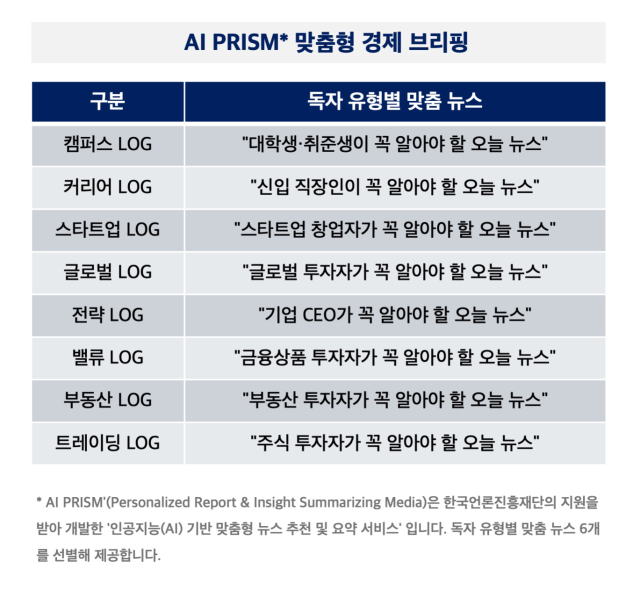
▲ AI PRISM* Personalized Economic Briefing
* Editor’s note: AI PRISM (Personalized Report & Insight Summarizing Media) is an artificial intelligence-based personalized news recommendation and summary service developed with support from the Korea Press Foundation. It selects and provides six news items tailored to each reader type.
■ AI productivity: In a survey by the Bank of Korea’s Employment Research Team under its Economic Research Department, 66.5% of respondents said they use generative artificial intelligence at work, up 14.7 percentage points in a year. The correlation coefficient between the rate of work-hour savings and the rate of increase in work output stood at just 0.08, however, suggesting that time savings have yet to translate meaningfully into performance.
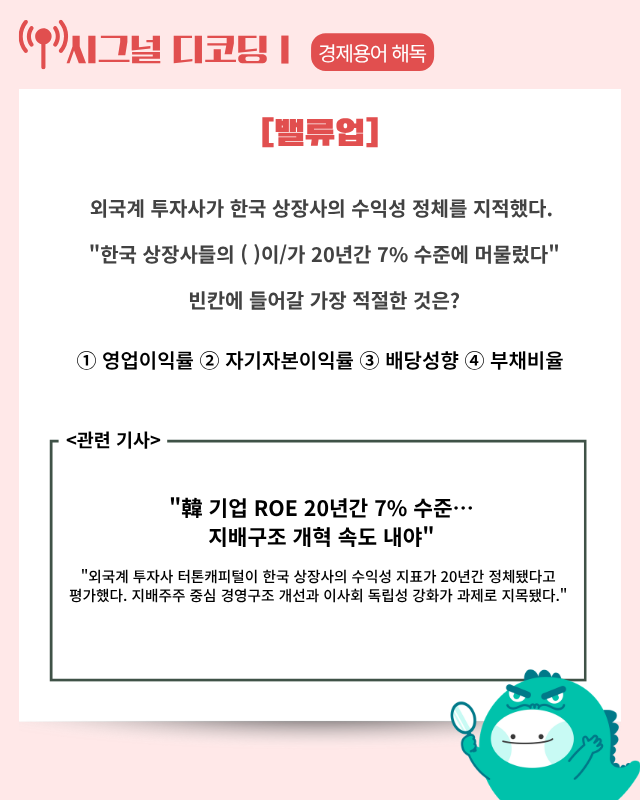
■ Governance reform: Turton Capital said the return on equity of Korean listed companies has remained around 7% for two decades, pointing to a management structure centered on controlling shareholders as the single largest cause. The firm said Korea’s value-up policy has moved faster than Japan’s, but that strengthening board independence and expanding shareholder returns remain unfinished tasks.
■ AI chip controls: The Bureau of Industry and Security under the U.S. Commerce Department issued a 166-page set of new rules, shutting down China’s indirect access to U.S. AI semiconductors through third-country data centers. China’s Foreign Ministry immediately signaled retaliation, reigniting U.S.-China tensions over technology.
[Top News for Corporate CEOs]
1. Two in Three Workers Say They Use AI, Saving 3.7 Hours on a 40-Hour Week
– Key points: The share of workers who said they use generative AI at work reached 66.5%, up 14.7 percentage points from 51.8% a year earlier. The Bank of Korea’s Employment Research Team surveyed 16,342 employed people aged 18 to 64, and the figure far exceeded the United States (43.0%) and the average of six European countries (33.7%). Average weekly usage among users rose to 8.0 hours from 5.9 hours. The rate of work-hour savings also grew 2.4 times to 9.2% from 3.8%, with hours saved by someone working a 40-hour week rising to 3.7 hours from 1.5 hours. Yet the correlation coefficient between the savings rate and the rate of increase in work output was only 0.08, and 0.09 against the rate of quality improvement. “For technology to realize its potential, complementary assets such as compensation systems or a reorganization of corporate structures need to be in place, and there is likely an aspect in which that support is still lacking,” said Oh Sam-il, head of the Bank of Korea’s Employment Research Team. Annual spending on AI services by workers as a whole was estimated at about 2.8 trillion won ($1.9 billion).
2. “Korean Firms’ ROE Stuck Near 7% for 20 Years; Governance Reform Must Speed Up”
– Key points: Ryan Albert, head of Turton Capital, said at a press briefing at the FKI Tower in Seoul’s Yeouido district on the 17th that a management structure centered on controlling shareholders was the biggest reason the return on equity at Korean companies has stayed around 7% for two decades. Albert said corporate governance was not the only cause but accounted for the largest share. ROE at Korean companies edged up only to 7.6% in 2025 from 7.3% in 2015. Over the same period, Japan’s rose to 9.2% from 8.0% and that of the United States to 18.8% from 12.5%. He pointed to a structure in which founding families run companies as if they owned them outright while holding 20% to 40% stakes, and to incentives to keep share prices low in order to reduce inheritance and gift tax burdens. He also called for broader shareholder returns, noting that the dividend payout ratio rose to 27% in 2025 from 21% in 2015 but still trails Japan (38%) and the United States (33%). Turton Capital plans to use the 3% rule applied to the appointment of audit committee members and cumulative voting as key strategies at next year’s regular shareholder meetings.
3. U.S. Blocks Rerouting of AI Chips to China via Third-Country Data Centers
– Key points: The Bureau of Industry and Security under the U.S. Commerce Department announced a 166-page set of new export rules on the 16th, local time, closing off China’s indirect access to advanced U.S.-made AI semiconductors. At the core of the measure is a requirement that U.S. permission be obtained before providing computing power to companies in China and other countries of security concern, regardless of where the U.S.-made AI chips and servers are located. Prior approval is also required for exports of advanced chips to five countries — Singapore, Malaysia, Thailand, Indonesia and Brazil — and the rules take effect immediately upon publication in the Federal Register on the 19th. Companies headquartered in the United States and others are exempt from the licensing requirement if they meet certain reporting conditions. The administration-level response came as criticism mounted over the Commerce Department’s slow reaction following the scandal involving former Nvidia Chief Executive Jensen Huang. Guo Jiakun, a spokesperson for China’s Foreign Ministry, signaled retaliation, saying Beijing “will take necessary measures and resolutely defend its legitimate rights and interests.”
[Reference News for Corporate CEOs]
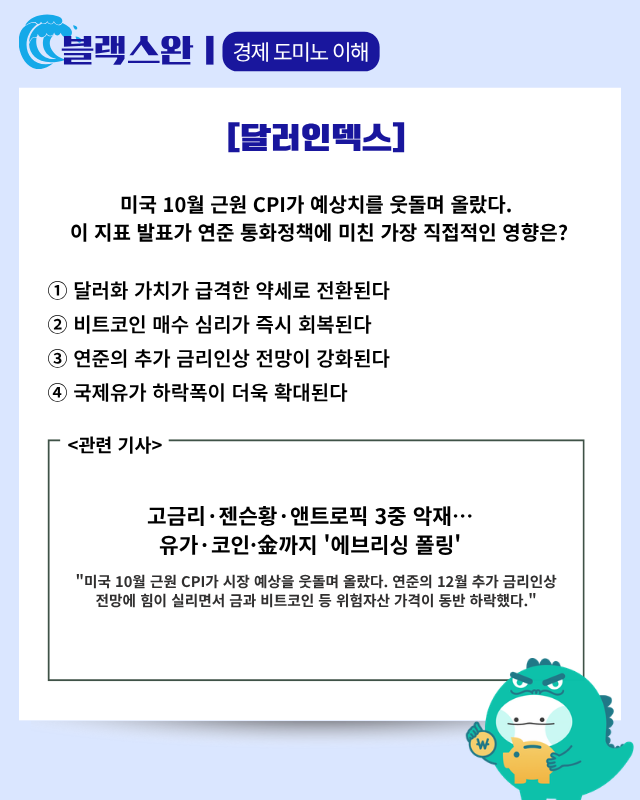
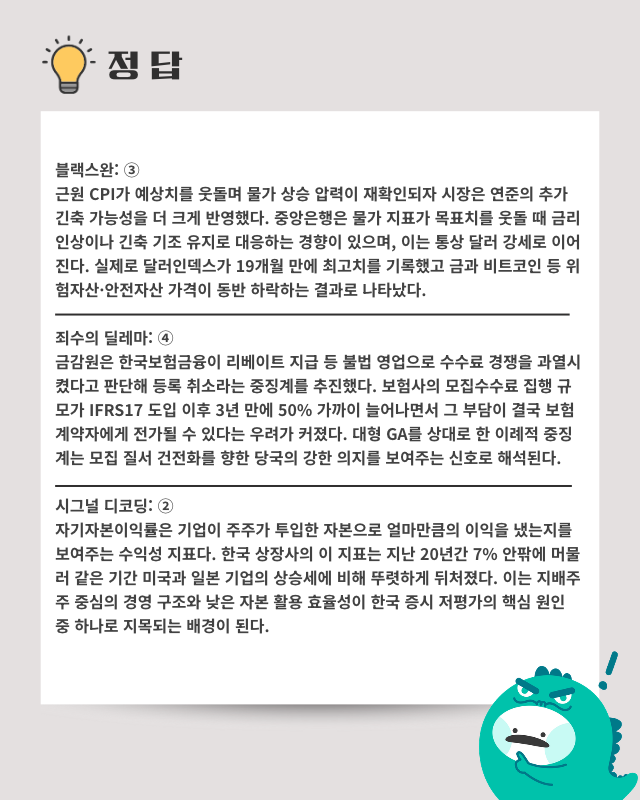
– Key points: Soaring government bond yields combined with uncertainty in the AI industry pushed equities, risk assets and safe-haven assets down all at once. Bitcoin traded around $65,000 on the 16th, about 16% below its level at the end of last month. In the week through the 15th, about $1.1 billion flowed out of bitcoin exchange-traded funds on a net basis, marking a third straight week of outflows. International gold prices also fell 6.36% in a week to $3,853 per troy ounce, which analysts attributed to the yield on 10-year U.S. Treasuries climbing back above 5%. The dollar index, meanwhile, rose to 103.695 on the 17th, its highest since April last year, while December West Texas Intermediate crude settled 3.21% lower at $85.72 a barrel. Kim Ji-woo, an analyst at KB Securities, said market concerns over tightening could gradually ease once declines in oil prices and shipping costs feed through to price indexes with a lag.
5. Large Conglomerates Poured 413.3 Billion Won Into AI Equity Stakes in First Half Alone
– Key points: Affiliates of Korea’s 30 largest business groups invested 413.3 billion won ($282 million) in AI-related equity stakes in the first half of this year. The figure comes from an analysis by Leaders Index, a corporate research institute, of investments in other companies by 397 firms that filed semiannual reports among the country’s 500 largest companies by revenue. Over the past two and a half years, such AI-related investments in other companies totaled 1.0972 trillion won. The share of AI in total investments in other companies fell to 8.0% last year from 14.9% in 2024, then jumped to 27.4% in the first half of this year. The largest investor over the past two and a half years was LG Group, which put 265.6 billion won into 13 entities. Kakao (035720) Group invested 156.2 billion won in the first half of this year alone, betting 150 billion won on Upstage, a domestic large language model startup. LS (006260) Group, in third place, spent 142.8 billion won centered on power infrastructure, including Gaon Cable’s acquisition of G&P and LS Electric’s acquisition of KOC Electric.
6. LS Electric Expands Vietnam Plant, Targeting $350 Million in Revenue by 2030
– Key points: LS Electric completed a second production building at its site in the Yen Phong Industrial Park in Bac Ninh province, Vietnam, broadening its local manufacturing base. The second building, with a total floor area of 7,611 square meters across four above-ground floors, will produce strategic products for the local market such as ring main units, battery control panels for energy storage systems and air circuit breakers. The company will begin production immediately, having already secured orders covering the volume needed to run the plant at full capacity next year. “Based on bold and preemptive investment, we will secure an insurmountable competitive edge globally,” Chairman Koo Ja-kyun said. Revenue at the Vietnamese unit is expected to roughly double to $166 million this year from $83 million in 2022, and the company aims to reach $350 million by 2030. The ASEAN power equipment market is projected to grow more than 6% a year to $46 billion in 2030 from $32 billion in 2024.