



Original Coverage & Source Attribution: m.hani.co.kr
Jennie. (courtesy OA Entertainment)
Korean artists and productions have cleared the bar at one major American awards show after another. “Parasite” took home four Oscars, “Squid Game” won six Emmys and “Maybe Happy Ending” swept six Tony Awards. Yet K-pop, for some reason, keeps coming up short at the Grammys. “Golden,” from “KPop Demon Hunters,” did win a Grammy earlier this year, but in a category that honors songwriters.
K-pop’s bid for the Grammys continues this year. When nominations for the 69th Grammy Awards were announced on Nov. 16, Blackpink’s Jennie earned two nods for “Dracula,” her collaboration with Australian act Tame Impala: record of the year, one of the Grammys’ top general field categories, and best pop duo/group performance.
That makes two years running that a K-pop singer has been nominated in the general field, following Rosé’s nominations for “APT.,” her duet with Bruno Mars.
The newly created category of best Asian pop music performance includes Ive’s “Bang Bang” and KiiiKiii’s “404 (New Era).” They are up against four other songs by Japan’s Babymetal and LiSA and the Philippines’ Bini and SB19.
The new category is not without its problems. It risks lumping together music from Asian countries with very different musical backgrounds under a single regional label, and pushing it to the margins. That is why BTS declined to submit its work, saying music should not be divided by region or language.
But submitting to the new category does not shut an artist out of the general field. As Jennie’s case shows, artists can still compete in the existing categories. A boycott is not the only answer.
Grammy record of the year nominees. (via Grammy.com)
What deserves a closer look is the nature of the Grammys themselves. Winners are chosen not by fans but by the votes of fellow music professionals: singers, songwriters, producers, engineers and the like. Popularity does not necessarily translate into trophies.
New Kids on the Block, who set off a frenzy in the 1980s and ’90s, received just one nomination, while the Backstreet Boys and NSYNC were nominated nine and eight times each without a win. The Spice Girls, who kicked off a girl group craze, never won either.
To be fair, the Grammys have been stingy toward idol music, but they have not ignored it entirely.
TLC won four Grammys on the strength of a distinct musical identity rooted in R&B and hip-hop. The Beatles, too, started out as pop stars mobbed by teenagers, but they went on to take control of their own music, and “Sgt. Pepper’s Lonely Hearts Club Band” became the first rock album to win album of the year in 1968. Building a musical world of one’s own is the single biggest key to winning a Grammy.
In that light, the making of “Arirang,” the fifth studio album by BTS, K-pop’s flagship act, is worth reflecting on. In the Netflix documentary “BTS: The Return,” the members are briefed on the album’s concept by company executives. The idea of working the folk song “Arirang” into the track “Body to Body” also came from Hybe Chairman Bang Si-hyuk. One member even bristles at the idea, dismissing it as nationalistic pandering. It is an emblematic scene, showing how much sway agencies hold over the creative process in K-pop.
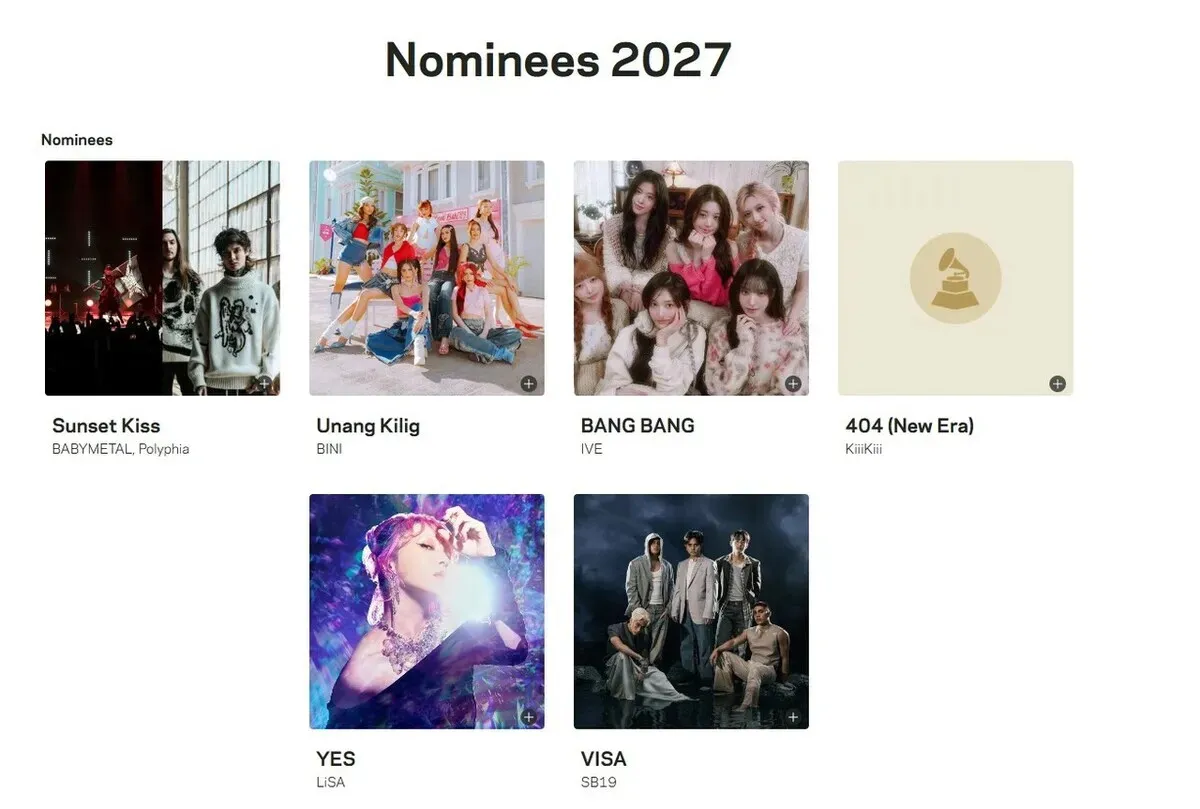
Grammy best Asian pop music performance nominees. (via Grammy.com)
This touches on a long-standing problem for K-pop. The industry runs from the top down: agencies design everything from the music to the visuals, and artists carry it out. Meticulous planning and division of labor turned K-pop into a global cultural industry, but they also produced a system in which artists’ creative control is easily pushed aside. If K-pop wants recognition for its music, and not just its commercial success, it needs to break away from this producer-centered model.
The government has a role to play, too. It should help small and midsize agencies and independent musicians with weak overseas networks by guiding them through the Grammy submission process and supporting distribution and promotion. Korean music’s competitive edge is not limited to idols from a handful of major agencies.
By Lee Jung-gook, staff reporter
Please direct questions or comments to [[email protected]]