


Original Coverage & Source Attribution: kenyanforeignpolicy.com
IN DIPLOMACY, a handshake is rarely just a greeting; for regimes starved of international recognition, it is what sociologist Erving Goffman called a “ritual of ratification”- a press release waiting to happen.
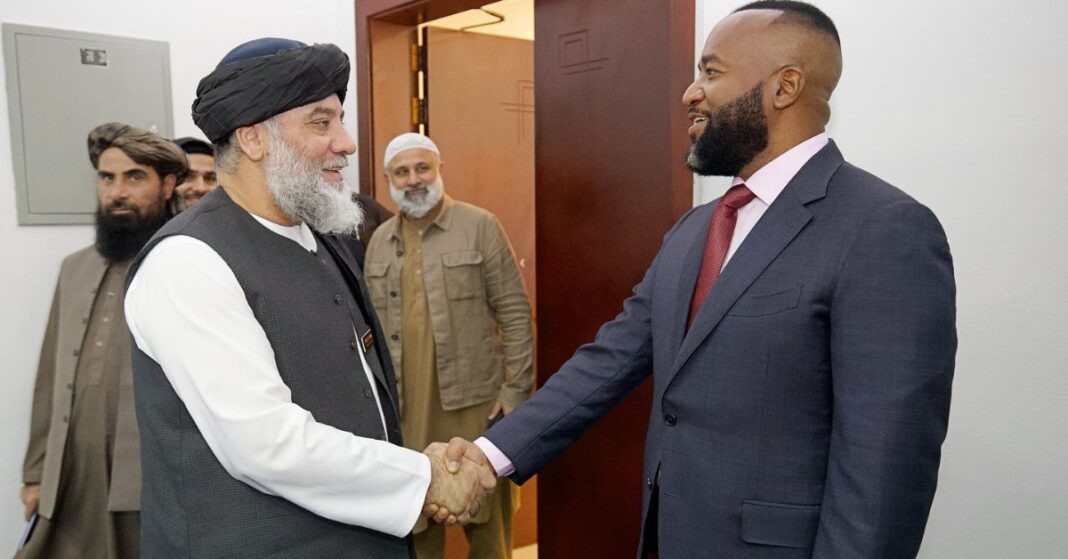
On November 20, on the sidelines of the Tanzania Mining and Investment Conference in Dar es Salaam, Kenya’s mining minister, Hassan Ali Joho, held a bilateral meeting with Nooruddin Azizi, the Taliban’s acting minister of industry and commerce.
To Joho, a domestic political heavyweight better known for coastal politics than diplomatic protocol, it appeared to be routine conference networking.
In a brief post on X, he casually paired the encounter with a chat with Australia’s high commissioner to Kenya, referring to his interlocutor simply as “Afghanistan’s Minister of Industry and Commerce” and noting they had discussed mutual trade.
In Kabul, however, the encounter was treated like a diplomatic breakthrough. Within hours, the Taliban’s commerce ministry issued a formal communiqué, widely amplified across Afghan media announcing that Kenya and the “Islamic Emirate of Afghanistan” had discussed mining cooperation, Kenyan tea and coffee imports, joint trade exhibitions, and a draft memorandum of understanding to establish a joint working group.
For a movement that remains unrecognized by the United Nations and shunned by most capitals since seizing Kabul in 2021, every photo opportunity with a foreign cabinet minister is liquid gold. By treating a sanctioned, unrecognized administration like any other trade partner at an investment forum, Joho handed the Taliban a low-cost legitimacy victory.
Whether Joho grasped the diplomatic optics is another matter. Kenya does not recognize the Taliban government, and Nairobi’s foreign ministry has avoided formal engagement with Kabul. Indeed, when asked this week whether the government had sanctioned talks over a formal memorandum of understanding with the Taliban, Kenya’s foreign affairs principal secretary remained conspicuously silent.
The silence is telling. When sectoral ministers travel abroad to pitch critical minerals and agricultural exports, diplomatic guardrails often blur. What looks to a Kenyan politician like harmless commercial small talk—who would object to selling more Kenyan tea? looks to an isolated regime like an opening wedge into East Africa.
To be sure, Nairobi is hardly alone in facing this dilemma. Countries from China to regional neighbours in Central Asia have increasingly separated pragmatic trade talks with Kabul from formal diplomatic recognition. In Dar es Salaam itself, Tanzanian officials also met with Azizi. Russia became the first country to recognise formally the Taliban as Afghanistan’s legitimate government in July 2025.
Still, effective statecraft requires discipline over who signs what and who gets a photo op. If Nairobi intends to explore commercial openings with Kabul, that decision belongs in the foreign ministry, backed by clear boundaries rather than an unscripted corridor chat. Otherwise, Kenya risks discovering that in international politics, the other side always writes the communiqué first