



Original Coverage & Source Attribution: www.thenationalherald.com
WASHINGTON – Speaking at the National Hellenic Society’s 2026 Heritage Weekend & Classic, Pavlos Geroulanos, Member of the Hellenic Parliament and former Minister of Culture and Tourism, said the greatest challenge facing Greeks in the 21st century is ensuring that Hellenic values help define what it means to be human in an age of artificial intelligence.
Geroulanos took the podium following the panel “A Salute to America’s Founding Philhellenes.” He opened with an image from antiquity. For centuries, he noted, the Buddha was depicted without human form, as an empty throne, a wheel, a tree, or a footprint. Then, in the 1st century BC in Gandhara, after Buddhism came into contact with the Hellenism that Alexander the Great had carried east, the Buddha first appeared with a human face: the face of Apollo.
“I have come here at the National Hellenic Society to talk about a challenge we face as Greeks that concerns the future of Humanity,” he said. “No longer shall we be concerned with how and to what extent machines simulate human nature, but about how and to what extent human nature shall need to simulate machines in order to survive and thrive.”
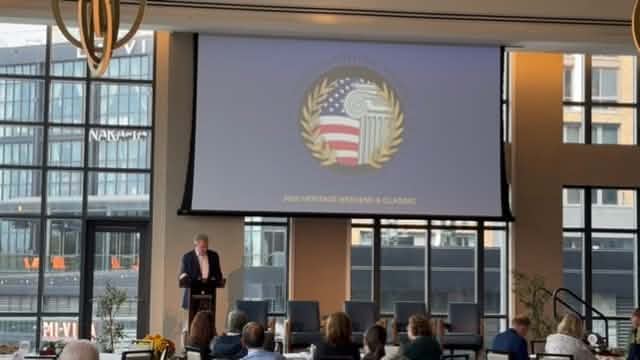
MP and former Minister of Culture and Tourism Pavlos Geroulanos speaks at the National Hellenic Society’s 2026 Heritage Weekend & Classic. (Photo: TNH/Eraklis A. Diamataris)
As biomedicine, genetics, neuroscience, and AI force humanity to ask again who we are, he argued, the world will turn once more to the Greek way of thinking. “From the Buddha of Gandhara to the Enlightenment, and from Shakespeare to the Declaration of Independence, Greek values are summoned, over and over again, to answer contemporary problems.”
He pointed to examples from the past week alone. Canadian poet Anne Carson, deeply influenced by Sappho, received the Nobel Prize in Literature. The U.S. Secretary of State used the Parthenon as a backdrop to speak about the future of the world. And The Economist featured a digitized Aristotle on its cover. He also noted that in the recent film adaptation of the Odyssey, “the work of Homer is being used by an American director to speak to America’s contemporary problems.”
‘Can You Teach Them the Greeks?’
Geroulanos, a Williams College alumnus, recounted a conversation between Williams alumni and leaders of major technology companies. Asked how a university should teach technology, the executives answered, “Don’t bother.” Technology changes too quickly to be taught in time, they said, and they asked instead: “Can you teach them history, philosophy, and ethics? Can you teach them music, theater and poetry? Can you teach them the Greeks?” Their reason: “Because in our hands this technology is frighteningly dangerous. In theirs, it can save the world.”
“In Homer, even a foe has a face and a family,” Geroulanos said. “In tragedy, every form of power must answer for its actions. In philosophy, truth is not imposed. It is sought through dialogue. And in democracy, a person is not a subject. A person is a citizen.” The most timely Greek message today, he said, is “that every power — political, social, cultural, economic, and/or technological — must serve Humanity, and the dignity of the Person.”
The Risk of Becoming Invisible
AI, he warned, “is not born in a cultural vacuum.” It learns from the languages and narratives most present online. “When a civilization is not present in this data, it risks becoming invisible,” he said. “Not necessarily because it ceases to exist. But because machines learn to see the world without it.”
He called for Greek cultural policy to shift from “defensive, fearful and conservative” to “assertive, dynamic and progressive.” He laid out four priorities:
- aggressively digitizing Greece’s cultural wealth so that Greek and international AI systems can be trained on it
- protecting creators through rules on consent, transparency, attribution, and fair compensation
- extending tools and funding beyond the major Athens institutions to regional and diaspora communities
- strict accountability for every public program in culture and AI
A Research Center at Plato’s Academy
Geroulanos closed with his vision for a Global Research Center for Ethics and New Technologies. It would unite Greek and international universities, cultural institutions, and technology leaders, possibly under the auspices of the United Nations. It would be located “naturally, at the Academy of Plato,” in “a neighborhood of Athens long overlooked.” “Public and private interest already exists,” he said. “But it is up to us to act on this interest now.”
Returning to his opening image, he concluded: “Before the Buddha took human form, he was just an empty throne. Greeks gave him a human face. Today, globalization and new technologies have once again left… a throne empty. The question is whether we, the Greeks of today, can give it the Human face it so desperately needs.”
!function(f,b,e,v,n,t,s)
{if(f.fbq)return;n=f.fbq=function(){n.callMethod?
n.callMethod.apply(n,arguments):n.queue.push(arguments)};
if(!f._fbq)f._fbq=n;n.push=n;n.loaded=!0;n.version=’2.0′;
n.queue=[];t=b.createElement(e);t.async=!0;
t.src=v;s=b.getElementsByTagName(e)[0];
s.parentNode.insertBefore(t,s)}(window,document,’script’,’https://connect.facebook.net/en_US/fbevents.js’);
fbq(‘init’,’874922596557858′);
fbq(‘track’,’PageView’);