Original Coverage & Source Attribution: www.diplomacyandlaw.com
Introduction
The reported Donbas NATO membership proposal is not a concluded agreement. In remarks made on November 13 and reported internationally on November 14, 2026, Ukrainian President Volodymyr Zelensky disclosed that American negotiators had raised the possibility of Ukraine withdrawing from Donbas in exchange for admission to NATO. The suggestion raises a difficult legal question: can Ukraine lawfully surrender territory to Russia as part of a settlement intended to secure its future against another Russian invasion?
International law permits states to alter their borders through lawful, voluntary agreements. It does not recognize territorial acquisition through unlawful force, and a treaty procured through prohibited military coercion may be void. Ukraine’s Constitution imposes additional restrictions on territorial changes, while NATO membership requires the unanimous agreement of the Alliance’s existing members. None of these conditions can be satisfied by a bilateral understanding between Washington and Kyiv alone.
The distinction between withdrawing Ukrainian forces from Donbas and legally transferring sovereignty over the region is central. A military withdrawal would not necessarily amount to recognition of Russian territorial claims. A formal cession would have substantially different consequences, particularly while Russian forces continue to occupy Ukrainian territory and demand concessions as a condition for ending the war.
1. What the United States Raised in November 2026
The proposal entered public discussion following renewed negotiations between American, Ukrainian, and Russian representatives in November 2026. Zelensky told journalists on November 13 that American negotiators had raised a question connecting Ukrainian NATO membership with withdrawal from Donbas. His remarks were reported the following day by Reuters, the Financial Times, and other international news organizations.
According to the account published by Reuters on November 14, the Americans asked: “What if Ukraine joins NATO? Would Ukraine withdraw from Donbas?” Zelensky said the possibility had not previously been raised in that form. He also acknowledged the difficulty of discussing Ukrainian accession to an alliance that Russia has repeatedly identified as unacceptable to its security interests.
The wording is significant. A question raised during negotiations does not establish that Washington has presented a formal peace proposal, secured NATO’s approval, or obtained Russian agreement. No concluded instrument setting out an exchange of territory for membership has been publicly established. The reported discussion is best understood as an exploratory diplomatic possibility.
Zelensky reiterated that Ukraine was unwilling to surrender its territory. He nevertheless indicated that a sufficiently detailed settlement, supported by credible security guarantees, could be presented to Ukrainian society for consideration. Such a package would need to address Ukraine’s ability to maintain a strong military and identify reliable financial arrangements for reconstruction.
His position also preserved an important legal distinction. Zelensky said that any possible arrangement would exclude formal recognition of occupied Ukrainian territory as Russian. Ukraine might therefore consider proposals affecting military deployment or territorial control without accepting a transfer of sovereign title.
1.1 The Territory at Issue
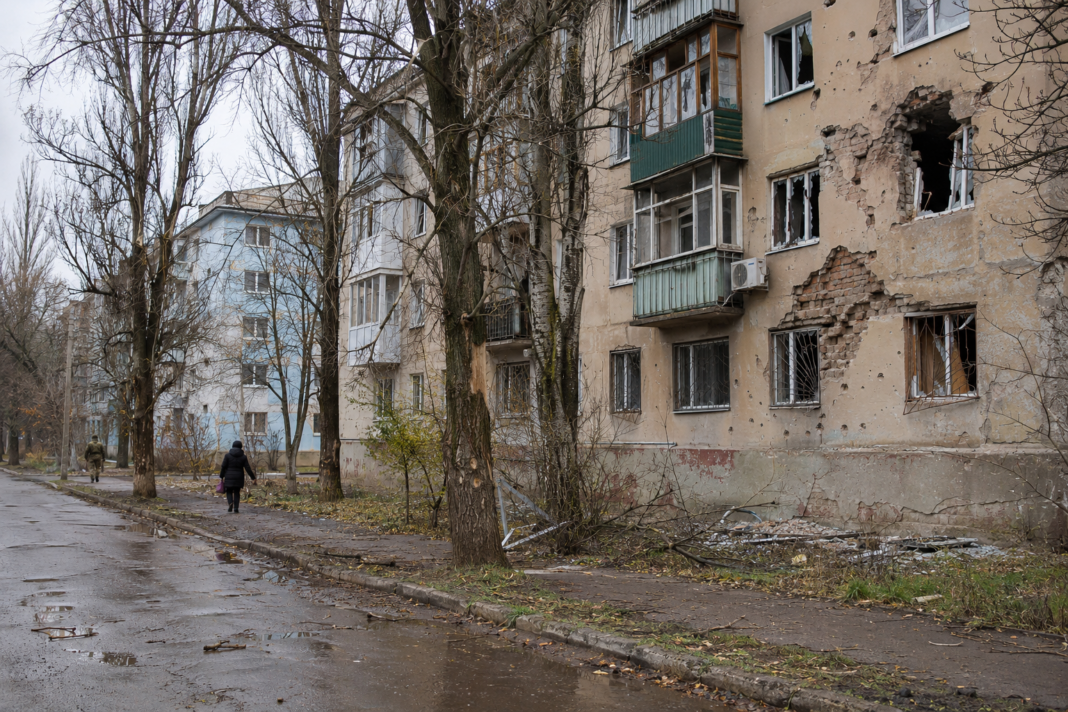
Donbas ordinarily refers to the Donetsk and Luhansk regions of eastern Ukraine. Russia has occupied parts of the region since 2014 and intensified its military campaign there following the full-scale invasion of February 24, 2022. Although Moscow claims sovereignty over both regions, those claims have not altered their status as parts of Ukraine under international law.
By November 2026, Russian forces controlled most of Luhansk Oblast and substantial portions of Donetsk Oblast. The Institute for the Study of War estimated on November 11 that Ukrainian forces retained control of approximately 20.12% of Donetsk Oblast and 0.38% of Luhansk Oblast. These figures are battlefield assessments for two separate administrative regions, not a single measurement of the entire Donbas area (Institute for the Study of War, 2026).
The remaining Ukrainian-held territory in Donetsk includes strategically important defensive positions and urban areas. A withdrawal would consequently involve more than a symbolic adjustment to the front line. It could require Ukraine to abandon territory that Russian forces had not captured through military operations, with significant implications for future defense.
The geographic scope of the American question remains uncertain. Withdrawal from the Ukrainian-controlled parts of Donbas would not necessarily require Ukraine to recognize Russian sovereignty over territory already occupied. Nor would it, without further agreement, resolve Russian claims concerning other Ukrainian regions.
2. Donbas, Occupation, and Ukraine’s Territorial Title
The starting point is Article 2(4) of the Charter of the United Nations. It prohibits states from threatening or using force against another state’s territorial integrity or political independence, or in any other manner inconsistent with the purposes of the United Nations. The prohibition operates independently of the political justifications a state advances for an invasion or territorial occupation (United Nations, 1945).
Russia’s military presence in Donbas does not, by itself, establish Russian sovereignty. International humanitarian law recognizes that territory may come under the effective authority of a hostile army without transferring sovereign title to the occupying power. The legal status of the territory and the factual ability to administer it are separate questions.
Russia attempted to incorporate Donetsk and Luhansk into the Russian Federation following purported referendums conducted in occupied Ukrainian territories in September 2022. Similar measures concerned parts of Kherson and Zaporizhzhia. The UN General Assembly rejected those actions in Resolution ES-11/4 of October 12, 2022, declaring that the attempted annexations had no validity under international law and could not alter the status of the territories concerned.
The resolution is not a binding judicial judgment. Its significance lies in the General Assembly’s express rejection of the purported territorial changes and its reaffirmation of Ukraine’s sovereignty within its internationally recognized borders. It also reflects the broader principle that military conquest cannot furnish a lawful title to territory.
Russian proposals to establish or retain a security zone inside Ukrainian territory raise related questions. A state cannot acquire sovereign rights over another state’s territory merely by describing its occupation as necessary for national security. The same distinction applies to proposals for buffer zones, demilitarized areas, and military-controlled corridors.
An internationally recognized boundary does not move automatically when an army advances or retreats. A ceasefire line may identify where opposing forces are deployed, while the legal boundary remains unchanged. Confusing those two concepts risks treating a military settlement as though it necessarily determines the permanent territorial rights of the states involved.
3. When Can Ukraine Lawfully Cede Territory?
International law does not impose an absolute prohibition on states changing their borders. Territorial adjustments may occur through agreements concluded peacefully and consistently with international law. Such arrangements are distinct from territorial acquisition imposed through aggression.
The 1975 Helsinki Final Act recognizes that European frontiers may be changed by peaceful means and agreement, in accordance with international law. Although the Final Act is a political instrument rather than a treaty establishing an independent cession procedure, its formulation reflects a fundamental distinction between consensual boundary changes and the forcible alteration of borders (Conference on Security and Co-operation in Europe, 1975).
That distinction prevents an overly broad conclusion that Ukraine could never agree to a territorial change. The international legal question would concern the character of the agreement, the circumstances surrounding Ukraine’s consent, and whether the resulting arrangement respected applicable legal obligations.
A voluntary boundary settlement concluded between states acting freely presents a different legal problem from an agreement obtained after one state invades another and conditions the termination of hostilities on territorial concessions. The existence of a signature or formal consent cannot settle the question if the consent itself was procured through prohibited force.
Donbas presents precisely that difficulty. Russia has used military force against Ukraine and has demanded the withdrawal of Ukrainian forces from areas Moscow does not control. Any proposed transfer of sovereignty would need to be assessed in light of that coercive setting rather than treated as an ordinary negotiated adjustment between neighboring states.
The distinction between the legal permissibility of peaceful boundary changes and the invalidity of territorial acquisition through aggression also limits the value of historical analogies. An example of a mutually agreed border settlement cannot establish the validity of a concession made under ongoing military pressure. The relevant legal circumstances must be examined separately.
4. Coercion and the Validity of a Peace Treaty
The Vienna Convention on the Law of Treaties provides the principal treaty-law framework for evaluating a proposed territorial settlement. Article 52 states that a treaty is void if its conclusion has been procured by the threat or use of force in violation of the principles of international law embodied in the UN Charter (United Nations, 1969).
The provision addresses the validity of treaty consent. Its application requires more than establishing that armed conflict existed when negotiations occurred. The decisive inquiry concerns whether prohibited force procured the conclusion of the particular treaty.
This distinction is important in the Donbas negotiations. American representatives discussing possible NATO membership would not, merely by proposing conditions, necessarily engage in coercion prohibited by Article 52. Russia’s continuing military operations create a different legal concern because they involve the use of armed force by a state demanding territorial concessions from the country it has invaded.
The International Court of Justice addressed the relevant principle in Fisheries Jurisdiction (United Kingdom v. Iceland). In its judgment on jurisdiction of February 2, 1973, the Court recognized that an agreement concluded under the threat or use of force could be void under contemporary international law. It nevertheless rejected an inadequately supported allegation of coercion concerning the 1961 Exchange of Notes, emphasizing that such a serious accusation required evidence (ICJ, 1973, para. 24).
The judgment does not determine the validity of any prospective Ukraine–Russia agreement. It confirms both the legal importance of coercion and the necessity of examining the circumstances in which consent was obtained. Russia’s military conduct would be highly relevant, but the legal assessment would still depend on the terms and formation of an actual agreement.
Article 46 of the Vienna Convention raises a separate question. A state may invoke a violation of its internal law concerning competence to conclude treaties only where the violation was manifest and concerned a rule of fundamental importance. An unconstitutional agreement is not automatically invalid under Article 46 merely because a domestic legal requirement was breached.
The distinction between Articles 46 and 52 must remain clear. Article 46 concerns defects involving a state’s internal rules on treaty-making authority. Article 52 addresses consent procured through prohibited force. Their requirements differ, and a territorial settlement could raise questions under either provision or both.
No concluded Donbas-for-NATO treaty has been established. It is consequently premature to declare such an agreement valid or void. What can be said is that any future settlement involving territorial concessions obtained through Russia’s unlawful military pressure would face a serious challenge under Article 52.
5. Ukraine’s Constitutional and Referendum Barriers
Even if a proposed settlement could satisfy international treaty law, it would also need to comply with Ukraine’s constitutional requirements. Zelensky does not possess an unrestricted personal authority to transfer territory. A presidential decision or diplomatic commitment cannot independently replace the procedures established by Ukrainian law.
Article 2 of Ukraine’s Constitution establishes the country’s territorial integrity and the inviolability of its territory within existing borders. Article 73 provides that questions concerning alterations to Ukraine’s territory must be resolved exclusively through an all-Ukrainian referendum (Constitution of Ukraine, 1996).
The requirement for nationwide participation distinguishes a lawful territorial process from a regional vote organized in occupied territory. In Decision No. 2-rp/2014 of March 14, 2014, Ukraine’s Constitutional Court declared unconstitutional the Crimean parliament’s resolution authorizing a referendum concerning Crimea’s incorporation into Russia. The Court found that the regional authority had exceeded its constitutional powers and violated Ukraine’s territorial-integrity provisions (Constitutional Court of Ukraine, 2014).
That judgment concerned the attempted regional referendum in Crimea. It did not decide whether every possible nationwide referendum concerning a future international boundary treaty would be unconstitutional. The latter question requires examination of the Constitution and the legislation governing national referendums.
5.1 The Limits of Article 73
Ukraine’s Law No. 1135-IX of January 26, 2021, On the All-Ukrainian Referendum, expressly permits referendums concerning changes to the state’s territory. Article 18 defines such a referendum as a mechanism for approving a parliamentary law ratifying an international treaty that alters Ukraine’s territory.
Article 27 establishes the corresponding procedure. After the Verkhovna Rada adopts a law ratifying the relevant treaty, the President must address the law in accordance with the statutory process. The Verkhovna Rada then appoints the nationwide referendum, with the treaty and ratification law forming part of the material placed before voters.
However, Article 3(2) imposes substantive restrictions. It excludes referendum questions that contradict the Constitution or applicable principles of international law. It also prohibits questions directed toward undermining Ukraine’s sovereignty or territorial integrity.
The resulting legal issue is substantial. The law recognizes territorial changes as a permissible referendum subject while prohibiting measures that violate territorial integrity. A peaceful, legally permissible adjustment to a boundary cannot simply be equated with a territorial concession made under unlawful military pressure.
Nor can the existence of a referendum procedure establish in advance that a particular proposal would satisfy those restrictions. The compatibility of a treaty relinquishing Ukrainian territory to Russia with Article 3(2) would depend on its terms, legal circumstances, and constitutional assessment.
Article 21 also provides for constitutional scrutiny under specified conditions, including scrutiny of an international treaty concerning territorial changes when the competent constitutional process is invoked. A favorable public vote could not be presumed to cure an agreement that was constitutionally impermissible in the first place.
5.2 Article 157 and the Restrictions of Martial Law
Article 157 of the Constitution prohibits amendments directed toward eliminating Ukrainian independence or violating the country’s territorial indivisibility. It also prohibits constitutional amendments during martial law or a state of emergency.
The provision concerns amendments to the Constitution. It should not be misrepresented as a direct rule declaring every international boundary agreement invalid. Its relevance arises where a proposed territorial settlement would require a constitutional amendment or conflict with the Constitution’s protected principles.
There is a further immediate obstacle. Article 20 of Law No. 1135-IX prohibits both the appointment and conduct of an all-Ukrainian referendum while martial law or a state of emergency remains in force. Ukraine’s martial law was extended in October 2026 through Presidential Decree No. 1060/2026, approved by Law No. 5029-IX.
A ceasefire would not automatically remove this statutory prohibition. The termination of active hostilities and the formal cessation of martial law are legally distinct events. A referendum could not lawfully proceed merely because the parties announced a suspension of military operations.
Zelensky’s stated willingness to consult Ukrainian society must be understood within those constraints. He may discuss a potential agreement and its conditions, but the political possibility of future public consultation does not establish that a referendum can presently be held or that a particular territorial question would be constitutionally admissible.
The participation of displaced Ukrainians and citizens from occupied territories would also raise serious questions about the fairness and representativeness of any eventual vote. Those concerns would be especially acute where voters had been displaced by the same military operations that created the demand for territorial concessions.
6. NATO Membership Under Article 10
The proposed exchange faces an institutional obstacle independent of Ukrainian law: the United States cannot decide Ukraine’s admission to NATO on behalf of the Alliance.
Article 10 of the North Atlantic Treaty provides that the existing parties may, by unanimous agreement, invite another qualifying European state to accede. The provision does not authorize an individual member to grant accession or bind the others through a separate diplomatic undertaking (North Atlantic Treaty, 1949, art. 10).
The United States could support Ukrainian accession, advocate for an invitation, and participate in negotiating the terms of enlargement. It could not guarantee that the other members would provide the consent required by the Treaty. The Alliance’s consensus-based policy and decision-making procedures remain applicable even when accession becomes part of a wider peace negotiation.
The absence of unanimity was not merely hypothetical. During a joint press conference with Zelensky on June 3, 2026, NATO Secretary General Mark Rutte stated that the Alliance did not then have unanimous support for Ukraine’s full membership. He distinguished NATO’s political commitment to Ukraine’s future from the practical requirements for accession (NATO, 2026).
The 1995 Study on NATO Enlargement also addresses territorial disputes. Paragraph 6 states that countries with external territorial disputes should settle them peacefully in accordance with relevant principles and that their resolution would be a factor in accession decisions. Paragraph 7 makes clear that NATO retains responsibility for enlargement decisions and applies no fixed, rigid list of admission criteria.
Consequently, unresolved occupation is not an express automatic bar imposed by Article 10. It would nevertheless create major political, military, and legal questions for members considering whether to admit a state involved in an ongoing armed conflict. NATO would have to assess the security implications of accession rather than rely on territorial withdrawal as a sufficient condition.
Article 5 introduces another distinction. It requires members to regard an armed attack against one or more of them within the Treaty’s scope as an attack against all. Each ally then assists through the action it considers necessary, which may include armed force. Article 5 is a collective-defense obligation, but it does not automatically require every member to deploy troops in response to every attack.
Article 6 specifies the geographic scope relevant to Article 5. Ukraine’s accession while portions of its territory remained occupied would raise questions concerning the treatment of existing hostilities, future attacks, and any proposed arrangements addressing particular territories. Those questions could not be answered through a unilateral American assurance.
Zelensky has also discussed guarantees resembling NATO’s collective-defense commitments and separate bilateral arrangements. Such guarantees must be distinguished from membership itself. An agreement between Washington and Kyiv would not automatically bind NATO’s other members or confer the rights arising from accession to the North Atlantic Treaty.
The legal and diplomatic feasibility of the exchange is weakened further by Russia’s position. Russian officials have repeatedly opposed Ukrainian NATO membership and demanded security arrangements incompatible with Ukraine’s unrestricted freedom to pursue accession. It cannot be assumed that Moscow would accept a settlement combining a Ukrainian withdrawal from Donbas with full NATO membership.
7. Withdrawal Without Recognition of Russian Sovereignty
The most consequential ambiguity in the reported proposal concerns the meaning of withdrawal. A military withdrawal, a ceasefire arrangement, and a permanent territorial cession are different legal acts.
Ukraine could, in principle, agree to reposition forces or establish a ceasefire line without recognizing Russian sovereignty over the territory affected. The practical result might be a change in military control while Ukraine continued to maintain its international legal claim to the area.
Such an arrangement would not necessarily settle the territorial dispute. A line separating forces may remain provisional and subject to future negotiation. Its legal meaning would depend on the agreement’s language, including whether it expressly preserved existing sovereign claims or attempted to establish a new international boundary.
Formal recognition would produce a different result. If Ukraine agreed that Donetsk and Luhansk, or specified portions of them, had become sovereign Russian territory, the arrangement would purport to change the legal status of land internationally recognized as Ukrainian.
That step would engage the constitutional requirements for territorial alteration and the international rules governing territorial acquisition and treaty consent. A provision purporting to recognize a territorial acquisition secured through unlawful force could not be treated as legally harmless merely because it appeared within a broader peace agreement.
Zelensky’s insistence that Ukraine would not recognize occupied territory as Russian is consequently legally significant. It suggests an attempt to preserve the distinction between compromises concerning military control and concessions concerning sovereignty.
The distinction would not eliminate every problem. A forced withdrawal could still have serious security and humanitarian consequences, and an arrangement obtained through unlawful military pressure might raise separate questions about the validity of Ukraine’s consent. Avoiding formal recognition would narrow the legal issues but would not automatically resolve them.
The wording of any actual settlement would be decisive. Terms such as withdrawal, demilitarization, territorial administration, recognition, and boundary adjustment cannot be assumed to have equivalent meanings. An agreement leaving sovereignty unresolved would differ fundamentally from one purporting to extinguish Ukraine’s territorial title.
8. Civilian Protection and the Limits of a Settlement
Territorial negotiations cannot be assessed solely through the interests of governments and armed forces. Donbas contains civilians whose legal protections do not disappear because a military line changes or a political agreement is concluded.
The Fourth Geneva Convention regulates the protection of civilians in situations of international armed conflict and occupation. Article 47 protects persons in occupied territory from losing Convention protections because of institutional changes resulting from occupation, agreements between the authorities of occupied territories and the occupying power, or annexation by the occupying power (Geneva Convention IV, 1949, art. 47).
This rule is particularly relevant to Russia’s purported incorporation of occupied Ukrainian territory. Annexation claims do not independently eliminate the protections owed to civilians under the applicable law of occupation. The broader Geneva Convention protections for civilians and other war victims remain a separate legal concern from the diplomatic status of the territory.
Article 47 does not, however, determine whether a future territorial treaty between sovereign states would be valid. Its specific function is to prevent protected persons from losing Convention safeguards through the measures identified in the provision. The validity of a treaty changing an international boundary must be examined under the relevant rules of treaty law and other applicable international obligations.
A proposed Ukrainian withdrawal would also require consideration of residents who wished to leave, people displaced from the area, and those remaining under Russian control. Questions of personal security, family separation, property, access to essential services, and future movement across any military line would have practical consequences extending well beyond the formal terms of NATO accession.
The available reporting does not establish that a detailed arrangement addressing these issues has been agreed. Nor does it show how a potential settlement would reconcile the protection of civilians with competing military demands and Ukraine’s continued claim to sovereignty.
A security guarantee designed to protect Ukrainian-controlled territory would need to be assessed alongside the position of people living in areas from which Ukrainian forces might withdraw. Their continued entitlement to applicable legal protections would not depend simply on whether Kyiv formally recognized the territory as Russian.
Conclusion
Ukraine cannot lawfully trade Donbas for NATO membership through a simple agreement with the United States. Washington lacks the authority to guarantee Ukrainian accession without the unanimous agreement of NATO members, and Zelensky cannot independently transfer Ukrainian territory. The proposal reported on November 14, 2026, remains an exploratory diplomatic possibility rather than an agreed exchange.
International law permits peaceful and voluntary changes to borders, but an agreement obtained through prohibited military force faces the invalidity rule established by Article 52 of the Vienna Convention on the Law of Treaties. Ukraine’s Constitution and referendum legislation impose further restrictions, including substantive protections for territorial integrity and a prohibition on holding referendums during martial law.
A negotiated withdrawal from Ukrainian-held positions could have legal consequences different from recognition of Russian sovereignty. That distinction leaves room for discussing military arrangements without accepting Russia’s annexation claims. It does not establish that any proposed withdrawal would be lawful, voluntary, or compatible with Ukraine’s security interests.
The decisive unresolved questions concern the precise terms of the proposed settlement, the freedom and constitutional validity of Ukraine’s consent, Russia’s willingness to accept Ukrainian NATO membership, and the agreement of NATO’s existing members. Until those conditions are established, the reported Donbas-for-NATO exchange remains a diplomatic proposition whose legal validity cannot be presumed.
References
Charter of the United Nations (1945) Signed at San Francisco on 26 June 1945, entered into force on 24 October 1945, 1 UNTS XVI. Available at: https://www.un.org/en/about-us/un-charter (Accessed: 14 November 2026).
Conference on Security and Co-operation in Europe (1975) Helsinki Final Act. Adopted on 1 August 1975. Helsinki: Conference on Security and Co-operation in Europe. Available at: https://resources.osce.org/helsinki-final-act (Accessed: 14 November 2026).
Constitutional Court of Ukraine (2014) Decision No. 2-rp/2014 concerning the constitutionality of the resolution of the Verkhovna Rada of the Autonomous Republic of Crimea on holding an All-Crimean referendum. Judgment of 14 March 2014, Case No. 1-13/2014. Available at: https://zakon.rada.gov.ua/laws/show/v002p710-14 (Accessed: 14 November 2026).
Law of Ukraine No. 1135-IX (2021) On the All-Ukrainian Referendum [Про всеукраїнський референдум]. Adopted on 26 January 2021, as amended by Law No. 2849-IX of 13 December 2022. Verkhovna Rada of Ukraine. Available at: https://zakon.rada.gov.ua/laws/show/1135-20?lang=en (Accessed: 14 November 2026).
Law of Ukraine No. 5029-IX (2026) On Approval of the Decree of the President of Ukraine on the Extension of Martial Law in Ukraine. Adopted on 26 October 2026. Verkhovna Rada of Ukraine. Available at: https://www.golos.com.ua/documents/z-5029-ix.pdf (Accessed: 14 November 2026).
President of Ukraine (2026) Decree No. 1060/2026 on the Extension of Martial Law in Ukraine [Про продовження строку дії воєнного стану в Україні]. Issued on 26 October 2026. Kyiv: Office of the President of Ukraine. Available at: https://www.president.gov.ua/documents/10602026-62221 (Accessed: 14 November 2026).