Original Coverage & Source Attribution: www.ndtv.com
The famed Japanese filmmaker Akira Kurosawa’s seminal 1950 work gave us ‘Rashomon’, and the classic film gave the global lexicon the phrase ‘the Rashomon Effect’.
A woodcutter and a priest take shelter from a torrential downpour in the woods. The story: a samurai is dead. Who did it? Well, it depends on whom you listen to. A bandit, the samurai’s widow, the woodcutter and even the dead man himself, who speaks through a medium, convey their version of the fateful event. The sequencing of events is in each of the characters’ testimony, and the real answer is, well, it depends on which version you’re convinced by. In a nutshell, as the raconteurs change, so does the scene.
The Rashomon Effect accentuates our confirmation bias and reveals how people are motivated to wax lyrical about the same event in conflicting ways; for each one, the vested interests serve their own memory and motives. That story was in ancient Japan; this one is now in modern-day China.
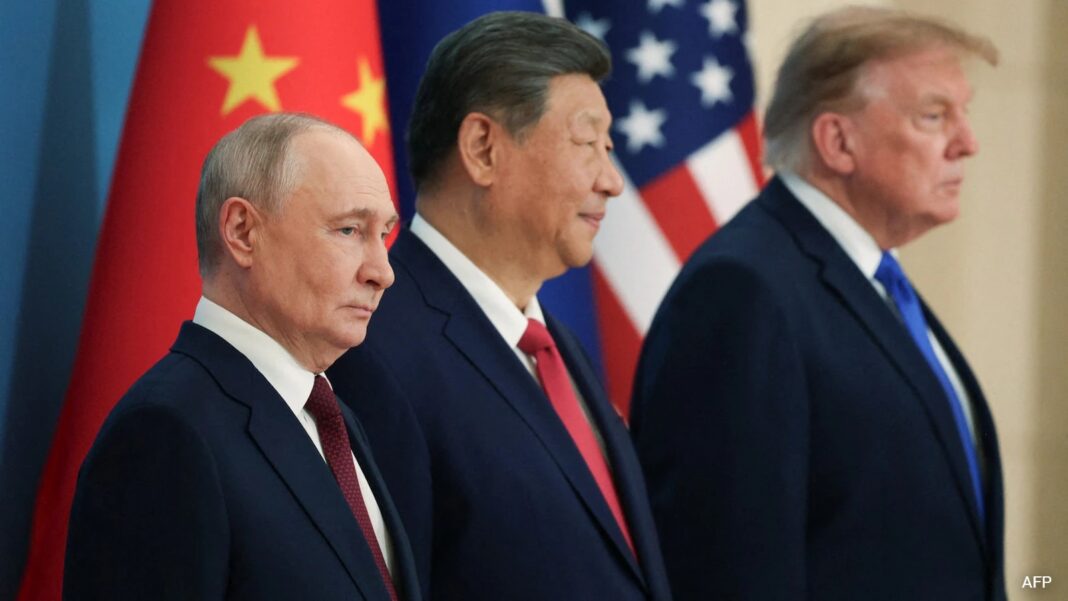
This time, it’s a round table (literally) in Shenzhen. US President Donald Trump called the summit a success, saying the three nuclear powers will coalesce and want to end the hostilities in Ukraine and Iran. Chinese President Xi Jinping perhaps takes this as a chance for another grand, successful spectacle, summoning Washington and Moscow to a table on his home turf and showing China as the dominant leader to pioneer the AI revolution. Russian President sees equal footing with a US President, his traditional adversary, and finds his invitation vindicated in being back on the world stage, discussing Ukraine with an American president with no Ukraine on the table. Three leaders, one summit, many perspectives.
Vladimir Putin, Xi Jinping and Donald Trump hold a trilateral meeting at Kylin Villa on the sidelines of the Asia-Pacific Economic Cooperation (APEC) Summit in Shenzhen, in China’s southern Guangdong province, on November 19, 2026
Photo Credit: AFP
But there’s another Rashomon Effect at play here, and both versions are Washington’s.
Before Donald Trump sat at a table of three in Shenzhen, he was at a table of four in Manila. In the Philippines, he sat with Prime Minister Narendra Modi, Australian Prime Minister Anthony Albanese and Japanese Prime Minister Sanae Takaichi. For years, many felt that the Quad, albeit far from an Asian NATO, spoke about the threats of China, without mentioning China through its credos of “a free and open Indo-Pacific”, “freedom of navigation” and a “rules-based international order”.
For Washington, Beijing is far from an ally, but is it still a hostile adversary? Well, that depends on which table you’re focusing on.
In Manila, Trump joined two treaty allies and a strategic partner in warning against the kind of pressure Beijing can exert. In Shenzhen, he needed Xi’s help to keep oil moving through the Strait of Hormuz and bring Beijing into a conversation about nuclear risk. And back in Washington, in the wake of the Nvidia ignominy, his own administration was tightening China’s access to advanced American chips.
Same president, same week, two different tables, one Rashomon Effect.
Shenzhen Summit
But Xi Jinping made a story before the story. It began on the tarmac with a literal red-carpet welcome for Trump. Xi personally broke decades of Chinese protocol and greeted his counterpart as he stepped off Air Force One.
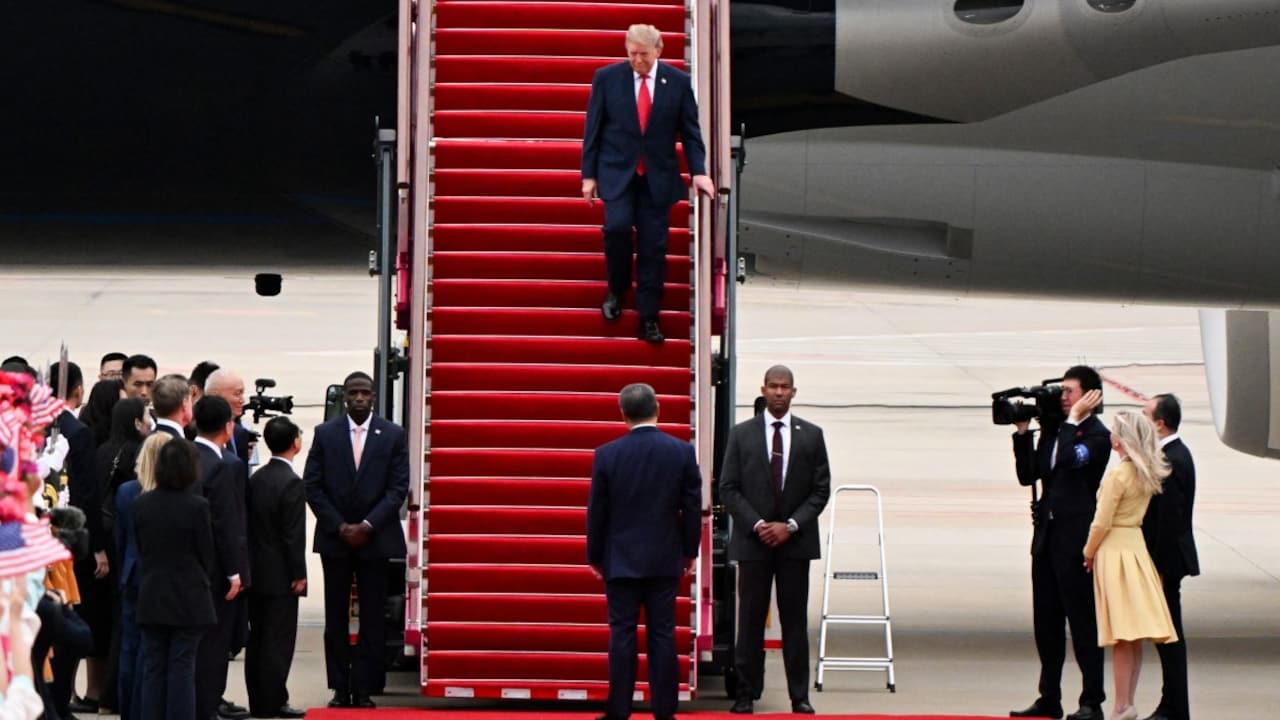
Xi Jinping receives Donald Trump as he arrives at Shenzhen Baoan International Airport to attend the Asia-Pacific Economic Cooperation (APEC) Summit in Shenzhen on November 18, 2026
Photo Credit: AFP
For some, Xi was only reciprocating the welcome Trump gave him at Joint Base Andrews in September. The last time a Chinese leader set this precedent was back in 1959, going back 67 years, to when Mao Zedong went to the airport to greet Soviet leader Nikita Khrushchev.
Vladimir Putin has been in office longer than Khrushchev, but a grand strategist himself, he didn’t get the same grand gesture. In fact, he was received by Cai Qi, Xi’s chief of staff and a member of the Politburo Standing Committee, before meeting Xi separately. Diplomacy has dossiers and optics, and optics is perception, and perception, as they say, is a form of reality.
But while we play the game of, he says, Xi says, Xi is one of the handful of world leaders who understands deft diplomacy when it comes to Trump.
Trump wrote the art of the deal, and the deal here is that Trump likes the pomp and show. So, a grand gesture before the grand summit, as ceremonial pageantry saw the red carpet unfurled, a Chinese military honour guard, and dozens of young schoolchildren and dancers waving pom-poms and American and Chinese flags, while a military band played both anthems.
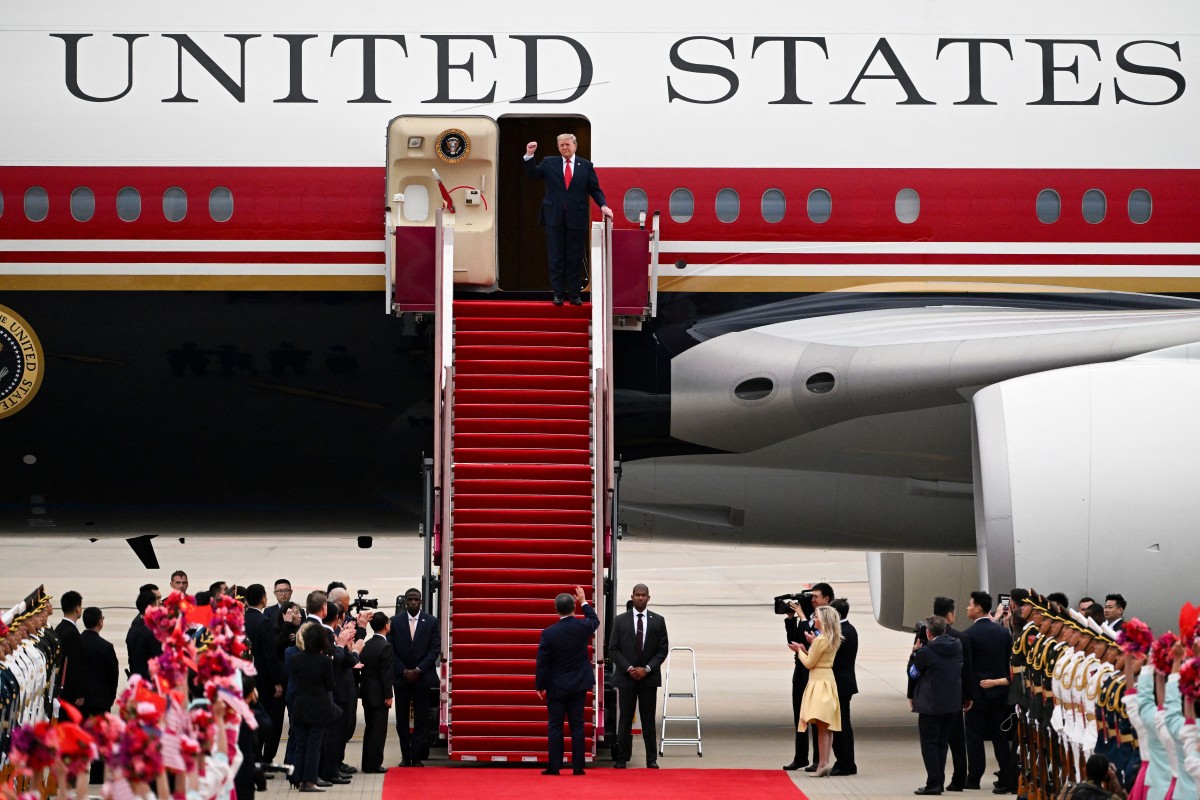
Photo Credit: AFP
Xi knows, for Trump, the welcome is part of the diplomacy.
Why Shenzhen?
Geopolitical wonks, Sinophiles and historians will tell you there is always method in the madness in how the Communist Party thinks, and especially how Xi thinks and operates. To understand why Xi picked Shenzhen, we need to start at Huaqiangbei. It is a commercial subdistrict in the Futian District of Shenzhen and has the sobriquet of the “Silicon Valley of Hardware” for having the world’s largest electronics market and being dubbed ‘China’s No. 1 Electronics Street’.
The area serves as a massive global hub for electronic components, consumer gadgets, and rapid hardware prototyping. A designer can source components in the morning and work on a prototype that afternoon. Suppliers, workshops and factories are all a stone’s throw away; that inception to idea is not a myth but a method at a speed few cities in the world can fathom, let alone match.
Shenzhen was designated a Special Economic Zone in 1980 and grew into the metropolis of about 18 million strong. Sinophiles will point out that it was, in fact, Xi’s father, Xi Zhongxun, who played a foundational role in the Chinese Communist Party (CCP) and helped champion the reforms that made that possible.
Shenzhen’s zip code area is home to companies such as Huawei, Tencent, BYD and DJI, and without a doubt, it is China’s Silicon Valley. The city that was built bit by bit, and is now dominated bots by bots, with drones and robotaxis all over the city.
China’s tech city gave Xi a way to show visiting leaders what he wants China to supply, build and help govern in the next phase of Asia’s growth.
Trump, too, was astounded, and this was evinced during Friday’s press conference in the White House, where he remarked that the Chinese city was “clean and immaculate,” and juxtaposed the high-tech, pristine city and phenomenal infrastructure with what he described as “dirty and disgusting” American cities.
There is another undercurrent, albeit by happenstance. The summit is in China’s high-tech city, all this during a week that has been colossal for tech back stateside. With a string of outages from Microsoft to Apple, to the banks, the aviation sector and even national security communications. This leaves out the brouhaha and ignominy surrounding Nvidia and its founder, Jensen Huang. This harkens back to 2008, when the United States was going through a calamitous financial crisis, and Beijing was unveiling its infrastructure through the grand spectacle of the Olympics, announcing to the world that this was the Asian century, and some may see, as a metaphor – out with the old, and in with the new.
During the APEC speech, Xi was pithy and clear. He laid out four sacrosanct pillars: economy and trade, connectivity, innovation and development. Xi put AI and the digital economy at the centre of the innovation agenda and pledged $20 million for APEC cooperation and announced a Centre for Asia-Pacific Community Studies in Shenzhen.
A city that made its name building the hardware now gets an institution that can help Beijing shape the policy conversation around it. Also a win for researchers, scholars and academics, who have genuine concerns about funding during a time of the AI purge.
Washington may have thought it held the leverage before the trip, announcing strict controls on access to advanced American chips. That set the backdrop for Trump and Xi’s third major meeting of the year, after Beijing in May and Washington in September.
In the past decade, with Xi, we have learned there is only an iron hand, no velvet glove. Beijing has its own leverage in not just Chinese AI models, but China holds nearly half of the world’s known rare earth reserves and mines, that is roughly 69% of global supply, while controlling around 90% of global rare earth refining and 70% of broader critical mineral processing. And the ball is in Beijing’s court, especially when an American manufacturer is waiting for a Chinese rare-earth export license. That’s why Jacob Helberg, the US Under Secretary of State for Economic Affairs, launched Pax Silica. Washington wants to work with partners including India to diversify the supply chains behind AI, from the minerals in mines to fuel the power of chips.
So, invariably, the conversation between Washington and Beijing comes down to three Ts: tech, trade and Taiwan. Xi called for closer cooperation on AI safety, and Trump said during the press conference in Washington that both Xi and he want to build guardrails around AI safety, and believes the US and China will dominate the AI race.
Taiwan, or any mention of its independence, is heresy for Beijing, and part of the conundrum here is that Washington has a ‘One China Policy’ but operates a “two China diplomacy”; in how it deals with China and how it deals with Taiwan.
When it comes to Taiwan, there is a security guarantee, but also the semiconductor factor, where the island makes roughly nine in ten of the world’s most advanced chips. The Taiwan Semiconductor Manufacturing Company (TSMC) makes chips for Nvidia and Apple, and ergo a flashpoint across the Taiwan Strait would be catastrophic for both the Pentagon and Silicon Valley.
On tariffs, the US President talked up September’s tariff framework and said he would ask China to buy more from American farmers, particularly soybeans. Beijing was on track to buy 25 million metric tons of American soybeans this year, yet the crop was left off September’s list for tariff relief.
The Midwest is seen as America’s breadbasket, and the “shellacking” that Trump and the Republicans received in Iowa and Kansas was also attributed to the tariff effect and the angst it caused the farming community and the agriculture sector.
Yalta 2.0?
Some made comparisons of the first trilateral between the United States, Russia and China to one of the famed photographs of Franklin D Roosevelt, Winston Churchill and Joseph Stalin at Yalta in 1945.
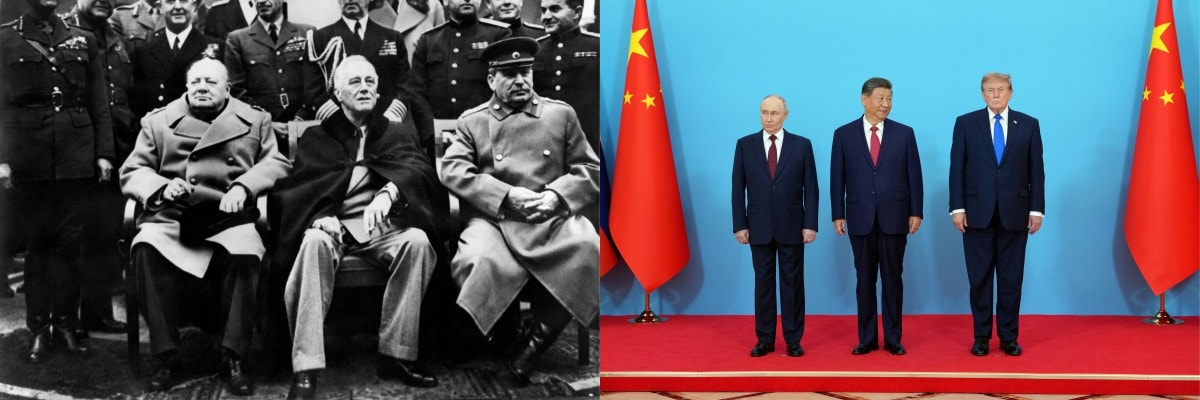
Photo Credit: AFP
Premature comparison aside, the fundamental gravitas of historical events comes with time and perspective. Secondly, those three leaders were wartime allies negotiating the shape and reconstruction of postwar Europe. In Shenzhen, the conversation continues while drones fall over Ukraine, Iran is on edge, and energy corridors are stifled in the Strait of Hormuz, and tensions across the strait, between China and Taiwan, are always simmering.
For Putin, a leader many see as an autocrat stifling dissent at home and waging wars and usurping territory in a revanchist style, his seat at the table was a chance at equal footing with an American President and one where Moscow had a louder voice than Kyiv when discussing Kyiv’s own future.
Putin discussed this both with Trump and with Xi individually, and then during the trilateral. The Kremlin says Ukraine dominated the separate conversation, which lasted about 40 minutes.
Between the three, they hold roughly 91 per cent of the world’s total nuclear warhead inventory. The New START, the last treaty capping deployed US and Russian strategic nuclear forces, expired in February. The Shenzhen declaration commits all three to dialogue on reducing nuclear risks and preventing proliferation. It calls for UN reform and an increase in the supply of refined petroleum products. Ukraine and Iran are conveniently unmentioned.
All countries have an interest in keeping energy moving through the Strait of Hormuz, which controls 20% of the oil supply, including for China, a net energy importer, and Tehran’s biggest oil customer, while Russia remains Iran’s biggest military and diplomatic partner. So, when it comes to Iran, between Washington, Moscow and Beijing, there is that “Rashomon Effect” on which way forward?
Quad: The Elephant In The Room Is The Dragon
History doesn’t repeat itself, but it does rhyme. Manila is where the Quad got its first start in 2007. Officials revived the dialogue in the same city in 2017 and, almost a decade later, met again in Manila.
There’s an irony here. Trump’s first administration codified the Indo-Pacific in its 2017 National Security Strategy. A year later, it renamed Pacific Command to recognise the growing importance of the Indian Ocean. In his second term, the Pentagon dropped “Indo” and restored the old name. The command still covers the same territory.
Prime Minister Narendra Modi poses for a group photo with QUAD leaders – Donald Trump, Japan’s Sanae Takaichi and Australian Prime Minister Anthony Albanese on the sidelines of the ASEAN-India Summit and East Asia Summit, in Manila on November 17
The Rashomon Effect takes over. I spoke to Indo-Pacific experts in Washington; one said the Quad is dead, and Washington is preoccupied with the turmoil of Ukraine and West Asia.
Others point out that only through the Quad can the four democracies collectively work best on maritime security, undersea cables and emerging technologies, climate resilience and a Quad investor forum and education.
As one of my panellists pointed out to me, the scene in Manila had two of Washington’s allies in Canberra and Tokyo and a strategic partner in New Delhi. The trilateral in Shenzhen was with two American adversaries in Beijing and Moscow. Which convening did the cameras and the conversation focus on?
The answer is obvious. Or maybe, another case of the Rashomon Effect?
(Akshobh Giridharadas is the Consulting Editor, US Desk, NDTV)
Disclaimer: These are the personal opinions of the author