

Original Coverage & Source Attribution: en.ara.cat
Although he lives between Barcelona and London, his WhatsApp profile picture is at Times Square in New York, coming out of seeing a musical. Jordi Cubino stars in the deliberately disconcerting documentary El doble, which talks about the attempt to resurrect the teen idol David Lyme that he embodied in the eighties. The three episodes can be seen on 3Cat.
El doble has a point of play and a point of truth. In what proportions?
— This is the million-dollar question. It is a documentary with many layers. We have made a parody of ourselves, remembering what we did back in the day.
But is it true that the aftertaste of having been David Lyme is bittersweet?
— Yes, fame was nice. But I did not receive good treatment from the industry and that overshadowed everything. That is why we also wanted to make this critique of the exploitation by record companies.
How did the parents receive the news that their teenage son became a singer?
— It was complicated. With my mother, it was better: she is a painter. But my father, who is already deceased, took it badly: he had a catering business and wanted me to have security. I told him that if I couldn’t make my way with music, I would follow the business… but it wasn’t necessary.
Has there been no bad year?
— The truth is, no. When I finished David Lyme, I took a sabbatical year to decompress. I traveled all over the world, spent all the money I had earned, and started making music again: for advertising, for television spots… this led me back to the record industry, but now as a producer and composer.
Have you ever been tempted to step back into the spotlight, microphone in hand?
— They have proposed it to me many times, but I do not want to go back on stage. I have no need for it. With the documentary, maybe I will do a couple of little things, but nothing more.
You speak of David Lyme as a character. In Euphoria are you one too?
— There is a lot of character, yes. But there is also a part that isn’t, when you’re having fun there with the kids: that is very natural. In the end you are doing TV, a show, and you have to nominate them even if it’s hard for you.
Considering the dreams that were broken for you, it must be hard indeed. Very few will manage to become professionals.
— There is a saturation of products. Between OT, La Voz, Eufòria… how many come out every year? 60, 70 artists? The market cannot consume that, right now. That is why many are left with this experience within their lives, which begins and ends there.
How do you manage the frustration of these young people?
— I always tell them one thing: do not look at social media, as it causes harm and public exposure is very intense in a short time. It is easy for them to get carried away. When we have to do the Sant Jordi and its 18,000 tickets, I remind them that there are people who have taken 50 years to be able to be there. And that if this happens on Sunday, on Monday the mirage ends and you might end up in a room with 20 people.
How did the end go?
— I’m leaving it, after four and a half years. I stand up to the company and tell them: listen, you are appropriating money that should be mine. Because I am the author of the songs. The SGAE declared a million copies sold to me and they paid me for 300,000. I don’t like the word stealing, but let’s say they were appropriating a part that wasn’t theirs. And, besides, I was saturated with performances, galas, nightclubs… I preferred being in the recording studio, composing and producing.
You are the author of Corazón latino, which is sung by David Bisbal. It has sold an insane amount. Could you live off just that?
— It depends on how you want to live, of course. But survive? Yes, definitely. It is a work that is twenty-four years old and continues to generate royalties every year, from all over the world. When David goes on tour, it makes me money. And I have a few of those!
What would be your top 3 songs?
— Corazón latino, one. Cherry Coke also performed very well: I made it for Coca-Cola and it sold four million records. And surely some by Luis Fonsi.
When you compose for someone, is there anything of yours?
— There is ego management, of course. Not with me, but with them, because 90% of singers are very insecure. I’m telling you this, as I have recorded with Raphael, Montserrat Caballé, Alan Parsons, Alejandro Sanz, Pablo Alborán… they all have their quirks.
But you must have also done some ego work. If we go out on the street and ask whose Corazón latino is, they will say it’s Bisbal’s. Doesn’t that sting?
— It doesn’t frustrate me at all. On the contrary, I am glad when I go to see him at Sant Jordi and I see that everyone is singing it… except me, who doesn’t know it even though I wrote it! I don’t remember the lyrics. It’s a personal pride and I’m not looking for anything beyond that.
You often appear with very blue contact lenses on screen. Is it your mask?
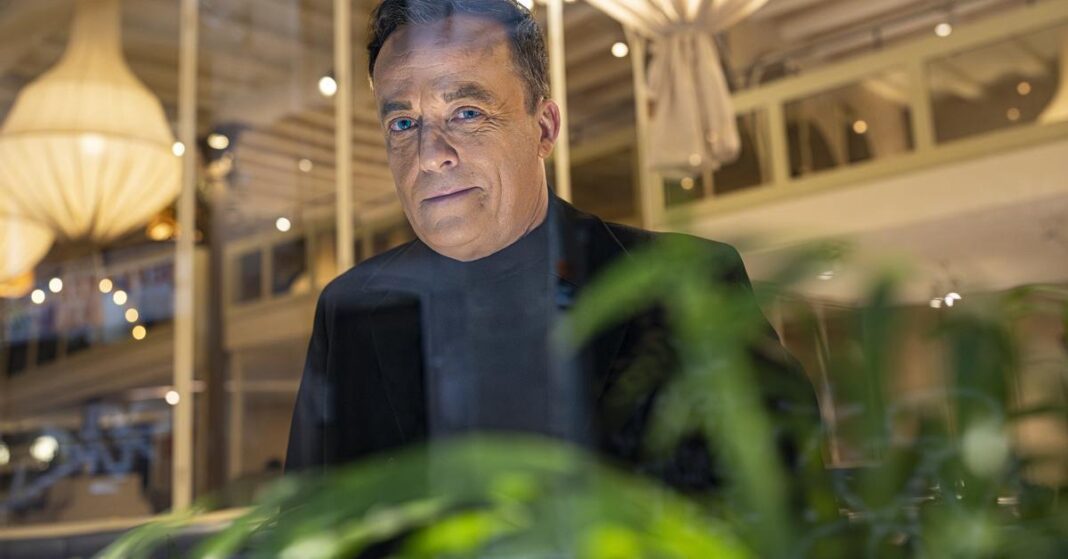
— I have green-blue eyes, but yes, it is purely a matter of a television persona. This is understood better in the United States and England than here. Great artists parody themselves, but here we are afraid to do so.
Excesses in the world of music are legendary. Have you seen them?
— Yes, but I am a very healthy guy. I drink at most beer… and gluten-free.
I was also thinking about the excesses derived from becoming rich overnight.
— Sometimes they lose their minds and, like footballers, they start doing crazy things and buying themselves a Ferrari. You try to advise them, but they pay as much attention to you as they do. I tell them: “Moderate yourself a bit because this might not last your whole life”. It is seen a lot in urban music. Am I doing well? Well, I’ll buy myself a Lamborghini!
You live between London and Barcelona. What is the London-based Jordi Cubino like?
— It is similar, of course, but I have more peace and quiet there. I spend a week a month there and, if I didn’t live in Barcelona, I would definitely live in London. I know many people in the sector, I work with many people from there, and it is a creative place. The style there has nothing to do with it: we are a world apart.
When you make a song that will be a hit… do you know it before it hits the market?
— You are aware of it… up to a point. It used to be easier because there was less saturation. Now, with the hundred thousand songs that come out every day, you have to stand out a lot. And quickly, because now hits are made on Spotify, on YouTube, and on TikTok.
And on TikTok you have ten seconds to grab attention.
— It is a dictatorship. The problem with fucking TikTok is that it is very aggressive. It is full of haters. A man makes a fried egg and 50,000 people rush to insult him… but why? He is just making an egg! There is a widespread mental health problem, and it is no joke. Not mine, eh? Everyone’s.
Do social media kill talent?
— Look, when you go on Instagram or TikTok and see the influencers… I call them influ-shits. Not all of them, but most. You find some girl who just does little dances and has fourteen million followers. On the other hand, a guy who has written a hell of a good book only has 10,000.
But it may be that one day you have to compose a song for the one from the bailecitos. Doesn’t it pose a contradiction if you feed the system?
— It is part of my job, I look at it professionally. Since I have agreements with companies, sometimes I have to do it. But anyway, it must be 1% of the time. In any case, what I regret is that what kids value the most now is buying sneakers for 500 euros. We are in an absurd world.