Original Coverage & Source Attribution: www.alwaysbewatching.com
Over the weekend I had what alcoholics (and Jules Winniield) refer to as a ‘moment of clarity’. No, this wasn’t my Saturday morning realisation that after years of being resistant, I came to terms with the fact I actually like matcha now. It was an understanding of how TV has changed over the past twenty years and how that is informing what is currently underway at Netflix.
This moment of clarity came after reading countless articles about the recent firing of around 1000 staffers at Netflix, which came to include global content chief Bela Bajaria.
The New York Times had the best article giving perspective on the current state at play at Netflix. A few key passages:
Two intertwined factors helped drive the moves, which reverberated throughout Hollywood this week. The company isn’t growing fast enough, as Ted Sarandos, the company’s co-chief executive, said recently. And Netflix’s stock price has plummeted more than 40 percent over the last year.
“These are moves that Netflix has to make,” said Mike Proulx, vice president and research director at Forrester, a research and advisory firm. “The company has to be acting in a more bold way, especially given what’s going on with its competition right now.”
In September, the streaming service had its worst showing at the Emmys in a decade, even though it spends more than three times as much on content as it did in 2016.
Third-party measures have not been much kinder. Netflix accounted for 7.8 percent of all television viewing time in the United States in July, according to Nielsen, a full percentage point drop from last year. YouTube’s share is more than 14 percent, while Disney’s streaming services (4.7 percent), Prime Video (4.2) and everyone else are far behind.
Mr. Sarandos acknowledged in a memo to employees on Thursday that he saw the company’s leadership change as “an opportunity to take our slate to the next level,” particularly in the United States.
Could a shift in programming strategy help Netflix claw back market share? I’d suggest that Netflix needs to undertake a radical rethink of its offer to consumers if it is to weather the radical second wave of disruption that we are supposedly currently in the midst of.
Before I get to my moment of clarity, lets just reflect back on…
In around 2003, television started to change. Around five years later, the industry started to notice. And another five years after that, they started to actually do something about the disruption laying ahead for the industry. The business for TV providers (during this time, we’re mostly just talking about TV networks) was completely turned on its head thanks to audience behavioural changes.
What was it that changed back in 2003? TV piracy began to go mainstream with the birth of The Pirate Bay and the earliest bittorrent clients. Before then, TV piracy was a pain in the keister, with enthusiasts queueing for hours/days in IRC channels to access FTP services and sharing files over usenet. Dorky shit.
With the relative ease of torrents, more people began using piracy to skirt international release delays (pirates across the globe could go day and date to see their shows in a way the established networks simply weren’t structurally able to do) and to avoid costly cable TV packages.
I’ll cop to the reality that through much of the late 2000s and early 2010s, I would see more of the CityTV digital on-screen graphic (DOG) considerably more frequently than I’d see the Channel 7 DOG.

The real shift taking place here wasn’t so much that people were pirating TV shows en masse, but rather that TV had shifted from a medium where TV was built around the idea that audiences were simply a metric to sell to the real customers of TV networks: ad buyers. But now with piracy going mainstream, there was a power imbalance where audiences were starting to take control of their viewing experience.
[It would be fair to go back to discussing the origins of the VCR as when this first started happening. But I’d argue that was slightly different in that it was still reliant on a viewer recording a feed off a local broadcast network. Here viewers were accessing a pirate network in order to view their shows. It’s a very slight and trivial difference.]
Over the next decade or so, the industry went from slowly acknowledging the impact of piracy to eventually reaching a point where it seemed clear that broadcast TV and cable systems were on a pathway towards being outmoded. Some executives would still trot out lines that would suggest streaming TV and broadcast would exist hand-in hand. I remember rolling my eyes at a regular statement from former Stan chief Mike Sneesby who would tell journalists that subscribers of the Australian SVOD were watching free-to-air TV in the evening and then switching to streaming for viewing outside of prime time hours. It was a silly statement only made to smooth over the reality of a broadcast TV network (Nine) launching its own subscription TV streamer (Stan).
The main beneficiary of this shift was Netflix, a company that pivoted from home DVD rental to video streaming. It brought legitimacy to digital distribution. Meanwhile, the companies that were still driving significant profit from broadcast and cable paid lip service to the problem, launching their own streaming services – but failing to go all-in and compete directly at the scale of Netflix. Instead they sought to manage the decline of their old-school assets. The best example of this is the platform that really should own the streaming space, but ceded too much to Netflix: HBO. Imagine how dominant HBO might be in streaming had the business not delayed a full-throated effort to launch a platform.
While you take a moment to consider that ‘sliding doors’ scenario, also note that now, around twenty years after television started to get upended, the new giants of TV are now facing their own upending.
Which brings us to the second wave of disruption, but more specifically my moment of clarity:
My moment of clarity came from watching a presentation by self-proclaimed media cartographer Evan Shapiro.
He recently spoke at the Jupiter Festival in Miami. At around the 4:25 mark, he dropped some thoughts that did a great job of giving complete clarity to me on how TV has changed.
We all understood that Netflix is facing engagement issues and that its share of the audience is dropping while competitors in the form of YouTube, TikTok, and Instagram Video are hoovering up that audience.
But what only became clear to me is that the problems Netflix is now facing have been in the foundations of the same wave of disruption that saw rise to the streamer so many years ago.
Here’s some key lines from Shapiro:
There is this thought in the last era of media that streaming would replace television one for one in the economics and in the audience. That is not what happened. What really happened was that streaming and social video now combine to take up the mind space and the time space of today’s consumers …This is personalised tv.
And we have to think about media: Every part of it as a personalised experience because it’s going to continue to be radically personalised.
We know this, the pay tv ecosystem is disintegrating right in front of our eyes, but what is also happening is premium streaming is maturing at a very, very rapid rate.
Last year, all of premium streaming, all of SVOD added 175 million subscribers and lost 156 million subscribers for net retention of just 11%. That in business school is called a shitty business. And in a couple of years, this is going to be where the cable industry is now: losing subscribers every year, not gaining them. Losing revenues every year, not gaining them. And this year was a critical moment.
Personalised TV. Isn’t this basically what the early era pirates were creating by curating their own TV experience as they downloaded episodes of Buffy: The Vampire Slayer, 24, and old episodes of MacGyver from FTP servers and torrents 20+ years ago?
The difference now is that personalised TV has increasingly become short-form, vertical, and distributed by way of algorithm. If you want to call this algorithmically-driven shift a second wave of disruption, go right ahead. But for me, this just feels like a continuation of what I have been seeing for my entire adult life now: As media has gone digital, audiences are now fully empowered to make viewing choices that define their consumption. That’s what the disruption was.
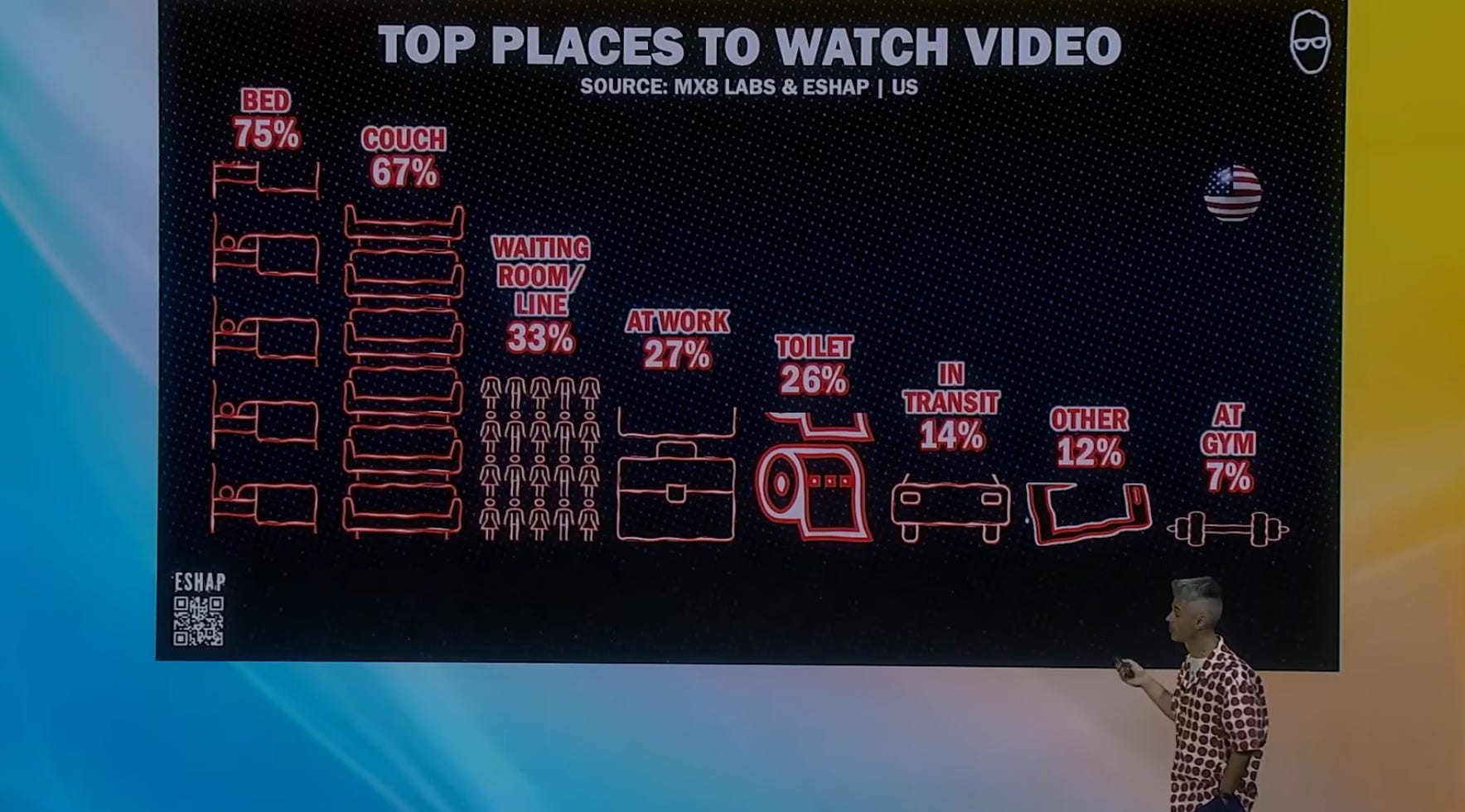
Shapiro’s contention is that the real disruption that has taken place is that video has moved to the mobile phone. And that mobile viewing has enabled users to integrate video consumption into our lives beyond the couch.
If we’re watching more video throughout the day, that almost certainly means that premium video experiences are going to start seeing a diminished share in engagement.
There likely aren’t that many toilet viewers making Netflix their primary viewing option while regretting their dietary choices the night before. And its not the audience Netflix should be courting with its programming. Slightly lower engagement is okay if it is a more premium of audience engagement.
This is where I think we need to start contextualising what Netflix is, what it isn’t, and where the value for subscribers rests in all of that. And by ‘we,’ this is a conversation Netflix would be well-served to consider itself as it shapes the conversation that surrounds it for Wall Street.
Is the experience of watching Netflix the same as watching Instagram Reels or YouTube Shorts? Not at all. And do we value Netflix content more than content on either of those platforms?
I don’t. But I’d be curious to see more viewer research on that question.
Because that’s ultimately the issue when it comes to audience share and maybe what Netflix is missing in establishing a narrative over its value proposition. Not all video consumption experiences are weighted equally. It’s why I suspect Netflix is damaging its brand equity by chasing a boost in engagement hours with long-form social video like ‘podcasts’.
Netflix isn’t the same as the other platforms. Subscribers value it more. So, why confuse its value in the minds of subscribers?
Shapiro spoke about that churn rate for all of SVODs. But Netflix still retains a very low monthly churn rate in the US.
The industry has significant problems with engagement and churn (I’d sure hate to spend $110 billion on buying a studio in this climate…), but Netflix mostly have a perceived issue with churn. What I would be more interested in seeing is subscriber satisfaction research rather than just engagement hours. Because at the end of the day for a subscription service, it is that satisfaction that keeps viewers spending their money.
Where Netflix have an issue is the pivot to ads. It needs subscriber engagement growing in order to grow that ad revenue. This is where it makes all the sense in the world that Netflix laid off chief content officer Bela Bajaria, replacing her with Fox and Disney veteran Peter Rice. It’ll take some time shifting content already in the pipeline, but Netflix could use a few more shows capturing the hearts and minds of its subscribers rather than serving up empty calorie ‘gourmet’ cheeseburgers.
If the wave of disruption is about viewers wanting the TV experience to be more personalised, the answer is in finding fandoms and making the content feel personal to the viewer. The industry has been talking the talk about fandoms driving viewership for years. It just rarely walks the walk. And Netflix is just as guilty of that as the rest of them.
-
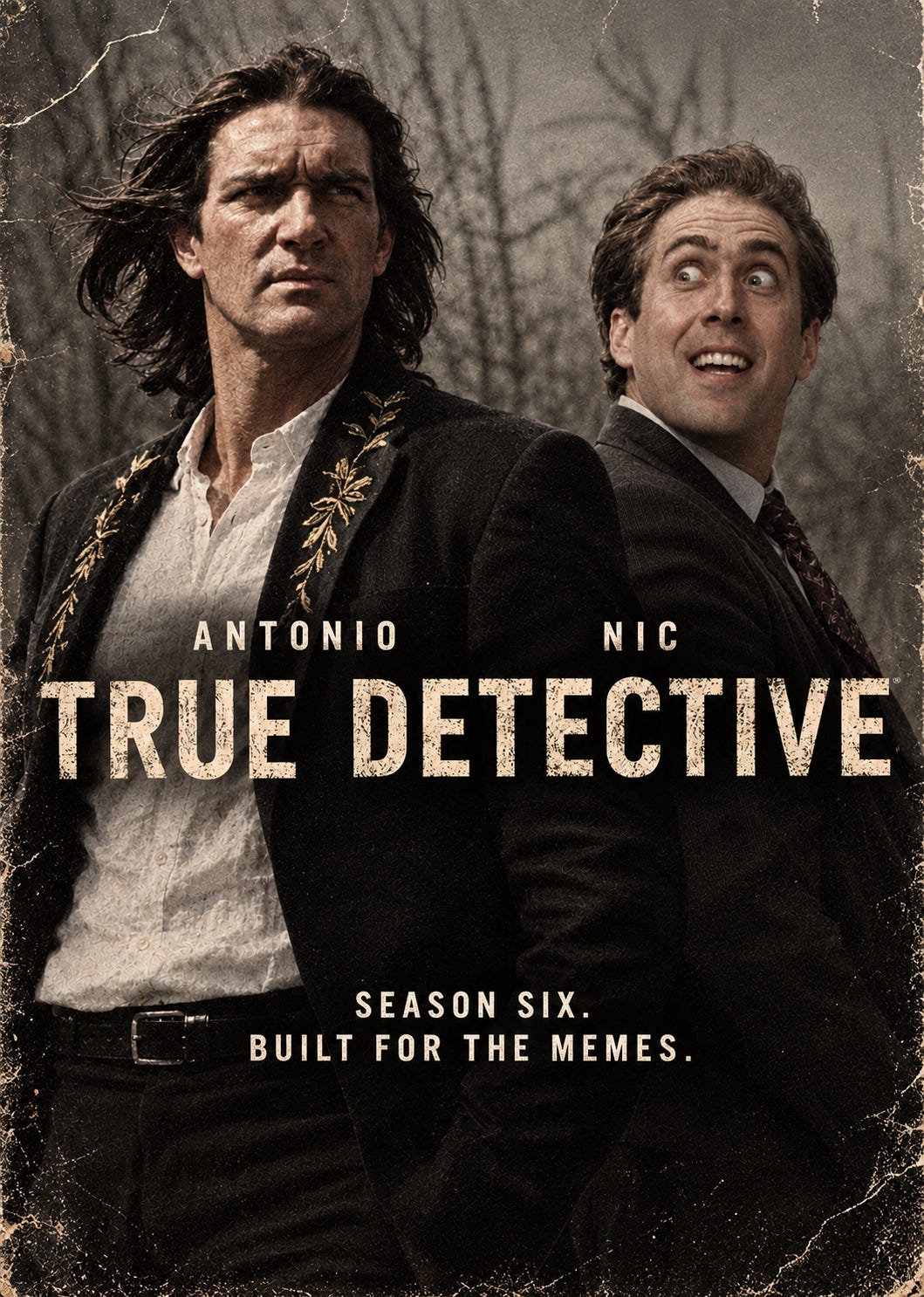
Nicolas Cage and Antonio Banderas will lead season 5 of HBO’s True Detective as Henry Logan and Rai Garcia, with season 4 showrunner Issa López returning ahead of a 2027 production start. Read: The Hollywood Reporter
-
A New Mexico judge threw out the child sexual abuse indictment against The West Wing and thirtysomething actor Timothy Busfield, ruling that prosecutors effectively blocked grand jurors from hearing defense witnesses who were waiting in the hallway. Prosecutors say they’re still weighing whether to seek a new indictment. Read: Variety | The Hollywood Reporter
-
Jon Watts and his Skeleton Crew co-showrunner Christopher Ford reportedly spent much of 2026 developing an eight-episode, Western-flavored Star Wars series for Disney+ before Watts was tapped to direct the first film in Lucasfilm’s next trilogy, and the show has since gone quiet. Read: Dark Horizons
-
Former Star Trek: Picard showrunner Terry Matalas says Patrick Stewart was keen to appear in his never-made follow-up Star Trek: Legacy, pitching himself as the figure who’d hand the crew their missions. Read: Dark Horizons
-
James McAvoy, who took over Professor X from Stewart in the X-Men prequels, says he pitched a young Picard limited series titled Mutiny on the Stargazer that came close to happening before logistical issues got in the way. Read: Deadline
-
Netflix reported box office for the first time as Spain’s Oscar submission La Bola Negra opened to US$277,500 on four screens in Los Angeles and New York, a US$69,375 per-screen average the streamer says is the best ever for a Spanish film. It debuts on Netflix streaming December 2. Read: Screen Daily
-
Tubi is building an R.L. Stine shared universe around the fictional town of Redhaven, following Pumpkinhead and its October 9 sequel Pumpkinhead 2 with Afraid of Clowns and an adaptation of The Babysitter. Read: The Hollywood Reporter
-
Tom Arnold has denied Chuck Lorre‘s claim in his memoir Sitcom that Roseanne writers were ordered to put Arnold’s name on scripts he didn’t write. Read: Deadline
-
Apple’s new HomeView smart display can reduce online recipes to hands-free, step-by-step instructions, but food writer and Verge editor Dominic Preston argues it also strips away the context, ads, and affiliate links recipe creators rely on. Gosh, it would be a shame to lose the 4000 words of preamble and all those affiliate links when all you’re trying to do is make a risotto. Read: The Verge
Chaar Yaar debuts on Prime Video on Oct 23. Four middle-class friends whose bond is their armor end up trapped between gangsters and cops after one fateful decision changes the course of their lives.
Dead-End Job debuts on Netflix on Oct 30. In this Korean thriller, a young man drowning in debt takes lucrative part-time jobs from a mysterious agency, only to find his hustle turning nightmarish.
Tyler Perry’s The Gospel of Christmas debuts on Netflix on Nov 11. A struggling pastor moves his family to a troubled New York neighborhood, where they must save a neglected church from foreclosure before Christmas.
Toxic Crusaders is coming to PC, PlayStation, Xbox, and Nintendo Switch later this year. A four-player retro beat ‘em up based on the 1991 cartoon, in which Toxie and his mutant squad defend Tromaville from Dr. Killemoff and the polluting Smogulan Empire.
That’s the newsletter for the today.
Consider becoming a paid supporter of Always Be Watching.
Connect with Dan on Bluesky. Connect with Dan on Letterboxd. Connect with Dan on Linkedin. Challenge him on the NYT word game Crossplay. Email Dan @ alwaysbewatching.com or just reply to this email.