Original Coverage & Source Attribution: breakingdefense.com
MILAN — As NATO races to update its battlefield tactics, a senior official said the use of Ukrainian forces as a “red team” in exercises is meant to “trigger an adaptation cycle” within the alliance.
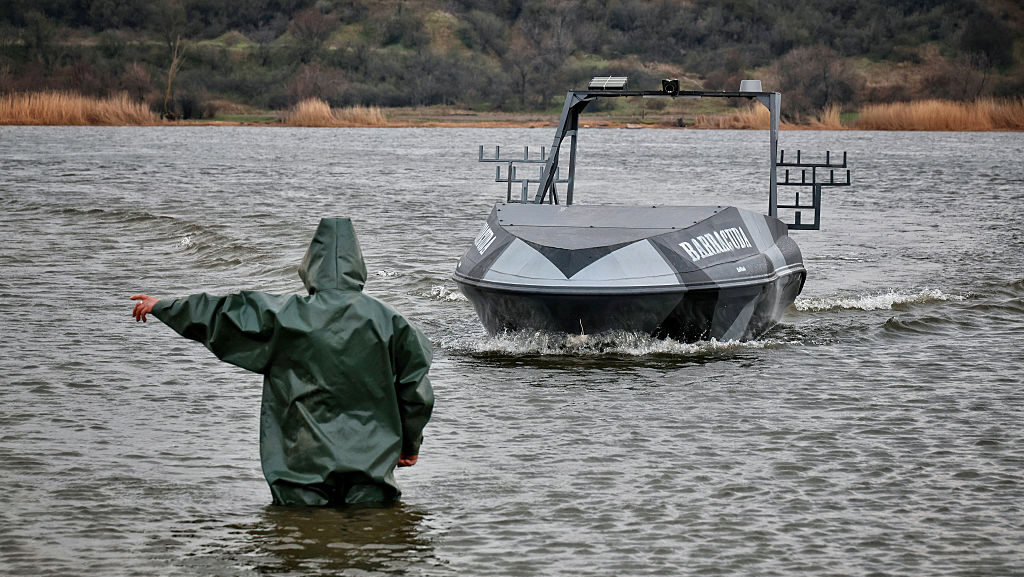
“My job is to build the capabilities of victory. What we’ve done so far, we took some experience from Ukraine, for example, where we hid some Ukrainian forces and Ukrainian-made USVs and made them the red team against the blue force of NATO,” Adm. Pierre Vandier, Supreme Allied Commander of NATO’s Allied Command Transformation (ACT), told Breaking Defense on Monday.
Vandier didn’t point to any specific exercises, but Ukraine’s Ministry of Defense has said that in 2025’s REPMUS exercises off Portugal, Kyiv’s “red team” forces defeated NATO members at sea in five out of five combat scenarios, reportedly in part using unmanned surface vessels.
The threat from unmanned surface vessels has not escaped Vandier. In the current security landscape, he said, if a military were to conduct amphibious operations, it would be equally threatened by naval and aerial drones. “So you cannot envisage any kind of operations without counter-drone [defenses]” and must be able to counter incoming swarms of them.
NATO is also preparing for the modern fight through an initiative called Fight Club within its Joint Warfare Centre. Fight Club is part of a larger five-year campaign and is envisioned as a strategic debate forum that brings together external experts and NATO personnel.
Within Fight Club, Vandier said NATO makes “military vignettes,” essentially focused hypothetical scenarios used to test operational concepts and doctrine to “see where the limit is” in a military concept. “To see,” for instance, “how many drones as part of a swarm will submerge a navy, where is the known limit to trigger adaptation,” he said.
Assessing The Russian Naval Posture
Last month, another NATO official, speaking on the condition of anonymity, told Breaking Defense that the alliance has tracked a significant decline in Russian naval presence in the Mediterranean. Until early September, Moscow observed a two-month naval hiatus in the strategic body of water.
However, as Ukraine heads into its fifth winter at war, Vandier said the Russians have been able to sustain momentum in undersea warfare capabilities.
“If you consider the anti-submarine domain, I think the Russians have kept pace in building some good capabilities, like the Yasen-class [advanced nuclear-powered attack submarines], which are good submarines,” Vandier said.
He added that the anti-submarine warfare domain is one of the “main domains of concern” for the alliance.