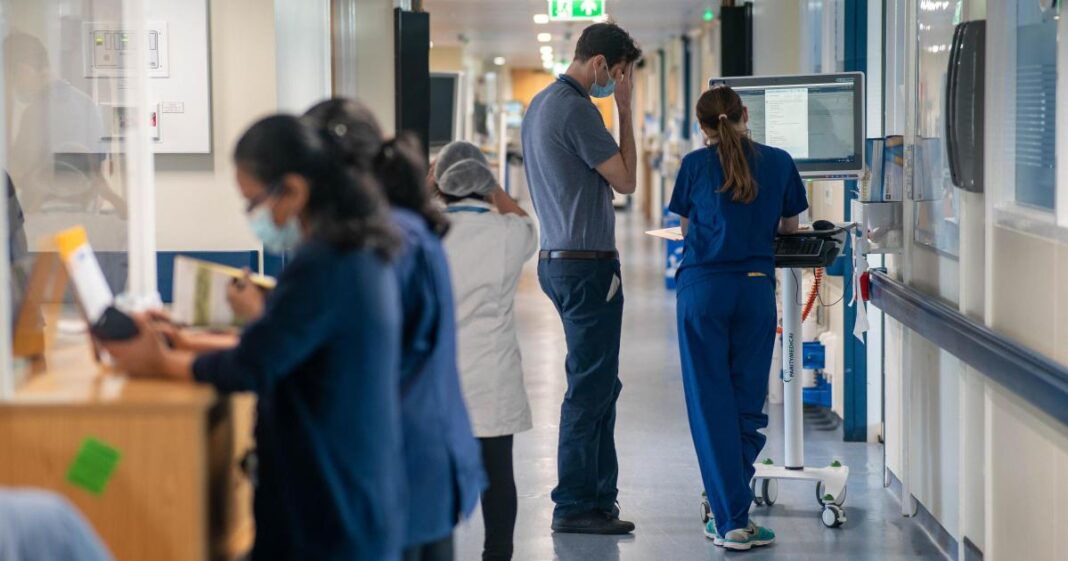
Original Coverage & Source Attribution: www.heraldscotland.com
From personal and others’ experience: pre-op – no pre-meds administered. Drugs that were formerly given to sedate the patient before being taken into theatre no longer available; no thought given to the psychological effect on the patient of entering the theatre environment. On enquiry, the anaesthetist explained: “We’d have to keep you in longer.”
Recovery: A persistent leak in the lung, a not-uncommon occurrence in lung surgery, precipitated a suggestion that I could go home wearing an ambulatory drain or be transferred to another hospital. Question 1) Why? Question 2) To what? Answer 1) “To make way for other patients.” Answer 2) “To an open ward.”
Response 1) They were told in no uncertain terms that I was not leaving with an item belonging to the NHS still attached to my innards. Response 2) Danger of infection in an open ward precluded that option. Ward staff were furious at this intervention: “You’re going nowhere.”
Discharge: to expedite discharge, highly addictive opioids are being prescribed to patients from which later they must be “weaned” if they are to be spared the ravages of withdrawal symptoms, ie agitation, loss of sleep, appetite, sudden and significant weight loss. On my return home, no follow-up appointment for a month and opioids continued to be prescribed by telephone by a doctor who had never clapped eyes on the patient. Perhaps by statutorily limiting the prescription of such to hospital environments a decrease in the level of drugs deaths in communities thus affected might be a desired outcome. Just a thought.
One wonders what the number-crunchers in Holyrood will dream up next but this fixation with statistics and its ill-considered consequences for patients needs to be addressed. The reaction, “described by one insider as ‘outrageous'”, is entirely fitting; corridor care is the least of their worries.
Maureen McGarry-O’Hanlon, Jamestown.
Read more letters
Lack of support not a surprise
Regarding Andrew Learmonth’s report today (“Scotland NHS merger has no business case, papers reveal”, The Herald, November 3): from experience in a major international telecommunications company, if a business case is written and senior management aren’t happy with what it reveals, they demand a rewrite until it confirms (on paper), the outcome they desire.
With that in mind, when I started my own wee, one-man business back in the day, I avoided doing a business case. I just committed a set amount of funds; got on with it; and made it work. Having said that, I was the only person accountable and was prepared to take the necessary risk onto myself.
However, I wouldn’t care to go into any venture that required multiple managers to buy in to something they might not like; which I guess might apply not only to the proposed NHS merger, but also to the proposed top-down local government restructuring which might not be to Cosla’s (and others’) liking, as indicated in Councillor Steven Heddle’s article (“Why Scotland’s council chiefs oppose Swinney’s reforms”, The Herald, November 3).
If the expected benefits, and how they are to be achieved, are not made clear at the outset, who’d want to support any such scheme?
Ian Waugh, Dumfries.
Time to cull ferry bodies
John NE Rankin (Letters, November 3) highlights the unfair focus on Calmac for our ferry problems. Granted their planning and communication skills leave a lot to be desired but they are not the source of the problem. The Scottish Government, Transport Scotland and CMAL provide the resources that Calmac operate. Clearly they are woefully inadequate.
Let’s use a football example. Calmac start the game a man down and 60% of the remaining squad are well past their sell-by date. Calmac’s October operational report highlighted that 30% of the squad was not available for selection in April and May due to technical difficulties (old age). Alan Simpson’s article (“No surprise that SNP ministers don’t want a probe into Calmac”, The Herald, November 2) suggested a lack of investment was the source of the problem. Unfortunately it’s much worse than that.
Management did make over £500 million worth of investment, but in the wrong players. The overspend on Glen Sannox and Rosa could have paid for 10 new Islay Class foreign players, who would have dramatically improved Calmac’s performance. As every football fan knows, years of failure need a root and branch reform of the management structure. For starters, I suggest the removal of Transport Scotland and the amalgamation of CMAL and Calmac into one strategic and operational unit.
A new season lies ahead, with the promise of several new foreign players over the winter and into the spring of 2027. The test will be whether the new management structure can create a team that delivers for its captive and visiting supporters.
Tom Tracey, Brodick.
• I was interested in Kathleen Nutt’s report in Saturday’s Herald (November 1), headlined “Top trio visit as Glasgow shipyard plays its part in war effort”.
Your picture showed UK Chancellor John Healey and Defence Secretary Wes Streeting on board HMS Glasgow at Scotstoun. Much media coverage has been given, quite rightly, to the delays and over-budget Clyde-built Calmac ferries, but no questions have been asked about the timescale involved in the Type 26 Frigate programme. The design stage began back in 2010 and more than 16 years later the first-of-class HMS Glasgow is still not in service, surely not good value for us as taxpayers and the usual overspend for the MoD.
John Macleod, Milngavie.
Our picture of John Healey (left) and Wes Streeting (right) meeting apprentices on board HMS Glasgow during a visit to BAE Systems Govan in Glasgow last week (Image: PA)
Towards a new union
I find myself much in agreement with Eric Begbie’s aspirations for a union of the four UK nations (in reaction to the tedious “independence versus unionism” debate) where each nation would have equal status, with a single governing body attending to common policy on defence and the economy (Letters, October 30). I wish to add some further thoughts and suggestions.
The Scottish independence and Brexit results together surely suggest a consensus in Scotland for, on the one hand, an autonomous nation but working alongside other nearby nations and involving some kind of union or federation.
It is not the Union as such that is the problem but rather the perceived dominance of England within that union. The UK and English governments, located in London, are indeed often portrayed in the media as a single entity.
Developing Mr Begbie’s proposal, I suggest two fundamental changes to the way the UK is organised, governmentally and locationally.
1) All four nations should have the same political arrangement, ie England should have its own independent parliament devolved from a central government.
2) The location of central government needs to be moved out of London to a location, as best as practicable, more accessible and relevant to all four nations. Such a move would clearly require careful consideration – taking into account factors such as equal proximity and large city rivalries. A new capital in one of the other nations would be contentious to agree and the Isle of Man, another blue sky thinking option, impractical. The north of England might be the best compromise, ie in a smaller city/town, perhaps with historic/heritage importance, avoiding rivalry between large cities and best connected to Wales, Scotland and Ireland. Chester comes to mind as an example. There are a number of precedents abroad for locating governmental centres to address concerns over political dominance, for example in the context of the EU, selecting Brussels in Belgium, a smaller and traditionally less powerful nation to restrict any dominance from the historically stronger nations.
The cost of implementing these changes would not be expected to exceed that for any of the other devolutionary projects. As central government moves out of London, the new devolved English parliament would move into its former building. Temporary accommodation could be found for the central hub (relocated away from London) pending completion of a new building, as was the case for the devolved Scottish parliament.
The present UK Government appears to be promoting increased devolution within the UK. I suggest this cannot be done without the sort of changes set out here, and by Mr Begbie.
Stephen Downs, Falkirk.